

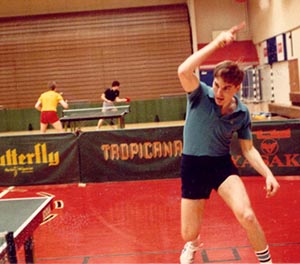
 Photo by Donna Sakai
Table Tennis Tactics for Thinkers Update
The page layouts are done! Well, mostly. I still don't have the front and back covers, and I need to do a lot of proofing of the layouts. The book is 240 pages, with 76 photos/illustrations, and 99,425 words. Due to the upcoming Nationals (I leave for Las Vegas on Monday), I probably won't get much more done this week - lots of coaching activities over the next six days. If all goes well, the book will be out by the end of January.
I did the final three segments in the book yesterday, giving more examples of tactics used in actual matches. They include:
- A player fell behind 0-2 in games because the opponent looped his deep serves, and either dropped short or quick-pushed at an angle his short backspin serves to the forehand or backhand. The solution? Short no-spin serves to the middle, which take away most of the angles and are difficult to push short.
- A match won by simplifying a strong but erratic backhand loop by deciding to go relentlessly crosscourt, even though shots to the middle and forehand gave the opponent trouble, as well as a late-match change to short receive, which hadn't worked earlier, but did now for reasons explained in the text;
- Turning a crosscourt 2500 monster into a down-the line 2200 mouse (and focusing on looping any slightly long serve, mostly down the line) leads to upsetting the top seed and making the U.S. National Cadet Team.
- A player spends a week working on a specific doubles serve, which leads to winning a doubles title.
- When paired with a two-winged ripper, a player learns to play control to set up his partner and win a major doubles title.
Note that none of these are complicated tactics. Tactics isn’t about finding complex strategies to defeat an opponent; tactics is about sifting through all the zillions of possible tactics and finding a few simple ones that work