

Welcome to TableTennisCoaching.com, your Worldwide Center for Table Tennis Coaching!

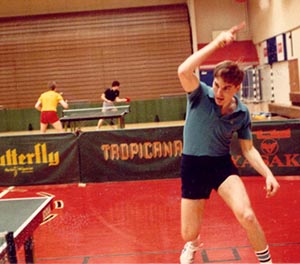
 Photo by Donna Sakai

This is an evolving website and Table Tennis Community. Your suggestions are welcome.

Want a daily injection of Table Tennis? Come read the Larry Hodges Blog! (Entries go up by 1PM, Mon-Fri; see link on left.) Feel free to comment!

Want to talk Table Tennis? Come join us on the forum. While the focus here is on coaching, the forum is open to any table tennis talk.

Want to Learn? Read the Tip of the Week, study videos, read articles, or find just about any other table tennis coaching site from the menu links. If you know of one, please let us know so we can add it.

Want to Learn more directly? There are two options. See the Video Coaching link for info on having your game analyzed via video. See the Clinics link for info on arranging a clinic in your area, or finding ones that are already scheduled.

If you have any questions, feel free to email, post a note on the forum, or comment on my blog entries.

-Larry Hodges, Director, TableTennisCoaching.com

Member, USA Table Tennis Hall of Fame & USATT Certified National Coach
Professional Coach at the Maryland Table Tennis Center

Recent TableTennisCoaching.com blog posts

Fairness Versus Progressive Issues Revisited

In my blog yesterday I wrote about "USATT: Fairness Versus Progressive Issues." I had an email discussion with someone who believed that it would be interpreted by the average reader as criticism of the current Chair of the USATT Board of Directors, Mike Babuin. To anyone who read it that way - Poppycock!!! Mike was only voted in as Chair at the December board meeting, and his first meeting as chair will take place in April.

It could be read as criticism of past leaders. Some of them left USATT better than when they arrived, and some left it worse. There are many "Fairness" issues that they might have resolved, for the betterment of the sport. What no past leaders has done is find a way to either dramatically grow the sport or consistently develop players that can compete with the best players in the world. The point of my blog was that nearly every past USATT leader got bogged down in the "Fairness" issues, and so weren't able to focus on "Progressive" issues. It is a nasty cycle I hope will come to an end.

What are the progressive issues USATT could focus on? I've argued strongly for two specific ones: a nationwide system of leagues, and more junior training centers.

USATT: Fairness Versus Progressive Issues

For many years I've advised and argued that USATT leaders need to divide issues into two types, which I call "Fairness Issues" and "Progressive Issues." Both are important.

Fairness issues are those that involve the ongoing governance of the sport. They include setting up procedures for selecting teams; most membership issues; the running of the U.S. Open and Nationals and other similar events (including site selection, dates, choosing personnel, etc.); disciplinary actions; the magazine and website (which can be used to promote progressive issues, but are not progressive issues themselves); and many more. These issues take up the great majority of the time for USATT leaders. Look over the agenda or minutes for any USATT board meeting, and it's dominated by such issues.

Progressive issues are those that grow the sport. There are many different opinions on how this should be done, such as junior development programs (both elite and grass roots), leagues, schools, TV, growing the U.S. Open and Nationals, professional circuits, etc. It also includes raising money for the sport, if the money is used in progressive ways.

The problem is that Fairness issues take up an inordinate amount of time. They are often timely, and so leaders feel they get priority over Progressive issues. They often take a lot of time. And so they dominate the agenda, while progressive issues are regularly left out.

Tip of the Week

Dummy Loops.

$16,700 Cary Cup Championships

It's been a long journey. I left for the Cary Cup Championships in North Carolina, five hours drive away last Thursday morning, going down with Tim Boggan, who drove down from New York. (After the tournament he and his wife, who met him there on Sunday, go on vacation in various locations down there.) Tim had some early problems in that his credit card stopped working, most likely because he was suddenly using it in Maryland, Virginia, and North Carolina, when he usually uses it in New York. But he's traveled extensively, using the credit card all over, and he said this had never happened. I had to put his hotel room for the first night on my credit card.

Here's the Cary Cup Championships web page, which includes complete results.

One major thing that jumped out at me this tournament was that the Maryland players who had played in recent tournaments tended to do well, while those who hadn't played tournaments in a while didn't do so well. This is actually an ongoing thing, as all the training in the world doesn't make up for a lack of "tournament toughness." When you play lots of tournaments, you get used to tournament pressures, to adjusting to different serves and playing styles, and to figuring out what serves and rallying shots you should use against various players. Players who hadn't played tournaments since, say, the Nationals in December didn't seem to have this tournament toughness, and it showed, especially in return of serve.

No More Blogs Until Monday - Cary Cup

I'll be leaving with Tim Boggan to drive down to the Cary Cup Championships around 4AM or so on Thursday morning, so no more blogs until next Monday. I'm helping with a clinic they are running on Thursday afternoon, then I play the hardbat event Friday morning, then I coach the rest of the way.

Fake Motions on Serves

One of the most under-utilized techniques is fake motions on serves. Most players have their racket move in a straight line from Point A to Point B, and since it doesn't take Ph.D. level geometry to read the spin if the racket goes in a straight line, the serve loses much of its effectiveness. It's like putting a big sign on your head before each serve that tells your opponent what the spin is going to be.

Instead, try two things. First, move your racket through a semi-circular motion so that the spin varies, depending on where the contact point is. At the highest levels players do this motion so fast and in such a short motion that few can even see the changing direction. There's a reason why, for example, a forehand pendulum serve is called a "pendulum" serve - the racket goes through a curving pendulum motion, and you get different spins depending on where on the curving path you contact the ball. Contact it early on the downswing, it's backspin; a split second later, it's side-backspin; a split second later, sidespin; a split second later, side-topspin; a split second later, it's topspin.

Tennis and Table Tennis

I used to play tennis regularly, going to the Quince Orchard Swim and Tennis Club for group training sessions. But it took up a lot of time and money, and I finally stopped about three years ago. Last night I had an urge to play, and so signed up for the 7-8 group session. It's a full-time center, with five tennis courts and a huge swimming pool. Each is contained in a huge "bubble," which comes down during the summer. (I hate when the bubble comes down, and we're stuck playing outside, in the sun, heat, and wind. If tennis were meant to be played outside, there'd have been tennis courts in the Garden of Eden, right?)

While I was paying for the session in the front lobby area, a kid walked up to me and said, "Hi Coach Larry!" I didn't recognize him at first, but I finally figured out he was Kevin, one of the kids in my Sunday junior session. Outside of a table tennis environment I hadn't recognized him at first. Then a man came up to me and asked if I also taught tennis. Again, I didn't recognize him outside the table tennis club, but he was the father of another player in one of my group sessions; his son or daughter was presumably out playing tennis or swimming. We chatted for a few minutes, where I explained I was just a player at the tennis center. When I went out on the tennis courts at 7PM, guess who was sitting next to the next court, watching his son take a tennis lesson? Stephen Yen, a local 2300 player! That's three separate table tennis people I ran into there in the course of a few minutes.

Tip of the Week

Practicing for the Big Matches.

Daylight Savings Time

Daylight Savings Time took a bite out of a Sunday morning practice session. I coach a six-year-old on Sundays from 10-11AM. Because of DST, that was like 9-10AM. Still not too early, right? After all, kids get up much earlier than that for school, right? Well, not in this case. I think the kid was used to staying up a little later on Saturday night, and his sleep clock was way off. When he came out to play, he was half asleep - literally. A few minutes into the session he put his head on the table and either went to sleep, or at least closed his eyes for a minute. I got him up, but a few minutes later he did it again. I had him splash water on his face to wake up - it did the trick for a few minutes. Then he sort of stood up, closed his eyes, and seemed to fall asleep standing up. Anyway, the first thirty minutes of the session were more or less alternate practice and sleep, practice and sleep. Then he woke up.

He actually had a pretty good second half. For his age, he's developed a pretty good backhand, can even smash pretty hard. (I have to get him to slow down.) On the forehand he tends to face the table without rotating his shoulders, and this also leads to an awkward grip. So we spent much of the second half shadow practicing this properly, and though he at one point put his head on the table again for a short nap, he got the forehand right. Near the end he was smacking forehands pretty well, including 22 in a row at one point - and he's hitting them pretty hard. Not bad for a six-year-old who is very small for his age - he looks about four. We also did some serve practice.

Junior Incentives and Team Leagues

One of the things junior table tennis in the U.S. tends to lack - including at my club - are junior incentives for each level. The kids come out and train and train, but for what? To win a rating event at a tournament? To win an age event at a tournament? (Not enough of them.) To win practice matches? To do well in a singles league? Rating points? These are all nice things, but they aren't quite enough. One way to address this is a junior team league. Another is to give training incentives, especially at the lower levels. At all levels there needs to be a balance between improvement (with specific goals) and fun. I'm now looking into both, with plans to set up various incentives and goals at the beginning level, and a junior team league starting this fall.

How would the junior team league be set up? Kids like doubles, so I want to include that. So most likely it'll be some version of two-person teams. However, rather than have just two or three players on a team (where the third can only play doubles), I'm leaning more toward six-person teams, where the top two play a best of five against the other team's top two (i.e. four singles and a doubles); the third and fourth players do the same against the opposing team's third and fourth; and the same for the fifth and sixth. This means each team will be made up of a balance of advanced, intermediate, and beginning players, but players would mostly compete against players in their own range.

Here are some thoughts on what are needed at the various levels. Please comment or email me if you have any suggestions.

Biggest Things Happening in Table Tennis

Here are the biggest things happening in U.S. table tennis right now. (I'm toying with putting in sandpaper table tennis, with all the new money events they are offering. I may feature them in an upcoming blog.)

How Many Serves Are There?

There are a lot of possible serves in table tennis. How many? Let's look at the ways to classify serves.

Table Tennis Online

As ITTF Coach John Olsen recently pointed out to me, we live in the golden age of online table tennis. You can watch just about any major table tennis match online these days, both live and afterwards. Over the last few days (and below) I've given links for many of the major matches taking place at the Chinese World Team Trials. During major USA Table Tennis events (Nationals, Open, Team Trials), you can watch the matches live as well. And you can go to youtube and find just about anything - just put in "Table Tennis" and anything else you are looking for. Over the weekend John watched the live streaming of the Swedish Nationals, the English Championships, and the Norwegian Championships. (Note that some of the links here that gave the live streaming still have the videos online.)