

Welcome to TableTennisCoaching.com, your Worldwide Center for Table Tennis Coaching!

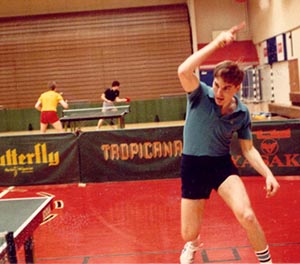
 Photo by Donna Sakai

This is an evolving website and Table Tennis Community. Your suggestions are welcome.

Want a daily injection of Table Tennis? Come read the Larry Hodges Blog! (Entries go up by 1PM, Mon-Fri; see link on left.) Feel free to comment!

Want to talk Table Tennis? Come join us on the forum. While the focus here is on coaching, the forum is open to any table tennis talk.

Want to Learn? Read the Tip of the Week, study videos, read articles, or find just about any other table tennis coaching site from the menu links. If you know of one, please let us know so we can add it.

Want to Learn more directly? There are two options. See the Video Coaching link for info on having your game analyzed via video. See the Clinics link for info on arranging a clinic in your area, or finding ones that are already scheduled.

If you have any questions, feel free to email, post a note on the forum, or comment on my blog entries.

-Larry Hodges, Director, TableTennisCoaching.com

Member, USA Table Tennis Hall of Fame & USATT Certified National Coach
Professional Coach at the Maryland Table Tennis Center

Recent TableTennisCoaching.com blog posts

Coaching in the Wilderness and Run-ins with Animals

I do some coaching each week on the road, including a trip out into Virginia. They pay me double to do this, otherwise I wouldn't want to leave the safe confines of the Maryland Table Tennis Center, which is eight minutes from my house. The kid I'm coaching in Virginia is five years old, and like most kids his age has an attention span of roughly from now to now. So I find all sorts of interesting ways of keeping him interested during our one-hour sessions - mostly with targets on the table (giant rubber frogs, stacks of cups, etc.) or by setting up imaginary scenarios where he has to do something or the world will explode. This kid lives in a mansion in the middle of woods - a great place to grow up.

Yesterday after I drove down their front driveway (about two hundred yards) and pulled into the street out front, I found myself surrounded by six deer. I'd driven right into their midst and then stopped my car, and rather than run, they all just stared at me as if they were used to this. I stayed absolutely still, and after a minute they ignored me. Four more joined them, and now ten deer surrounded me. As if that weren't enough, I very large hawk sat perched on a telephone cable just over the street, looking down on us like the specter of death.

After about five minutes the deer all took off suddenly as another car came by. (Apparently my car wasn't as scary.) As I drove out, four more deer came out onto the road, blocking my path. They froze for a moment, and then they too took off. A minute later, as I drove home, I passed a large horse farm with dozens of grazing horses.

Tip of the Week:

Training Cycles.

My Weekend

I'll tell you about my weekend, and then you tell me about yours. Mine was about evenly split between table tennis and my outside interest, science fiction & fantasy writing, along with some Baltimore Orioles baseball.

FRIDAY: Friday is ancient history now, and I only vaguely remember what I did after doing the blog in the morning. I was a practice partner for our junior program that night (5-7), and unfortunately set our junior program back ten years by going 5-0, with wins over a pair of 2200 players (both 3-0, though one wasn't a junior) and a 2300 player (3-1). As I told the 2300 player, "I'm going to get a swelled head." (I'm too old and stiff to compete at that level anymore!)

SATURDAY: I coached a beginning junior class from 10:30AM to Noon, coached two others players from 2-4 PM, and then went home. (I twinged my chest and shoulder near the end of this session, which is worrisome.) Normally we have a 4:30-6:30 training session, but with Coach Jack in China until the end of October (vacation) and with most of the club taken over by the local Coconut Cup tournament (a local mostly-Chinese event, over 100 players), we cancelled it. I spent the rest of the night reading "Behold the Man" by Michael Moorcock. Isn't that how normal people spend Saturday nights?

Columbus Day and Pongcast

Today is Columbus Day, a Federal Holiday. Who am I to go against Federal Law and work today? I'll be back tomorrow with both the blog and the Tip of the Week. For now, let's contemplate the surprise of the American Indians in 1492 who discovered their lands had been "discovered" by Columbus, who no doubt looked forward to rising economic prosperity due to trade in the worldwide economy with their new European partners, all of whom had properly stamped green cards and visas.

If only the Indians had foreseen the rise of ping-pong 400 years later, and counterlooping with tensored inverted sponge in 500, they could have set up training camps in their cornfields and among the buffalo, and gotten such a head start on the Chinese that they'd dominate the sport with their tomahawk serves and obsidian blades.

But for you diehards who absolutely need their daily TT fix, here's Pongcast TV Episode 16 (21:40), which covers the recent Men's World Cup.

You're still here?

***

Send us your own coaching news!

Value of the Backhand Loop

If I could go back 36 years and tell myself one thing as I was developing my game, I'd tell myself to develop my backhand loop.

Sponges weren't nearly as good back then as modern ones, and so it was much harder to backhand loop with great power without backing well off the table to give yourself time for a bigger swing. The thinking for many was that if you develop your footwork and forehand, you don't need as much of a backhand attack - i.e., "one gun is as good as two." And backhand loop? It was a nice shot, but not really necessary.

And so I didn't really develop a backhand loop until I'd played many years. The result is it's not natural or particularly strong, can be erratic, and is not a particularly instinctive part of my game.

With modern sponges you can loop just about anything, even balls that land short over the table (especially with the backhand, where you can wrist-loop it), and so players pick up the backhand loop early as a dangerous weapon. A good backhand loop gets you out of those pushing rallies (including pushing back deep serves to the backhand) that put you at the mercy of the opponent's loop. Meanwhile, I still struggle to get myself to backhand loop against deep serves (I can't step around and loop forehand every time), and against quick, angled pushes to my backhand, especially after a short serve to my forehand. You don't have to rip these backhand loops; consistency, depth, and spin are key. (You can often get away with a weak loop if it consistently goes deep.)

Just as difficult is backhand looping in a rally. These days many of our up-and-coming juniors backhand loop (often off the bounce) just about everything - or at least topspin their backhands to the point where, compared to backhands of yesteryear, they are backhand loops. This turns players like me into blockers, and not in a good way. 

Coaching Footwork

Someone posted on the about.com table tennis forum on how difficult it must be to coach footwork in the U.S., since most coaching here is done one-on-one rather than in groups. Because of this, he thought that coaches can't really see what the student is doing, and so can only coach strokes, not footwork.

It's a good point, but it's not really a problem for good coaches. You teach footwork one-on-one by having the student do it without the ball, where you often do it together, with the student matching the way the coach does it and making corrections as necessary. If you have a student shadow practice footwork this way regularly, they learn it. Then, when you get to the table, you can tell by their body posture and positioning if they are doing it correctly.

The most important aspects to stress are foot and body positioning; balance (which involves moving with your feet, not with your hands, i.e. reaching); and the idea that you don't decide whether you have to move, you assume you will always have to move. 

Yesterday Was a Bad Day (mostly non-table tennis)

Let's see, Obama didn't perform well in the debate, the Orioles lost, the Yankees won, two of my three TT students cancelled, I had a headache half the day, a new online video of our club got our web address wrong (see below), the sole of my shoe broke, and from my todo list I didn't update the "Celebrities Playing Table Tennis" page or work on the Codex contest SF story I started last night. Can we have a Groundhog Day replay?

MDTTC Video

USA vs. Belgium Clubs

Someone emailed me yesterday saying he was pretty sure Belgium didn't have 500 full-time clubs, as I'd quoted someone posting yesterday. There's no way to judge from here. But the key is that both seem to agree they have 500 clubs in an area about the size of Maryland with about twice the population. Maryland, the state with the highest percentage of USATT members among its population, has only six clubs. That's about an 83-1 ratio by area, or 42-1 by population. I think we're outgunned.

The writer also pointed out that clubs in Europe are organized differently and said there's no point in comparing numbers, but I disagree. People are people, and if we create a good product, they will come. Every time someone has opened a nice table tennis club in the U.S. and run it properly, the people have come. The limiting factor isn't the U.S.; it's the small number of people in the U.S. able and willing to create such clubs. Sure, Belgium and other European countries have more government support, but entrepreneurs in the U.S. have shown over and over that professional table tennis clubs can make it in the U.S.  Look no further than the San Francisco Bay area, where new full-time clubs seem to pop up every week.

Table Tennis Centers in Maryland, the U.S., and Belgium

On Friday at the Maryland Table Tennis Center I was wondering how USATT would be different if all their board members were required to spend a week at one of the "elite" training centers. Their perspective on table tennis in the U.S., and where it could go, might be a bit different from what they are used to.

There are about 50 full-time table tennis centers in the U.S. (Current count: 53; let me know if I'm missing any.) Of these, perhaps 5-8 can be considered "elite," i.e. ones with large junior development programs that consistently develop strong players. Key here is both the elite aspect and the large number of players they have.

Tip of the Week

Short Serves to the Forehand from Backhand Side.

The New Plastic Balls

Here's a review of the new ball by Alex Vanderklugt of the OOAK forum. He reviews it with visual inspection, sound, size, the bounce test, and in actual play. The results are not good.

As some of you may have heard, plastic poly balls (instead of celluloid) are coming to table tennis, replacing the usual celluloid, care of the ITTF, starting July 1, 2013. The reasons seem to be vague, but involve a supposed worldwide ban on celluloid because of their flammability. Can someone point me in the direction of a good article on the current status? I've heard they may postpone the actual switch if they are unable to come up with poly balls that are satisfactory, but can't remember where I've heard this. Anyone know anything?

USATT Coach of the Year

It's that time of year again - time to nominate coaches for the USATT Coach of the Year Awards! There are five awards - National, Developmental, Volunteer, Paralympic, and Doc Counsilman. (I was the USATT Developmental Coach of the Year in 2002, and was runner-up three times, alas.)

Men's World Cup Results and Video

2009 Strategic Meeting

I just realized that Wednesday, Sept. 26 (two days ago) was the three-year anniversary of the 2009 USATT Strategic Meeting. I still consider that one of the greatest disappointments in USATT history. We had a new board of directors looking to really do things but not sure what, and they and table tennis people from all over the country gathered for two days to decide what to do. Unfortunately, the same old arguments that look good but lead to nothing won them over, and we ended up with lots of slogans and a series of vague priorities that predictably never led to anything. I wrote much more about this one year ago, on Sept. 26, 2011. I don't know when we'll ever have such an opportunity again to get USATT to really start developing the sport the way it's done successfully in other countries and other sports. I was going to write more about this, but you know what? It's too depressing. So instead we'll go to anagrams and smile. Yes, smile.

Table Tennis Anagrams

Don't blame me - I'm just the messenger!!! On February 22, 2012, I did anagrams of the U.S. Men's Team (Michael Landers: "Me Learn as Child," "Lame Child Nears," many more; Timothy Wang: "I Own That Gym"), and the next day, February 23, 2012, I did them on the U.S. Women's Team (Ariel Hsing: "Irish Angel," "Shinier Gal," several more). Here are others; Tim and Mike are going to kill me! (Remember, I'm just the messenger!!! If they can find "positive" ones with their name, I'll post them.)

Last-Minute Looping: Learning to Loop

Yesterday I taught an 11-year-old girl to forehand loop. She'd attended ten junior group sessions I'd taught, and this was I think her fourth private session. Her forehand and backhand drives are getting pretty steady, and of course we'll continue to work on them to make them "perfect."  

Sometimes it's good to wait longer to really ingrain the forehand and backhand drives before starting them on looping, but I'm a believer in getting to looping (at least against backspin) as soon as possible. Otherwise, they tend to become pusher/blockers (since they can't attack backspin), their loops aren't as natural (since they ingrain drive strokes early on rather than topspin strokes), and they don't take advantage of a characteristic that gives them the advantage at that age - they are shorter, and so looping is a bit more natural since they can let the ball drop down to their level. Plus, it gives them something to get excited about when they begin doing shots that match what the best players in the club are doing, and that excitement leads to more focus and determination, which leads to faster improvement.

I started her on looping in the last ten minutes of the session, feeding backspin with multiball. At first she had difficulty. Sometimes she wouldn't bring her racket down enough, or she wouldn't sweep up enough and would instead start up, then switch to a more forward-driving stroke. The result was flat strokes with little topspin. The scary part here is that since I'm giving her the same spin over and over, it's pretty easy to drive the ball with light topspin, and to believe that it's a good shot. (And it would have - in the hardbat era.) So I have to explain how a drive against backspin without great topspin isn't that good and will rarely be as consistent or effective in a match situation as looping. She understood, and kept trying.