
Tip of the Week
Are You a 10-8 or an 8-10 Player?
Happenings
Photo by Donna Sakai
This is an evolving website and Table Tennis Community. Your suggestions are welcome.
Want a daily injection of Table Tennis? Come read the Larry Hodges Blog! (Entries go up by 1PM, Mon-Fri; see link on left.) Feel free to comment!
Want to talk Table Tennis? Come join us on the forum. While the focus here is on coaching, the forum is open to any table tennis talk.
Want to Learn? Read the Tip of the Week, study videos, read articles, or find just about any other table tennis coaching site from the menu links. If you know of one, please let us know so we can add it.
Want to Learn more directly? There are two options. See the Video Coaching link for info on having your game analyzed via video. See the Clinics link for info on arranging a clinic in your area, or finding ones that are already scheduled.
If you have any questions, feel free to email, post a note on the forum, or comment on my blog entries.
-Larry Hodges, Director, TableTennisCoaching.com
Member, USA Table Tennis Hall of Fame & USATT Certified National Coach
Professional Coach at the Maryland Table Tennis Center
Forehand Blocking
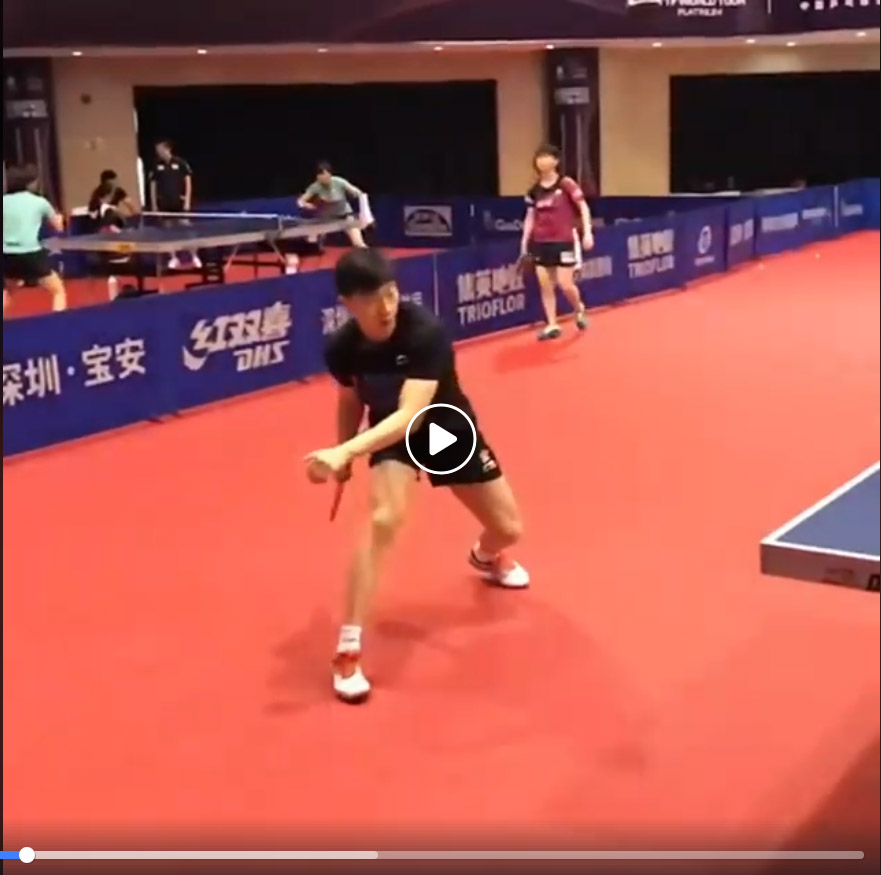
Here's the last point of the match (18 sec) where 14-year-old Japanese whiz Harimoto Tomokazu (world #13) recently upset world #1 Fan Zhendong at the ITTF-Asian Cup. The camera angle shows just how fast these players play. But to me the key thing here is what Tomokazu does at the start of the rally when Fan loops to his forehand - he blocks. Yes, at the highest levels of our sport, where nearly everyone tries to counterloops everything on the forehand (and often on the backhand) - he forehand blocks. And this is a well-placed block. He has an angle into the forehand, so Fan has to be ready to cover that - and so when Tomokazu instead blocks down the line, he forces Fan to play his backhand, followed by an awkward, out-of-position forehand, which sets Tomokazu up to win the point. (Fan would have tried to counterloop.)
One of the most under-used shots in table tennis (at all levels) is the down-the-line forehand block - most players automatically go crosscourt, both because of the angle (which forces the opponent out of position) and because it's easier. And that's probably the best shot at least half the time. But with the opponent reflexively moving to cover that angle, he's almost always vulnerable to a down-the-line block to his backhand. It was one of my bread-and-butter shots when I competed regularly. When I play practice games with students it drives them crazy, not just because it catches them off guard, but because they claim few of their other opponents block forehands down the line. And because players tend to copy other players, few of them have developed this shot. Jeez, talk about a simple way to improve!
Tip of the Week
If You Miss a Practice Session, You Will Know. (This normally goes up on Mondays, but I was away on Mon and Tue, and had so much on Wednesday that I decided to postpone it one more day.)
USA Nationals
It's that time of year again - time to enter the USA Nationals! You can enter online or with a paper entry form. They are in Las Vegas, July 2-7.
There are 91 events this year. They include:
But the Nationals is much more than just playing and competing. You also get to mingle with your friends and peers from around the country, as well as perhaps a contingent from your club - a built-in cheering section when you play. (But make sure to cheer for them when they play as well!)
USATT Hall of Fame Inductions and Lifetime Achievement Award
They have been announced, and so today is sort of a "WOW!" day. Why?
I'm this year's recipient of the USATT Lifetime Achievement Award! (The official title is "Mark Matthews Lifetime Achievement Award," named after 1931 and 1932 U.S. Open Men's Champion, then called Marcus Schussheim.)
This year they are inducting five new members to the USATT Hall of Fame - most years it's two or three, but this year we're inducting a basketball team!!! This year's inductees are Li Ai, Dhiren Narotam, Norm Bass, Henan Li Ai, and Doru Gheorghe. The induction ceremony for all six of us will take place at the USA Nationals in Las Vegas, on Thursday night, July 5.
This could also be called the "Resident Training Program" (RTP) induction ceremony, as four of the honorees were from that program at the Olympic Training Center in Colorado Springs, circa 1985-1992. I was part of it from 1985-1990, at varying times the manager, director, and (mostly at the end) one of the coaches, and as chair of the RTP Committee. Li Ai and Dhiren Narotam were players there. Henan Li Ai was the head coach for about five years.
Why?
But to tide you over until Wednesday, here's Ukulele Pong (14 sec), with Mary Lieu!
Summer Table Tennis Training Camps
Summer is coming, and it's time to plan for your summer training needs!!! Email me if you'd like me to add you to the listing below - I will likely link back to it numerous times. (With apologies to those missed - I put out a note last week asking for those running camps to contact me, plus I listed the ones I already knew about. I visited many of the major full-time clubs to find info on their camps, and listed those I could find.)
Why would you go to a table tennis camp? The simple answer is . . . to get better. But many would say, "I can train at my home club, why go to a camp?" At a camp, besides getting expert coaching, you get intensive training typically for five days, which is enough time to dramatically improve your game. This type of saturation training will lead to far more improvement than just practicing on and off for longer periods of time. Plus, it's a memorable event - you love table tennis, and this is a table tennis vacation! Some of my best table tennis memories are from the late 1970s when I was a regular at the Seemiller Camps. (I've emailed to see whether Dan is running camps this summer.) But I do suggest researching the camps and finding the perfect one for you. Some are primarily for kids; others are for all ages.
Alameda TTC (Alameda, CA) has 8 weeks of camps with a kids-only and kids/adult program: http://alamedattc.org/2018SummerCamps.htm
Michael Maze Short Push
Denmark star Michael Maze retired in 2016 after a series of injuries, but recently has been training for a comeback at age 36. He's a former top ten player, who won the bronze medal in Men's Doubles at the 2004 Olympics, made the semifinals of Men's Singles at the 2005 Worlds, won the Europeans Men's Singles Championships in 2009, and made the quarterfinals of Men's Singles at the 2012 Olympics. At the 2005 Worlds he beat two Chinese players, Wang Hao (Men's Singles Silver Medalist at the 2004 Olympics and world #1 or #2 at the time) and Hao Shuai, often lobbing them down. Against Hao in the quarterfinals he was down 0-3 and saved three match points before winning in one of the great comebacks in history. He's a lefty looper, and probably the best lobber in the world. But he's also known for his soft touch, such as in receive.
Here's a video (1:35, some of it in slow motion) of him practicing his short push against a side-backspin serve. Most players, when pushing, whether short or long, just aim in the opposite direction of the sidespin to compensate. But at the advanced levels they do more than that. Notice how he not only angles his paddle sideways to offset the incoming sidespin, but sidespin-grazes the ball back, meeting the sidespin straight on and putting his own sidespin on the ball? (Watch how the ball curves away after he hits it.)
By finely grazing the ball, most of his energy goes into spin, and so there's little forward energy, making it easy for him to push short. That's probably the most common reason players do not push short well - they try to just tap the ball back softly rather than graze it back.
Off This Morning
I have to take this morning off from blogging. I'd like to say it's for some big table tennis reason, but actually it's because I'm in a pair of upcoming writing workshops, and have to read and do extensive critiques on seven science fiction & fantasy short stories. Don't worry, I'll be back to table tennis tomorrow! (Actually, I also have to do player evaluations for about ten junior players from our Talent program, so as soon as I finish the SF critiques I switch back to TT.) I plan to spend the day working at the eatery at Lake Forest Mall, so if you are local, stop by and say hello. (But I really, Really, REALLY need to get this work done, so no more than a few minutes and then I have to get back to work.) But to entertain you this morning, here's Plate Bouncing Pong (31 sec)!
Tip of the Week
How to Return Nets and Edges.
Susan Backed Pingpong Parlor Coming to D.C. - SPiN Washington!
Here's the article. I think it's great we'll have one nearby! They really are a different type of club, going for the upper-scale recreational player, with more of a party atmosphere. I've been to the SPiN NY club twice, and had fun playing there. They now have (or will soon) clubs in New York, Chicago, San Francisco, Toronto, Philadelphia, Seattle, Austin, and now DC. Here is their main web page. Here's their About Us page, which explains their interesting history. (Addendum added Monday afternoon: As I drove to my shoulder therapy session after lunch they were talking about the new table tennis club on the radio! It was on WTOP - 103.5FM.)
Their location is right in the middle of DC, which according to Google Directions is just over 30 miles driving distance south of my club, MDTTC. So there's no serious conflict between the clubs - and as I've blogged before, having multiple full-time clubs in one region, but not too close, actually helps all of them as each club brings in new players who might also join or attend tournaments and leagues at the other clubs. While MDTTC focuses on serious training, SPiN has great food - here's the rather extensive NY menu. They have pizza!!! They also serve alcoholic beverages. MDTTC has water and gatorade.