
Table Tennis Biographies
Why not spend a weekend curled up with a good table tennis biography or autobiography? Here are a few to choose from. (I have copies of each of these books in my table tennis book collection.) Or, of course, you could always buy one of my books!
Welcome to TableTennisCoaching.com, your Worldwide Center for Table Tennis Coaching!
 Photo by Donna Sakai
This is an evolving website and Table Tennis Community. Your suggestions are welcome.
Want a daily injection of Table Tennis? Come read the Larry Hodges Blog! (Entries go up by 1PM, Mon-Fri; see link on left.) Feel free to comment!
Want to talk Table Tennis? Come join us on the forum. While the focus here is on coaching, the forum is open to any table tennis talk.
Want to Learn? Read the Tip of the Week, study videos, read articles, or find just about any other table tennis coaching site from the menu links. If you know of one, please let us know so we can add it.
Want to Learn more directly? There are two options. See the Video Coaching link for info on having your game analyzed via video. See the Clinics link for info on arranging a clinic in your area, or finding ones that are already scheduled.
If you have any questions, feel free to email, post a note on the forum, or comment on my blog entries.
-Larry Hodges, Director, TableTennisCoaching.com
Member, USA Table Tennis Hall of Fame & USATT Certified National Coach
Professional Coach at the Maryland Table Tennis Center
Recent TableTennisCoaching.com blog posts
Backhand-Forehand Towel Drill
Here’s a great drill I used yesterday while coaching Navin, one which you might want to try. Like many players, his crosscourt backhand doesn’t always go wide enough to the backhand, instead wandering out to the middle backhand, making things easier for the opponent as well as giving them an angle to attack into his forehand. It’s important to be able to hit accurate shots (forehand and backhand) almost always to the three main spots – wide corners and opponent’s playing elbow.
Once you do learn to play consistently wide angles into the backhand, an opponent may look to find ways to get out of this type of rally, often by going down the line to the forehand. This often happens to Navin, who can dominate the backhand diagonal but can be vulnerable to attacks to the forehand if he gives an easy opening.
So here’s the drill. I put my towel over much of the backhand side, leaving an opening about a foot wide from the corner. Then Navin and I played backhand to backhand where he had to avoid hitting the towel. A key to this was not aiming for the area between the corner and the towel, but aiming right for the corner or even slightly outside it. That way, even if you mishit slightly, the ball still stayed near the backhand corner. Then, randomly, I’d suddenly hit my backhand down the line, and Navin had to quick hit the ball to my wide forehand. If he’s keeping the ball to my wide backhand, then my down-the-line backhand not only can’t really angle him, but leaves me open to a wide angle to my forehand, and so he should be able to hit a winner nearly every time. For this drill, I didn’t bother playing out the point, just grabbing another ball to get the next rally started, but you can do it that way or play out the point.
Table Tennis People Who Owe Me Money
My trusting nature has cost me $450 plus interest. Maybe that’s not a huge amount over 41 years, but it’s an irritating $432 because of how they came about. (I’m probably owed other money over the years that I don’t recall offhand. These are the ones that stick out.)
Just last year I hired one of our local player/coaches to help run one of my beginning junior classes. He was short on money and asked if I could pay him $120 in advance. I did so. When the class started, he simply didn’t show, with no notice. The player still lives locally – about a mile from me, in fact - and coaches at a local rec center, but has never returned to MDTTC. I messaged him on Facebook (where he’s active and definitely got the message), texted him, emailed him, and called and left a message, but no response, not even an “I don’t have the money but will pay you later” note. (Not that that would have meant much after he didn’t show up to coach at the class as he’d been hired to do.) I’ve know the player since he was nine years old, practiced and coached him many hundreds of hours, used to coach him at tournaments, and gave him hundreds of rides. I later learned he did the same thing with another player, who he owes something like $300. What a disappointment.
Power Out
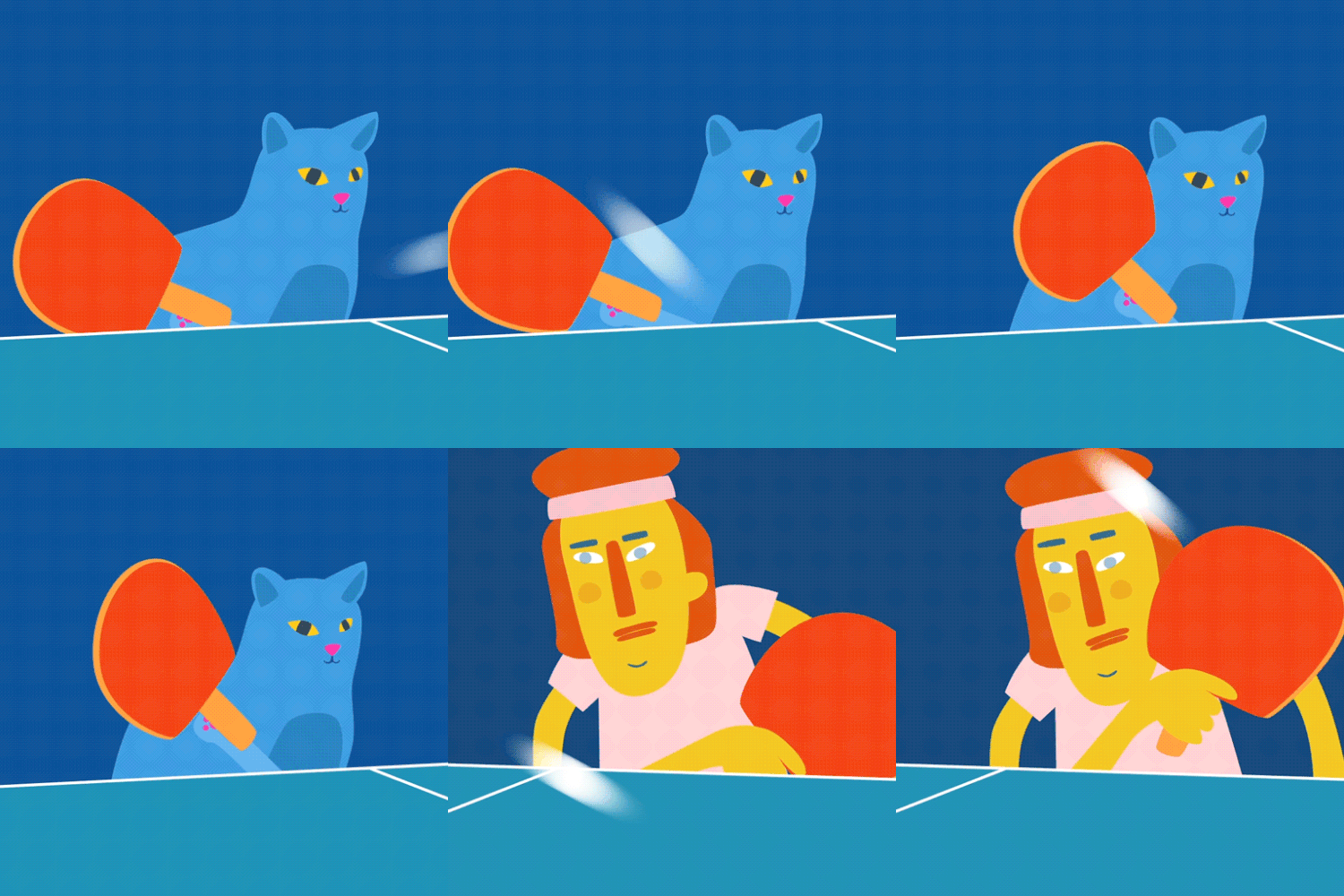
When I woke up this morning the power was out. I have no idea yet why, but it's been out for at least the last 2.5 hours. Alas, all my blogging files and links are on my desktop computer, so I don't have access to them. (I'm using my laptop on batteries for this.) So no blog today. Hopefully power will come back on soon. (I haven't called the power company yet, but will do so after this.) As if this weren't bad enough, I have a noon dentist appointment. To tide you over until tomorrow, check out the USATT news, ITTF news, or Butterfly news. Oh, and here's an animated gif of a man versus a cat.
ADDENDUM 1 (1:00PM): Power came back on around 10:30AM. And I have the beginning of a cavity, and so have to go back to the dentist at 3PM for that.
ADDENDUM 2 (4:00PM): Just got back from the dentist, gained a filling, spent $474 on checkup, cleaning, and new filling. There goes a lot of coaching hours....
ADDENDUM 3 (5:30PM): The pain killer that numbed my teeth and gums has worn off - and my teeth and gums HURT!!!
Tip of the Week
Assume You Have to Move.
Looping the Flip and Other Game Drills
One of the drills we did in my adult training class last night was a new one that none of them had done before. The drill itself was simple: one player served short to the other’s forehand; the receiver flipped the ball to the wide forehand (crosscourt – all the players were righties); and the server looped crosscourt, and the rally continued crosscourt, with the server looping against the receiver’s block. (If you are a hitter, you can do this hitting instead of looping.)
The drill is a subtle change on the more common version where you just serve topspin and start looping – now the server had to adjust his timing to looping against a flip, just as he’d have to do in a real match. The added bonus was the server got to work on his short serve to the forehand and his looping, while the receiver got to work on his flip and his blocking.
Once a player has the foundation of his strokes down, it’s important to do drills that bring in game-like conditions. For example, if you can forehand loop against backspin when your partner pushes to your forehand over and over, and backhand loop when your partner pushes to your backhand over and over, it’s time to make it more game-like, where your partner pushes anywhere randomly, and you have to loop, forehand or backhand.
Sundays are getting to be my favorite coaching time. I often have little private coaching, but have three consecutive 90-minute group sessions – the Beginning Junior Class at 4PM (16 players, I’m head coach); the Talent Junior program at 5:30PM (I think 24 players), and the Adult Training Session at 7PM (I’m head coach; numbers vary; last night we had eight).
Moving and Stroking
I had a rather interesting session with Todd (age 12) on Wednesday. He’s played for about 1.5 years and is now pushing 1500 in our league ratings (1456), looping nearly everything on the forehand, and recently almost as much on the backhand. But there’s always been this strange problem at the start of our sessions where it often takes him 3-5 minutes before he can effectively forehand loop. It sometimes seems as if he’s forgotten how to do it.
Then I noticed something – whenever we do footwork drills, his looping technique looks pretty good. It’s only at the start of the session, where I’m blocking to one spot for him to loop that he often seems to struggle, often reaching for the ball with awkward technique and not getting much spin. So I tried something – I had him do one-one footwork right from the start, where I blocked to his wide forehand and then middle, and he moved side to side and forehand looped. Immediately he was looping really well!
Then we went back to my blocking to one spot, and his looping technique again deteriorated. That’s when it dawned on me – he loops much, Much, MUCH better when moving!!!
School Closed, Larry’s Off
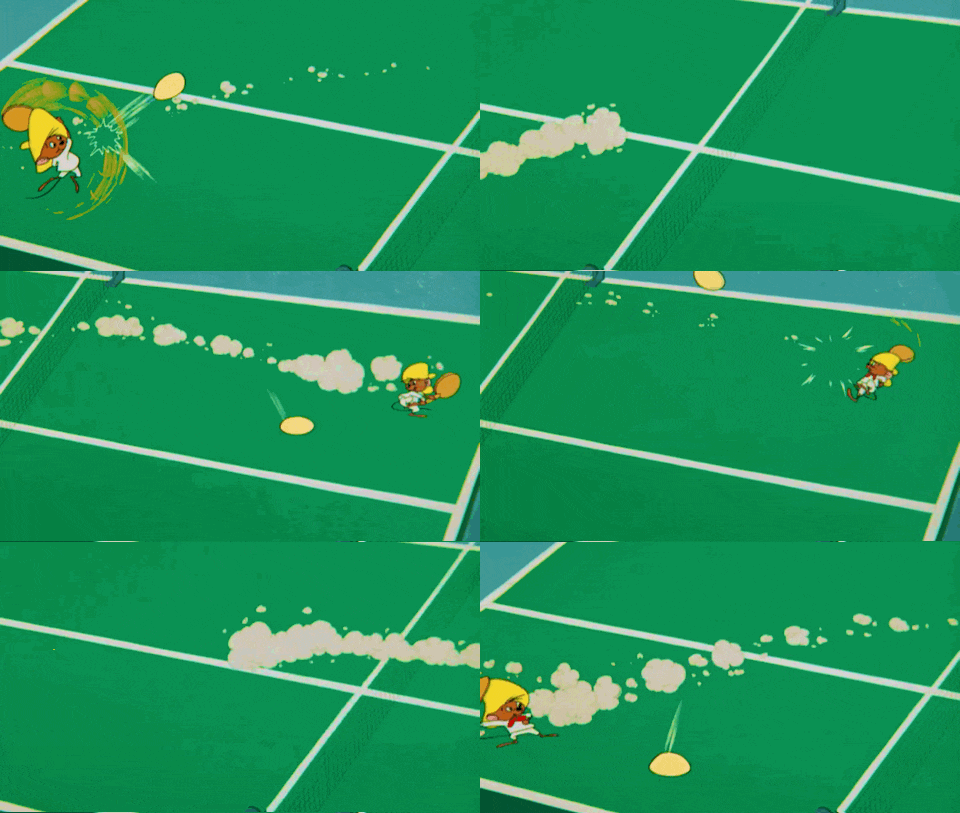
The local schools are closed as a “Non-Instructional Day,” presumably because of Rosh Hashanah. As is my normal policy, when the schools are closed, I’m off too. (Though I’ll spend much of the day on various writing and other projects.) We have a one-day camp today at MDTTC. I’m not needed in it – we have ten coaches at the club – but I may go in later and help out as a practice partner. Then I have three hours of private coaching from 5:30-8:30PM. Meanwhile, to tide you over until tomorrow, here’s an animated gif of Speedy Gonzales playing table tennis. So . . . who would win in a battle between Speedy Gonzales and the Energizer Battery?
Old Ping-Pong Stuff
My house is loaded with old ping-pong stuff. Here’s a rundown.
Backhand Topspins
Last Thursday I blogged about Teaching the Topspinny Backhand, and teaching it to an 8-year-old girl. I’d held back with her and others on this because I didn’t want to mess them up just before our “Talent” program trials. But now that they are over, we’re going backhand topspin crazy – and it’s great!
On Sunday I coached Todd, age 12, on topspinning his backhand. Before that he had a decent backhand loop against backspin, but mostly hit his backhand in rallies. Within minutes of trying it out he was playing backhand topspins like a pro, at least in rote drills where he knew where the ball was going. It’ll take time to incorporate this successfully more random drills and in matches – but on the other hand, I told him it would take time to incorporate the shot into drills, and that time turned out to be minutes.
Maybe I should just tell everyone to copy Ma Long, tell them it’ll take them time to incorporate his shots, and watch them all play like Ma Long in minutes.
To me, the biggest change in the game since I started out in 1976 has been backhand play. Back then most players either hit their backhand or they backed up and topspinned, and I’m comfortable playing against either style. Now they’re staying right up to the table and topspinning. It’s not fair - there should be a rule that you have to choose!
Tip of the Week
Always Think of a Loop as a Set-up Shot.
Sevens
In my 57th year I have this seven-year itch to tell seven of nine stories I have on sevens. Here are my seven deadly sins stories of seven, otherwise known as the magnificent seven.