

Off Today
As mentioned in my blog yesterday, I’m off today – I’ve been on the go for weeks without a break, including ten straight 14-16 hour days while working with Tim on his new book. But to help you get through the weekend, why not follow the action at the Bulgarian Open and the El Salvador Junior & Cadet Open? Oh, and here’s video (1:35) of a baby feeding multiball to a player – the best multiball practice I’ve ever seen!!!
Welcome to TableTennisCoaching.com, your Worldwide Center for Table Tennis Coaching!
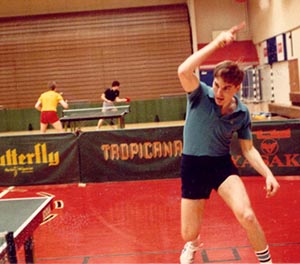 Photo by Donna Sakai
This is an evolving website and Table Tennis Community. Your suggestions are welcome.
Want a daily injection of Table Tennis? Come read the Larry Hodges Blog! (Entries go up by 1PM, Mon-Fri; see link on left.) Feel free to comment!
Want to talk Table Tennis? Come join us on the forum. While the focus here is on coaching, the forum is open to any table tennis talk.
Want to Learn? Read the Tip of the Week, study videos, read articles, or find just about any other table tennis coaching site from the menu links. If you know of one, please let us know so we can add it.
Want to Learn more directly? There are two options. See the Video Coaching link for info on having your game analyzed via video. See the Clinics link for info on arranging a clinic in your area, or finding ones that are already scheduled.
If you have any questions, feel free to email, post a note on the forum, or comment on my blog entries.
-Larry Hodges, Director, TableTennisCoaching.com
Member, USA Table Tennis Hall of Fame & USATT Certified National Coach
Professional Coach at the Maryland Table Tennis Center
Recent TableTennisCoaching.com blog posts
Most Common Mistake
I’ve been thinking about what are the most common mistakes players make, and came to a surprising conclusion. There are lots of common problems that gradually decrease as players improve, but what one thing seems somewhat more prevalent than most as players move up? I think it’s contact on the serve is too high.
If you contact the ball too high, the ball bounces higher on the other side. But it’s a subtle thing, and so there’s not a lot of feedback that forces a player to lower his contact point. Instead, players just generally return the serve more consistently and more aggressively. The server often doesn’t notice this as it often just means the receiver, given a slightly higher ball (and so a larger target on the other side), may just push better than otherwise, or perhaps attack just a little better. Instead, learn to contact the ball lower on the serve, perhaps at net height. This leads to a lower serve, which forces the opponent to lift the ball upwards instead of driving it forward, which leads to weaker and more erratic receives.
When I see players at our club practicing their serves I think about 80% of the time I’m calling out, “Lower contact point!” Here’s my Tip on Serving Low.
Injuries
They come in bunches. I’m taking tomorrow off from everything to rest, so no blog tomorrow. (Friday is my off day for coaching.) Here’s a rundown.
Bob Tretheway RIP
He died yesterday, at age 69, of congestive heart failure, which he’d been suffering from for several years. Bob was the director for USA Table Tennis from the early 1980s to around 1989. (He was never officially the Executive Director of CEO – his formal title was National Program Director – but since we didn’t have an ED or CEO in those days, he essentially was it.)
In 1985, Bob was instrumental in starting up USATT’s Resident Training Program, starting in September that year. This was primarily a junior program for the best USA players, where they’d live in a dormitory (“Building 83”) at the Olympic Training Center in Colorado Springs, go to school (East Middle School and Palmer High School), and train at the table tennis hall (“Building 65”).
In December he brought me in, officially as a player (though I was too old for the program at 25), but really to help develop various coaching manuals, including Instructor’s Guide to Table Tennis. Soon I was named assistant manager, then manager, and later I became the director and one of the coaches. Many players went through the program there, including Sean O’Neill, Jim Butler, Todd Sweeris, Eric Owens, Randy Cohen, Brian Pace, Sean Lonergan, Dhiren Narotam, Chi-Sun Chui, Rocky Wang, Diana and Lisa Gee, Nan Li, Li Ai, and many dozens of others (apologies for those not named). Coaches, practice partners, and other staff at various times included Li Zhenshi, Li Zhang, Henan Li Ai, Liguo Ai, Cheng Yinghua, Jack Huang, Xu Huazhang, Ty Hoff, Mark Kennedy, and Scott Preiss. (The program ended around 1993.)
USATT Board Teleconference
Last night we had a USATT Board teleconference. (I’m one of the Nasty/Naughty/Notorious/Nonsensical/Nauseating/Notable/Neighborly/Noble/Nifty/Nicest Nine – you choose the adjective.) It was a relatively short one, starting at 7PM and ending around 8:20PM. Attending were eight board members, plus CEO Gordon Kaye, High Performance Director Jorg Bitzigeio, High Performance Committee Chair Carl Danner, and legal Counsel Dennis Taylor. Here’s a rundown.
Tip of the Week
Attacking the Middle with the Forehand and Backhand.
Basics, Basics, Basics!!!
It seems like half my students were on vacation recently, and so they all seem out of practice. So what are we focusing on? Yes, BASICS!!! This doesn’t mean just forehand to forehand or other simple drills like that. But it means a lot of basic stroking and footwork drills. One of the things about taking time off is that when players come back, they often fall back into old habits we had spent so much time fixing. So I’m being very careful to watch for that.
For example, I have one student who used to habitually lift his elbow when he hit forehands, thereby closing the racket during the forward swing, leading to erratic shots. He kicked the habit, or so we thought – but he was right back to it in our last session. But we quickly fixed it, and did a lot of forehand drills to make sure.
Another student felt like he’d completely lost the feel of his forehand loop – nothing seemed right. We spent quite a bit of time in our session on it before it began to click. This was a case of his feeling tentative, and so he kept falling back, and so the ball was falling front of him, throwing off his stroke and timing. This led to erratic contacts, and so even when he did it “right,” he was erratic. I had him focus on positioning and contact, and soon all was well. He’s also seemingly forgotten how to smash lobs, so we focused on that, and the importance of doing a systematic one (bring racket back), two (raise the racket) and three (drive into the ball with legs, throwing upper body into the shot).
Another had had a slightly longer “break” – he had stopped playing for 40 years (!), and recently started up again. He used to have a forehand pendulum serve, but had forgotten how to do it. So we’re working on that, and it’s beginning to come back.
Progressive Coaching
A few days ago a student complained that while she could rally in drills, in games she not only missed, but tended to hit the ball right at the opponent, as if it were a drill. She wanted to know how she could fix this. So I put her through the following progression of drills, in this specific order. The key was to first build up accuracy from both the forehand and backhand sides, then do so off random balls, while always attacking the three spots you should always go after in a match – wide forehand, wide backhand, and middle (the elbow, the mid-point between the forehand and backhand). (This will likely be expanded into a Tip of the Week.)
Coaching a Junior Class for the First Time
At the MyTableTennis forum someone asked about teaching a junior class for the first time, and how to get them serious about the sport. Below is my response. The last paragraph might be the most important. But note the sale on the Handbook in the first paragraph! I’m willing to supply them at cost to large groups or to USATT events.
I have ten pages on this in my Professional Table Tennis Coaches Handbook, which comes in print ($5.99) and Kindle (currently on sale at 99 cents). I've run the beginning junior classes at MDTTC for decades.
I generally go with a 2-1 ration - 2/3 practice, 1/3 games. (More like 50-50 for kids 8 and under.) For new players, you'll be doing a lot of multiball. At the high school level, they should have the coordination to hit among themselves after some multiball practice.
For games, have them play king of the table, up-down tables, or Brazilian Teams. However, it's also good to have a large supply of paper cups and a bottle of Gatorade. Kids like to build large pyramids and walls out of the cups, and then they line up, taking turns knocking them down while you feed multiball. (Perhaps three shots each, though only one on first round.) Or you put the Gatorade bottle on the table and feed multiball, and they line up, taking turns trying to hit it, two shots per turn - and if they hit it, you have to drink it. But since these are high school kids, you'll want to focus more on the real games mentioned above. But let them try different games and see which they like.
Why Waldner Doesn’t Have to Move
Here’s the meme that’s making the rounds on Facebook. (Here’s the non-Facebook version.) “I am standing where the ball comes, that is why I don’t have to move, I can Read the Game,” said the great Jan-Ove Waldner.
Some will misunderstand this, taking it literally. Waldner did have to move, of course, but if you watched him play it often seemed like he wasn’t moving – because he was moving before the opponent hit the ball, and so was already there, waiting. Most players react to the ball as it is coming toward them, or perhaps as the opponent is hitting the ball - but this is way too late if you want to be a good player. Instead, you develop the habit of watching and reading the opponent, and reacting to where the ball is going the instant the opponent has committed, usually at the start of his forward swing. Here is my Tip on this, React to Opponent’s Swing.
This also helps if you want to develop a strong defense – you have so much more time to react if you are reacting before the opponent hits the ball then if you wait until afterwards. Here’s my Tip that covers this, Brick-Wall Blocking Defense.
Of course, it helps to be light on your feet – which is more technique than physical. I’ve known overweight players who were light on their feet. Here’s my Tip on that, You Can Be Light on Your Feet.
Pong Road
On Friday night I saw Pong Road, a roughly 30-minute video (in three parts), “an episodic documentary that follows Rocky [Wang] along his journey. Get ready to see ping pong that you've never seen before.” Alas, it’s not online yet so you’ll just have to wait until they do so, or there’s a showing in your area. They do have more segments planned. Here’s their Facebook page, here’s “The Story,” which explains more about Pong Road, and here’s their About Page, with more on Rocky Wang, and on Mark Weismantel, who was the “director, cinematographer, editor, sound designer and art director.”
I’ve known Rocky since he was 13, in 1987. He’s also from Maryland, but strangely I first met him in Colorado. I was (at various times) the manager, director, and one of the coaches for the Resident Training Program for Table Tennis at the Olympic Training Center from 1985-1990, where many of the best junior players in the U.S. lived, went to school, and trained, from 1985 to sometime in the early 1990s, when the program ended. My first memory of Rocky was when he joined us that September in 1987. I walked into the dorms and saw this little kid doing a split between the two walls, holding himself up like this! (The walls were a little closer – and yes, that’s Jean Claude Van Damme demoing here.) Rocky would reach about a 2500 level before quitting in the early 1990s for 12 years. He started up again around 2006, and since then has been coaching (often at Spin NY – see video ad below) and running table tennis events for a living.
Tip of the Week
Feet Parallel to Table is Usually a Backhand Stance.
Weekend – Pong Road, and History of U.S. Table Tennis, and Coaching
I had a hyper-busy table tennis weekend. Here’s a rundown.
On Friday I saw Pong Road, which features table tennis player and coach Rocky Wang on the road, at MDTTC (my club), Ashville, NC, and at a tournament in Knoxville, TN. I’ll blog about this later this week. I also managed to see Dark Tower on Saturday night and Game of Thrones on Sunday night. All were excellent, though the critics don’t seem to agree with me on Dark Tower. (I’ve read the five very long Game of Thrones books by George R.R. Martin – who I’ve met - but not the seven Dark Tower novels by Stephen King.)