Welcome to TableTennisCoaching.com, your Worldwide Center for Table Tennis Coaching!

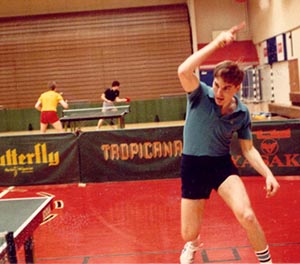
 Photo by Donna Sakai

This is an evolving website and Table Tennis Community. Your suggestions are welcome.

Want a daily injection of Table Tennis? Come read the Larry Hodges Blog! (Entries go up by 1PM, Mon-Fri; see link on left.) Feel free to comment!

Want to talk Table Tennis? Come join us on the forum. While the focus here is on coaching, the forum is open to any table tennis talk.

Want to Learn? Read the Tip of the Week, study videos, read articles, or find just about any other table tennis coaching site from the menu links. If you know of one, please let us know so we can add it.

Want to Learn more directly? There are two options. See the Video Coaching link for info on having your game analyzed via video. See the Clinics link for info on arranging a clinic in your area, or finding ones that are already scheduled.

If you have any questions, feel free to email, post a note on the forum, or comment on my blog entries.

-Larry Hodges, Director, TableTennisCoaching.com

Member, USA Table Tennis Hall of Fame & USATT Certified National Coach
Professional Coach at the Maryland Table Tennis Center

Recent TableTennisCoaching.com blog posts

Butterfly MDTTC April Open
April 8-9, 2017 • Gaithersburg, MD
By Larry Hodges

Players from six states, DC, and Nigeria competed in our 3-star April Open at the Maryland Table Tennis Center, with over $2700 in cash prizes. I sent the results in on Sunday night; found a mistake on Monday morning and resent the new results at 9AM, and USATT still managed to process the tournament that day! So the rating results of both the 4-star Cary Cup from the week before the MDTTC Open went up on Monday at the USATT Tournament Ratings Page. Here are complete results, care of Omnipong.

The Open final between the lefty top-seeded Alex Ruichao Chen (2689 and a full-time coach at MDTTC) and second-seeded Azeez Jamiu (2609, former Nigerian star visiting New York) was a nail-biter at the end. Alex may have the best pure serve and forehand attack game in North America, but Azeez’s tricky serves, receives, and his own relentless looping gave Alex fits, especially at the start. Azeez went up 2-0 in games, but Alex came back. In the seventh, Alex led 9-4 and 10-7, and then it was 10-9, Alex serving. His serve went slightly long, Azeez looped it really, really wide to the left Alex’s backhand – and Alex stepped way, way around, and absolutely pulverized a crosscourt forehand counterloop for the winner!

Tip of the Week
First Step to Blocking Well is Taking That First Step.

Tournament and Camp
I spent all day Saturday and Sunday running the 3-star Butterfly MDTTC April Open, assisted by Mossa Barandao. Here are complete results, care of Omnipong. I’ll write more about this tomorrow, but suffice to say I was there each morning at 8AM, finishing around 8PM on Saturday, and 5PM on Sunday – and then coaching for 1.5 hours. I was going to blog more about it this morning, but I’m running out of time – have to go coach at our MDTTC Spring Break Camp this morning, which is Mon-Fri this week, 10AM-6PM. Combined with the usual private coaching at night, it’s going to be a VERY busy week. (I ran out of time this morning, despite getting up at 6AM, because I had to fix some problems in the results for the tournament - technical problems - which I just managed to do before putting this up, and in a few minutes I'll be off to the club....)

USA Table Tennis Names Jörg Bitzigeio New High Performance Director
Here’s the USATT article and picture. “Bitzigeio was an integral part of the German Table Tennis Federation national team programs from 2005 – 2015, including serving as the Senior National Team Head Coach from 2006 – 2012. Under his guidance, German teams achieved unprecedented international success, including a bronze medal with the Women’s National Team at the 2010 ITTF World Team Championships.”

China and USA National Team Coaches
China just announced their new National Team Coaches Lineup:

  • Head Coach: Liu Guoliang
  • Men’s Team Head Coach: Qin Zhijian
  • Men’s Team Coaches: Liu Guozheng, Wang Hao, Ma Lin, Liu Heng, Ma Junfeng
  • Women’s Team Head Coach: Kong Linghui
  • Women’s Team Coaches: Xiao Zhan, Li Sun, Chen Bin, Zhang Qin, Huang Haicheng

As explained in the article, “Ma Long’s coach Qin Zhijian has been promoted to fill the role of Men’s Team Head Coach, with Liu Guoliang now overseeing the entire team. Meanwhile Xiao Zhan, Zhang Jike’s coach, has moved to the Women’s Team. The staff also sees the return of some familiar faces but in new roles. Ma Lin and Wang Hao are back in the national team, but now in the guise of coaches. Both will be looking to make their mark in this new chapter of their table tennis career.”

Much of this is a near who’s who of past championship players, as the previous generations works with the new – Liu Guoliang, Kong Linghui, Liu Guozheng, Wang Hao, Ma Lin, and others. Others were also top players, but are more notable and are being rewarded for their work with current top players, such as Qin Zhijian (Ma Long’s coach, but also 2001 World Mixed Doubles Champion and two-time semifinalist, and 2003 Men’s Doubles semifinalist with Ma Lin) and Xiao Zhan (Zhang Jike’s coach).  

USA does a similar thing. Here’s the listing of the USA National Team Coaches.

Kids and Blocking
It always surprises me at how quickly kids pick up on blocking against loops, at least in a drill. But there’s a simple method I’ve found that leads to this. As soon as I explain that blocking is just like playing a video game, they go into “game mode,” and suddenly they are blocking champions! I can loop over and over and they’ll get nearly all of them back, even if their level is in the 500-1000 range. I can even get a little practice out of this.

But there are obvious weaknesses. They can’t really adjust to changing spins – if I suddenly throw a super-slow spinny one at them, they usually block off. If I loop very deep on the table, they get jammed and miss. And they aren’t yet in the habit of stepping to the ball, and so have trouble if my loop goes outside a roughly 18-inch wide zone.

A key here is to teach them, right from the start, that they should step to each ball, even if it’s a one-inch step. If you allow them to develop the habit of reaching for the ball, it becomes a habit that’s harder to break. Even if my loop goes to exactly the same spot twice in a row, they should assume they have to move, flexing their knees as I’m hitting my shot in preparation for moving. You should also teach them not to jam the table – arm’s length is about right – or they’ll always struggle with deep balls.

The Three Types of People and Long Pips
This past weekend at the Cary Cup Open in North Carolina, one of my students, just-turned-11 Jackson (that’s his first name) went in rated 1416, but pulled off a series of upsets, including a win over a 1939 player with long pips on one side. There’s an interesting story behind this.

About a month ago I’d watched him lose a practice match to a 1500 chopper with long pips. In our next session, I pointed out that throughout the match, he’d served and just stood in the middle of the table, waiting to see what return he’d get. Since most of the returns came to his backhand, he mostly followed up with soft backhands, and so both lost his serve advantage and took his strong forehand out of play. I explained that when you play a chopper (or most players with long pips on the backhand who receive defensively), you essentially get one “free shot” off your serve. (This assumes the chopper is willing to chop your serve back.) So I pulled out my chopping racket (with long pips) and had him practice against it, where he’d serve and follow almost exclusively with his forehand. He picked up on this pretty fast.

I also explained to him that there are three types of players in this world:

April Fools’ Blogs
I hope you enjoyed the groundbreaking exposé in my blog yesterday of the new techniques by the Swedes to beat the Chinese – edge serves, net receives, knuckle shots. Some of you may have noticed that although the blog was on April 3, it referred to events that took place on Saturday. April 1. The more attentive of you may have read the first letter of each line. If not, now’s your chance!!! And for the record, Jan-Ove Waldner does have an older brother sort of named Ake Waldner – his real name is Kjell-Åke Waldner, and he too was a top table tennis player.

Here are my past April Fools’ Day blogs, where the first letter of each line spells out this secret message.

Tip of the Week
Coaching Tournament Matches.

How The Swedes Will Beat the Chinese Again
Ake Waldner visited MDTTC this past Saturday, spending the day watching our
players train. He is the brother of former Swedish superstar Jan-Ove Waldner, and was
recently named Head Coach of the Swedish National Men’s Team. Our players had some
interesting questions, of course. Sweden had battled with China for decades, with such
legendary players as Bengtsson, Persson, Appelgren, and of course Waldner.

First question, of course, was rather straightforward – how could Sweden, USA,
or any other team possibly beat China? I’ve always argued that if we use the same
orthodox techniques that make the Chinese so good, we’ll always be just a pale
likeness, with no chance of matching them.

Ake agreed with me! And it turns out the Swedes are working on new techniques,
practicing things that might allow them to beat the Chinese. Serve, receive, and
rallies – you have to win at all three, Ake said. The Swedish team had bought
into the new concepts, and have spent many countless hours preparing for their
likely showdown with the Chinese at the upcoming World Championships.

First, they’ve developed a revolutionary new serving technique. Ake demonstrated
over and over his ability to serve on the edge. He’d stand in his backhand side,
open his racket, and just tap the ball down the line. The ball would hit the edge and
lurch to the side, unreturnable unless you basically lobbed it up, an easy smash.

$2700 3-Star Butterfly MDTTC April Open and Coaching at Tournaments
I'm running the tournament next weekend (April 8-9) at the Maryland Table Tennis Center in Gaithersburg, MD. I hope to see many of you there! We've expanded our tournaments from last year, going to two days and three-star events, doubling the prize money, and going from seven to ten events. Here is our tournament page and here is the entry form. You can also enter online at Omnipong. The ten events are (on Saturday, with prize money in all events): Open, U2400, U2200, U2000, Over 50, and Under 15, and (on Sunday): U1800, U1500, U1200, and Under 12.

Some of you are playing a tournament this weekend. According to the USATT Tournament Page, there are four this weekend in the U.S.:

  • 4-star Butterfly Cary Cup in Morrisville, NC
  • 3-star DAC April Open in Davison, MI
  • 2-star NYISC April Over 40 Open in College Point, NY
  • 2-star Clearwater Spring Grand Open in Clearwater, FL

For these players, and for others in future tournaments, here is my article, Top Ten Ways to Play Your Best in a Tournament. Hope it helps! (Note – the following weekend there are ten USATT tournaments.)

USA Nationals Entry Form
While browsing around this morning I discovered that the entry form for the 2017 Supermicro USA Nationals was up. (Here’s a direct link to the print entry form.) This is the first I’d seen it – I printed it out and will go over it more closely later today. The tournament will be in Las Vegas, July 3-8 (Mon-Sat). (The hotel link still links to the U.S. Open hotel from December.)

There are a mind-boggling 97 events. Most are similar to last year’s Nationals. I did find some interesting items – for example, what appears to be Men’s and Women’s Singles are currently named simply “Hsing Family Foundation.” Presumably that’s a sponsor, but it probably should be “Hsing Family Foundation Men’s/Women’s Singles.” Beyond that are the usual events – Men’s & Women’s Doubles and Mixed Doubles; Junior, Cadet, and Mini-Cadet Team Trials (with the Cadets strangely listed differently as “Singles Team Trials”) for boys and girls; Under 10 and 21 & Under (also for boys and girls); numerous senior events, singles and doubles, ranging from Over 30 to Over 85; lots and lots of rating events, from U1000 to U2400, with the events from Under 2000 down mostly divided into Adult and Juniors categories, plus U4200 and U3200 Doubles; ten Hardbat and two Sandpaper events (Open and U1700); five Paralympic events; and something new, on Saturday, the last day - Junior and Adult Teams!

So what’s this about Team Events at the Nationals? We’ve had Junior Teams before, and there are both Boys’ and Girls’ Teams. But the Adults Teams is new. From the last page of the entry form:

Nationals Team Day

Saturday, July 8 2017

New – Adult Teams. Teams of 2-4 adult players. Teams must have matching uniform colors!

Tip of the Week
Serve and Forehand Loop.

Pre-Tournament Preparation
One of the kids I coached last night is preparing to play in the 4-star Cary Cup Open this weekend. I had gone into the session preparing to really work on his looping game, both forehand and backhand. However, he was noticeably glum about this, and admitted he didn’t think he’d be looping much in rallies at the Cary Cup, that he’d mostly be looping against backspin and then hitting.

Now I could have said, “No, you have to think long-term and focus on looping more,” or the opposite, “Sure, we’ll forget about looping and worry about developing that later on.” Instead, I did something in between. I pulled out an invisible piece of paper, and wrote with invisible ink with an invisible pen the invisible words, “After the Cary Cup, I will focus on looping in rallies.” I then pricked his finger with an invisible pin, and he signed the agreement with invisible blood. And so we spent the session preparing him for the Cary Cup – looping backspin, then hitting, as well as serves, receive, and other shots. Next week we’ll focus on looping in rallies – and I’ll wave that invisible paper at him if necessary.

I also made him promise to practice his serves the day before the Cary Cup. This is one of the biggest mistakes players make, showing up at a tournament where they haven’t been practicing the shot they’ll be using at the start of half the rallies, the serve, and so end up serving mostly to just get the ball in play. Often they don’t even realize how much they are losing because their serves aren’t as low, as fast, as spinny, or as varied as they could be.