

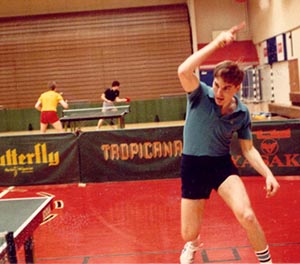
Welcome to TableTennisCoaching.com, your Worldwide Center for Table Tennis Coaching!

 Photo by Donna Sakai

This is an evolving website and Table Tennis Community. Your suggestions are welcome.

Want a daily injection of Table Tennis? Come read the Larry Hodges Blog! (Entries go up by 1PM, Mon-Fri; see link on left.) Feel free to comment!

Want to talk Table Tennis? Come join us on the forum. While the focus here is on coaching, the forum is open to any table tennis talk.

Want to Learn? Read the Tip of the Week, study videos, read articles, or find just about any other table tennis coaching site from the menu links. If you know of one, please let us know so we can add it.

Want to Learn more directly? There are two options. See the Video Coaching link for info on having your game analyzed via video. See the Clinics link for info on arranging a clinic in your area, or finding ones that are already scheduled.

If you have any questions, feel free to email, post a note on the forum, or comment on my blog entries.

-Larry Hodges, Director, TableTennisCoaching.com

Member, USA Table Tennis Hall of Fame & USATT Certified National Coach
Professional Coach at the Maryland Table Tennis Center

Recent TableTennisCoaching.com blog posts

Tip of the Week
Last-Second Changes of Direction on Receive. (As explained in my Dec. 28 blog in the Tip of the Week, I'm putting up extra Tips of the Week and post-dating them for earlier in December so I'll end up with 150 Tips for the period 2014-2016. So today's Tip of the Week is dated Dec. 26.)

Barry Dattel: 1958-2016
Last night I got the horrible news – here's the USATT news item. Apparently Barry, an icon in our sport, had a heart attack while at his club late on Friday, Dec. 30, and passed away around 1:30 AM on Saturday morning, Dec. 31, at age 58. So it was a very bad end to the year. (Here's the Legacy obit.) 

I've known Barry since around 1980; we've competed against each other ever since, first as players (where he soon left me behind as he reached a 2500+ level), and later as opposing coaches in many a match. He was a top USA player for many years; as recently as 2013 he was the U.S. Open Over 50 Men's Singles Champion. He was the father figure in the First Family of Table Tennis – husband to Hall of Famer, Olympian, and head coach Lily Yip at the Lily Yip Table Tennis Center; stepfather to star players Adam and Judy Hugh (both former USA Team Members and many other titles), and father-in-law to Cory Eider (married to Judy), former U.S. Men's Singles Finalist, Men's Doubles Champion, and past USATT High Performance Director.

High Performance Director and Supercamps
As those of you at the U.S. Open's USATT Assembly learned, High Performance Director Cory Eider resigned. (I think it's effective Dec. 31.) It was depressing for me as I'd had high hopes for this. But the problems had been mounting, many of them communications problems, as well as some policy problems, such as the youth team selection process. I hope Cory won't get mad at me for this (!), but IMHO, communicating was not his strength, and so often many of us had little idea what was going on, including the athletes and coaches.

Cory and I had a number of long late-night discussions, often via Facebook Messenger. We agreed on a lot, but also disagreed on a number of issues, but I'm not going to go into that. He brought a focus on aiming high, with a 52-week a year training mentality that aimed at beating our overseas rivals rather than our domestic ones.

One cornerstone to all this were the Supercamps (though in the end we only did one, plus an ITTF Cadet Camp at MDTTC). Below are the write-ups of the one held in July in New Jersey. (Why was it held at the Lily Yip TTC, Cory's home club, owned by his mother-in-law? Because it had to be put together very quickly, and other clubs, such as ICC, weren't able to do so at that last minute. It was a huge task, and far easier to do locally, where you have built-in help, then trying to do it alone elsewhere. As it was, they did an incredible job. But alas, the appearance to many was not good. The plan was – is? – to have the camps move about at the various high-performance facilities.)

USATT SUPERCAMP ARTICLES

Tip of the Week: Ask the Distributor!
(Today's blog is both a regular blog entry and a Tip of the Week.)

At clubs all across the nation and the world, the same routine goes on all the time - players are constantly asking and talking about equipment. Only ratings are more discussed. (Typical greeting at a club: “What’s your rating? What equipment do you use?”) And it’s true that you can learn a lot by asking others about equipment - and better still, trying out their equipment.

But think about it - a distributor might have dozens of sponges and dozens of rackets that might suit your game. The possible combinations can run into the thousands. While you may gain valuable information asking questions, remember that they mostly know what works for them, and no two players play alike. You need to find what works for you. You may find this by experimenting, but the probability that someone else at the club just happens to have the perfect racket and sponge combination for you isn’t likely.

But there’s an expert out there ready to help - and that’s the equipment expert at the distributor. All of the major ones have someone like this, who has literally tried out every combination of their equipment, and knows just about all there is to know about all of them. Their job is to find a perfect combination for you - because if they don’t, you’ll be going to a rival. Not only that, but each of these distributor “equipment junkies” lives and breathes table tennis equipment, and so it will be his lifelong dream to discuss your equipment needs and find you the perfect combination. He’ll know what questions to ask of your game with the goal of finding you just what you need.

So if you aren’t sure yet about what equipment to use, why not contact one of the major distributors and ASK? (You can also do this at most major tournaments.)

Tip of the Week
Racket Rotation Serve. You'll note that it's dated December 23, 2016, which was last Friday? Here's the reason. When I compiled my book "Table Tennis Tips," it included all 150 Tips of the Week (in logical fashion) from 2011-2013. Well, it's three years later, and soon I will be compiling all the Tips from 2014-2016 into "More Tips of the Week." However, because I traveled more these past years, I made the discovery that, as of this morning (before I put up today's Tip), I had only 141 Tips. So I'm going to cheat – and will date the last nine Tips of the Week as Dec. 23 to Dec. 31, thereby ending the three years with another 150 Tips. I'm still undecided whether to post a daily "Tip of the Week" until all I've reached 150 (with the last one going up on Jan. 9), or to continue posting them every Monday, with the 150th Tip going up on Feb. 20, but dated as Dec. 31. Of the eight remaining, I've already written four, and have topics for the other four. If other activities don't intervene, I hope to write all four today. (But there are already a number of things on my todo list, alas. But I'm off today from the MDTTC Christmas Camp, so I have more time, though I have private coaching tonight.)

Eventful Three Weeks
It's been a whirlwind three weeks! As noted previously, it started with the "Sail to Success" science fiction writing workshop Bahamas cruise, Dec. 4-9. I won't bore you with the details here since this is a table tennis blog, but here is my write-up of the cruise from my science fiction & fantasy blog – and note that I won the cruise ping-pong tournament!

Last Blog Until Wednesday, December 28
I'm going out of town almost continuously for the next three weeks. Here's my upcoming schedule.

  • Dec. 4-9: Science Fiction Writer's Workshop Cruise in Bahamas (sort of a working vacation)
  • Dec. 10-18: U.S. Open and USATT Board Meetings in Las Vegas
  • Dec. 20-25: Christmas in Eugene, Oregon
  • Dec. 26-31: MDTTC Christmas Camp in Maryland

USA Youth Team – Selections or Trials? – and the Missing Link
One of the interesting things about being on the USATT Board of Directors is that you hear all sorts of perspectives. Often there are "huge" controversies that go on and on, that few members of USATT actual even know about. The current example is the 2017-18 Youth National Team Trials Procedures Draft for Public Comment. We've received dozens of emails from concerned parents on this, and right now it's perhaps the biggest USATT issue. But the great mass of USATT members is mostly oblivious to this.

And yet this is a rather important issue. USATT is responsible for the selection process of USA Teams for table tennis, and getting this right is a rather touchy process. Alas, there's been more controversy on this over the past year then perhaps, well, ever. But again, the controversy only affects a few people directly, and so for most, it barely shows up on the table tennis radar.

The crux of the matter is two questions.

Boosting – No, Nobody's Doing It. Move Along. Nothing to See.
What brought this up now? They are openly discussing boosting at Mytabletennis.com right now – yes, right out in the open, they are talking about CHEATING!!! But no, it's not really happening. It's all imaginary. The numerous top players I've seen boosting before people began to complain didn't really boost, and when faced with opponents who strangely get more speed and spin on their shots than would seem possible from their strokes, it's all wizard stuff, not undetectable boosting. Magic.

I've blogged many times about how cheating is prevalent in our sport, both with illegal serves and boosting. Players blatantly hide their serves, but umpires and referees simply won't enforce the rules on this, and so to compete on an even basis at the higher levels you also have to serve illegally – it's sickening to me, but far too many others in authority positions prefer to look the other way. (I've blogged about illegal hidden serves many times, such as July 17, 2015. Here's my Net Visibility Rule proposal.)

Breakability, Playability, and Financiability of Plastic Balls
There are regular complaints about how the new plastic balls (which aren't so new anymore) break more easily than celluloid ones. Someone posted a note about this last night, and I responded as follows, about my experiences at the North America Teams – with the "breaking point" observation.

Most of the new plastic balls break more often than the celluloid ones. All you can do is call a let when it happens. One thing I noticed - I coached junior teams where the players were mostly 8-10 years old, and I don't remember them breaking a single ball. But I kept hearing from others, like you, that the balls kept breaking. Adults smash harder, and there's apparently a "breaking point" speed where they break too often.

Most of them also don't play as well as celluloid, though some of them are pretty good. There's going to be a titanic struggle at some point between the forces of seamed and unseamed balls – I'm guessing that eventually it'll be one or the other.

There are always going to be suspicions that the switch to plastic balls was more commercial than out of necessity due to the flammability of celluloid (which causes shipping and insurance difficulties). Perhaps it was both. Switching to plastic balls both enriches those who have the patents for them, and increases the number sold since they break more often. (I have no idea if they knew that part in advance.) However, I don't claim to be an expert on this.

Tip of the Week
Follow the Elbow.

North American Teams
I spent the weekend coaching at the JOOLA North American Teams. (Here are complete results.) As noted in my blog last week, I always have this conflict as I'm sponsored by Butterfly, which runs the Butterfly Teams the same weekend, but the JOOLA Teams are practically next door, and my students play there. So that's where I coach. 

As usual, since I was busy coaching MDTTC junior teams on the back tables, I didn't see many of the big matches. During the Division One Finals I was watching the Division Ten Final. Note I said watching, not coaching? That's because it was between MDTTC/HWGF1 and MDTTC/HWGF2! Yes, an all MDTTC final. (HWGF stands for HW Global Foundation, which sponsors and runs the Talent Program at MDTTC, which is mostly kids from around 7 to 11. Contact them if you are interested in such a program at your club.) The players on the two teams were mostly 8-10 years old. I'd coaching both teams during the tournament, though I'd been assigned to mostly  coach the #1 team. (Others coaching the MDTTC junior teams were Jeffrey Zeng Zun, Wang Qing Liang, John Hsu, and Jack Huang.) But when two MDTTC junior teams play each other, we have a firm rule – no coaching from coaches or parents; only the kids can coach each other. They are all teammates, and we don't want coaches or parents coaching against each other there. It was a battle, as the players were used to each other, with the #1 defeating #2, 5-2. It could have been closer as the #1 team won two matches deuce or 11-9 in the fifth. These players all came in with ratings roughly 1100 to 1400, but they were severely under-rated.

Next Blog – Tuesday, Nov. 29
I'll be eating Meleagris on Thursday, coaching at the Teams Fri-Sun, and exhausted in bed on Monday. See you Tuesday!

Coaching at the Teams
On Fri-Sun I'll be at the JOOLA North American Teams, coaching one of the junior teams from the Maryland Table Tennis Center. It's a rather big job, herding the kids to the right table, warming them up, getting the match slips filled out, scouting opponents, coaching matches, consoling tearful kids after a loss, and making sure they eat and drink properly. Fortunately, most of the kids are now "old pros," having played numerous tournaments.

It's a tough decision for many of us each year – JOOLA North American Teams in DC, or Butterfly Teams in Philadelphia? It's unfortunate they are on the same weekend, and only 2.5 hours apart, but both want the Thanksgiving weekend. For me, it's an especially uncomfortable choice, since I'm sponsored by Butterfly, but the North American Teams are practically in my back yard. Since the players I coach are playing there, I'll be coaching at the JOOLA North American Teams in DC. But I wish I could do both.

For those of you playing at the Teams (either one), here's my article, Top Ten Ways to Play Your Best in a Tournament. Unless you are playing an MDTTC Team. Then go out and party late the night before, and show up at the last minute to play – only wimps need to warm up, right?

One thing of possible great interest – at the North American Teams they will be following the new ITTF coaching rule. This means coaches are allowed to coach at any time during the match that the ball is not in play. I do not like this rule, and am not looking forward to it. Hopefully it'll be low key, and not three days of coaches screaming out instructions. But I'm sure there'll be some coaches signaling every serve.

Sixteen and Training Again . . . with Christer Johansson
The year was 1976, I was 16, and I'd just finished a week of hard training at the Monty Merchant Christmas Training Camp. On the last day I got a surprise – Monty had been so impressed with my skills that he'd arranged for Christer Johansson, the great Swedish coach, to fly to the U.S. to take personal charge of my training.

The preceding never happened – or did it? Let me tell the story in order.

I'm in my room, shadow-practicing my forehand, when Monty and Christer walk in. Monty introduces us, then Christer takes charge. Tells me I need to focus on looping from both sides. On the forehand, I was both hitting and looping; he assures me that the future is looping, and to focus on that.

But then we get to my backhand. "You must loop your backhand," he says. He guides me through the stroke as he wants me to do it, and I begin to shadow practice it.

"It's easy to do in practice," I vividly remember telling him, "but hard to do it in games."

"But you must do it in games," he says. We're still in my room at home, with a table somehow jammed into it. We begin training, as he blocks to my backhand loop, constantly on me to spin it harder, Harder, HARDER!!! He's moving me side to side, backhand to forehand, and I'm really into it, looping everything, as I want to be the best in the world, and now I have one of the best, maybe the best, coach in the world training me. Every now and then I see Monty in the background, nodding. I'm a hard worker, and both of them are impressed. He's focusing especially on my backhand, turning it into a deadly weapon.

Soon I'm ripping loops from both wings, relentlessly, like a champion. I'm 16 and I have a great future ahead.