

Welcome to TableTennisCoaching.com, your Worldwide Center for Table Tennis Coaching!

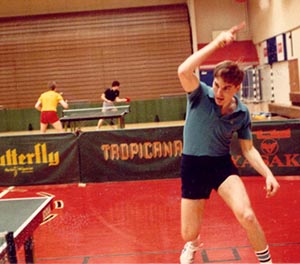
 Photo by Donna Sakai

This is an evolving website and Table Tennis Community. Your suggestions are welcome.

Want a daily injection of Table Tennis? Come read the Larry Hodges Blog! (Entries go up by 1PM, Mon-Fri; see link on left.) Feel free to comment!

Want to talk Table Tennis? Come join us on the forum. While the focus here is on coaching, the forum is open to any table tennis talk.

Want to Learn? Read the Tip of the Week, study videos, read articles, or find just about any other table tennis coaching site from the menu links. If you know of one, please let us know so we can add it.

Want to Learn more directly? There are two options. See the Video Coaching link for info on having your game analyzed via video. See the Clinics link for info on arranging a clinic in your area, or finding ones that are already scheduled.

If you have any questions, feel free to email, post a note on the forum, or comment on my blog entries.

-Larry Hodges, Director, TableTennisCoaching.com

Member, USA Table Tennis Hall of Fame & USATT Certified National Coach
Professional Coach at the Maryland Table Tennis Center

Recent TableTennisCoaching.com blog posts

Adjusting to Different Balls in the Yucky Insane Plastic Era (YIPE!)
One of the realities of the YIPE era (yes, that's what I'm calling it!), where we use plastic balls instead of celluloid (which is actually a type of plastic, but we won't get into that), is that the balls vary widely, far more than before. It used to be that everyone knew that Butterfly balls were slightly softer and lighter than Nittakus, and you'd warm up with the appropriate tournament ball and you'd be ready. But now they vary dramatically. Playing with the various 40+ Nittaku, DHS, Butterfly, JOOLA, and the seamless Xu Shao Fa is like trying to play basketball where one moment you're dribbling a basketball, then suddenly (in no particular order) it's a bowling ball, then a baseball, then a golf ball, etc.

One of my students, Daniel (who I've blogged about before) played in the Capital Area League this past Saturday. He tends to play too passive, and so we've spent a lot of time working on using his serve to set up his attack. Alas, we weren't using a Nittaku Premium 40+, and so when he used that in the league, he said it felt really heavy, and he had no confidence in his attack. Result? He went back to pushing.

The moral here, and for others, is that you need to work out in advance what events you'll be playing in, find out what balls they will be using, get a supply of each type, and make sure to practice with that ball before each event.

Tip of the Week
Depth Control on Serves with CBS.

Bottle Drill and Quotes
Here is a useful drills I used this weekend. Sameer (14, 1826) has reached the point where he's pretty consistent with his first and second loops (both forehand and backhand), but needs more focus on placement. He told me that in his league matches, he's making nearly 100% of his backhand loops off push, but they keep coming back – but that was because he's opening primarily to the middle backhand, where the opponent is ready and waiting. (And most players block better on the backhand.) Since your first attack should most often be to the opponent's middle (something top players routinely do, but beginners and intermediates often don't quite get – here's my Tip on Attacking the Middle), with follow-up attacks at the corners (since the attack to the middle draws them out of position), we did the following multiball drill.

I put a bottle just a bit to the left of the middle line on my side of the table, about a foot in, where the middle (playing elbow) of a typical right-hander would be. (This does vary based on the player, situation, and handedness.) I put another bottle on the right side of my side (my wide forehand), about 18 inches outside the corner, a couple inches from the sideline. First I fed just backspin to his backhand so he could practice hitting the bottle with his backhand loop. Then I fed just topspin to his wide forehand so he could practice hitting the bottle with a hooking forehand loop (so the ball curved to his left, my wide forehand). He reached the point where he was able to hit the bottles about 1/3 of the time.

Footwork Drills by Stefan Feth, and Attacking the Middle
Here's the new video (1:23) from Butterfly. Note how, for this drill, Stefan stresses that the he's putting the ball to his partner's middle. Far too often players just drill to the corners, and then wonder why they have trouble attacking an opponent's elbow, usually the weakest point – if you don't practice it, you won't do it very well. I've often faced this as a coach – I'll tell a player to attack the opponent's middle, and he'll get this pained look as he knows he's not comfortable doing so since he's so used to attacking the corners. And then he'll go out there and continue to go to the corners, since that's what his muscle memory wants to do.

Think about it. Any coach or top player will tell you that your attacks should go to three spots – wide forehand, wide backhand, and the opponent's middle (roughly his playing elbow). Most will agree that attacking the middle is usually the best spot for the first attack – here's my article, Attacking the Middle. Here's an excerpt:

Why is the middle so weak when attacked? There are five (yes, five!) primary reasons.

How to Avoid Hurting the USA National Team, and Some Training Stuff
While in a session with Daniel (age 11, about 1650, but should be more like 1750), he hit a ball that broke cleanly into two hemispheres. I pointed out that somewhere out there were two poor mice, huddling in the cold, and that we should donate the two hemispheres as hats to help these two mice keep warm. But then I realized that the hats would cover their ears, and so they wouldn't hear approaching cats, and so they'd get eaten, and it would be my fault. This is when Daniel took over, pointing out that this would lead to fat cats, which would get eaten by dogs, leading to fat dogs, which would be sold in China, where (in some places) they eat dogs. This would spur the Chinese economy, thereby giving them more money to fund the Chinese National Team, making it less likely the USA National Team would beat them. So . . .  sorry mice, you'll just have to stay cold. (Now you know what really goes on in my coaching sessions.) 

Okay, we actually did lots of training in the 90-minute session - Daniel was on top of his game, and should play some tournaments soon. Our main focus right now is improving his forehand looping (which has improved dramatically), and following up his serve by looping (forehand or backhand) - he tends to play to the extremes, either too passive or too aggressive with wild swats. I'm 90% certain he's the best under 12 lobber in the country, but he's learned to hold back on that in serious matches. If he can remember to take his time when he serves (rather than grab the ball and serve like the ball's a hot potato), he'll make a jump soon. There's also one serve I want him to really work on - sorry, can't tell potential rivals about that one!

USATT Announces Roster of National Coaches
Here's the announcement. They include Lily Yip, Barney Reed, Teodor "Doru" Gheorghe, Massimo Costantini, Stefan Feth, Wang Qing Liang ("Leon"), Zhou Xin, Han Xiao, Sean O'Neill, Maggie Tian, and Samson Dubina. (Han Xiao and Wang Qing Liang are both from my club, MDTTC.)

Most (or all?) of these coaches will be at the upcoming USATT Training Camp to be held at the Lily Yip TTC in New Jersey, July 10-24, right after the USA Nationals. The camp is primarily for members of the USA Junior, Cadet, and Mini-Cadet Team Members, with a number of others also invited. USATT's High Performance Director, Cory Eider, will be directing it. I'm the (unpaid volunteer) manager for the camp and one of the coaches, though I'll primarily be an assistant coach, helping out where needed – probably feeding multiball, acting as a practice partner for some of the mini-cadet players, or walking around looking important. (I'm no longer fast enough to train with the cadets and juniors, alas.) I'll be there the first 12 days, but have to leave two days early to go to my annual "vacation" – a writing workshop in Manchester, NH, July 22-30. 

Drills When the Kids are In Charge
I let two kids choose their last multiball drill during a session yesterday. Here's what they chose.

The first, age 9, alternated hitting backhands from the forehand side of the table, and forehands from the adjacent table. So I had to feed every other ball to the adjacent table to my left! He ran back and forth like a giggling maniac. 

The second one, age 7, chose the following four-shot sequence: Forehand from forehand corner; forehand from middle; backhand from middle; and then I was supposed to give him a backspin serve to his wide backhand for him to push; and then repeat. I have no idea why he wanted this, but he was very insistent on that backspin serve as part of the multiball drill. He also has his own name for backspin - he calls it "stopspin," since he's seen my backspin serves stop and go back into the net. This kid has a history of begging for weird drills - usually intricate combinations that often have him doing backhands from the forehand side, me suddenly serving in mid-drill, or (one time), I fed multiball with a cardboard box instead of a racket. 

In my group sessions, especially toward the end, I sometimes do give players either a pair of options for their next drill, let them choose the drill, or ask them what they want to work on and then design a drill around it. For example, I may give them the choice of doing forehand-forehand footwork, or forehand-backhand footwork. Or serve and forehand attack, serve and backhand attack, or serve and attack from both wings. 

Training Blog at MH Table Tennis
Matt Hetherington is now blogging about his daily training at MH Table Tennis, with links to video. So far he's blogged about days 1-4.

Tip of the Week
Move In to Cut Off the Angles with Quick Blocks.

Balance and Recovery
During coaching sessions yesterday I spent some time harping on balance. Way too often, when moving to the wide corners, players go off balance, either because they are reaching instead of stepping, or because they step, but not far enough. And so they hit the next shot off-balance, leading to a weak and erratic shot. Perhaps even worse is it leaves them unable to return quickly to ready position, so they aren't ready for the next shot.

What seems to happen to many players is they learn to make these slightly off-balance shots somewhat consistently, and so it becomes a habit. The problem, besides the loss of power, is that because they are off balance from that shot, it takes time to recover the balance to move back into position – and so they are late on the next shot. And then they scream, "I'm so slow!!!" It's not a slowness problem; it's a technique problem, caused by faulty feedback. Instead of realizing they are missing the next shot because of a balance problem that leads to slow recovery, they think it's natural slowness, and don't fix the problem.

Often staying balanced while moving to the wide corners is a simple matter of taking a longer step so as to keep your center of gravity between your legs. By doing so, you stay balanced, and can recover almost immediately for the next shot. And then, as if by magic, you'll think you've suddenly gotten faster! (An expanded version of this will probably become a future Tip of the Week.)

USA Nationals
So . . . are you going? Here's the entry form! Online registration will open later at the 2016 USA Nationals home page.

This year there is a record 100 events, something for everyone. They include "Championship Events" (Men's and Women's Singles, Doubles, Mixed Doubles, and singles and doubles age events ranging from 10 & Under to Over 85); Rating Events (ranging from Unrated and Under 1000 to Under 2400, often split into Adult and Junior events, plus rating doubles events from Under 2700 to Under 4200); ten Hardbat and two Sandpaper events; and five Paralympic events. All entries get a free USA Nationals t-shirt.

One of the nice features of the Nationals are the venders. There'll be a lot of them! Sure, you can do your shopping online, but there's something different about being there in person, where you can browse over the merchandise in your hands. Lots and Lots and LOTS of table tennis stuff on sale! Just browsing the lines and lines of rackets and sponge can take half a day, and then there's all the other stuff – balls, shoes, clothing, towels, books (BOOKS!!!), videos, and all sorts of miscellaneous stuff – including my books. (I can autograph them.)

Next to playing, probably the best thing about the Nationals is the 1000 other table tennis people who will be there - those you know personally, those you will meet, and the many table tennis legends who will be there. Most will be happy to hobnob with you and sign autographs. USATT officials will also be there if you have anything to discuss.

Down-the-Line Pushes, Chop Blocks, and Other Adventures
Yesterday I was showing a student how you can mess up an opponent when receiving a short backspin serve to the backhand by, at the last second, dropping the racket tip and pushing short or long to the forehand. The server reacts to your racket aiming to his backhand, and so is caught off guard when you make the last-second change. Why more players don't do this I've never figured out; it's incredibly effective.

But then he began experimenting, and when I served sidespin-topspin to his backhand, he did the same thing, chop-blocking the ball down the line. It's another effective shot that few use. I found myself struggling to react to the shot, even though it was right there, to my forehand, and I've got a pretty good forehand. I've used the same shot against others, but only occasionally have others tried it against me.

Why was it so effective? Three things are happening, all causing varying degrees of calamity. First, as noted above, he'd aim to my backhand until the last second, and then change directions to the forehand. This causes the muscle memory to prematurely react to a ball to the backhand, and so you get caught off guard when it goes to the forehand. Second, since we're mostly expecting a topspin return, muscle memory again misdirects us, leading us to move to a position a step or so off the table – but since it's instead a softer backspin return (with the backspin further deadening the shot), we end up too far off the table, and so are stuck reaching for a ball dropping in front of us. And third, since we're not expecting backspin, we're caught with our racket too high, and have to last-second drop it.

USATT National Team System
Here's the new document with the USATT Statement of Core Beliefs, Team Selection Procedures, and National Team Funding Methodology. The document is 10 pages long. Pages 2-9 are about the selection procedures for the USA National Junior, Cadet, and Mini Cadet Teams, and page 10 is about funding for team members. The first page is perhaps of most interest to readers. Below is the text from page 1, starting with the Henry Ford quote.

Perhaps the most important of these is #3, about creating a "team first" culture. At various times in the past, countries such as Hungary, Sweden, Korean, and Japan challenged and beat the Chinese – and they did so by working as a team. It's somewhat eyebrow-raising, for example, that I can give a lecture on how to play most of the top USA junior players that juniors from my club often face, but have no real idea about the top juniors from China, Japan, Germany, etc. Why? Because the focus right now is on beating other USA players. That's not going to completely go away, but once we have a core group of up-and-coming players who really can challenge their rivals from around the world, it's key that our top coaches know these rivals so they can train our players to beat them, both strategically (long-term development) and tactically (tactics at the table).