

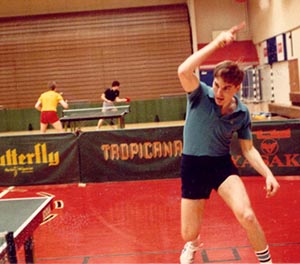
 Photo by Donna Sakai
The 800-Pound Gorilla in the Ping-Pong Hall: Muscle Memory
Think about it: everything you do when you play table tennis beyond the beginning level involves muscle memory. Muscle memory controls your strokes and serves, your reactions to the opponents' shot, even most of your tactics.
I'm sure there are many advanced studies on this, but what's important here is the practical aspect. And for that, I would say there are two types of muscle memory in table tennis: what I will call "rote muscle memory" and "reactive muscle memory." (I'm sure there are actual technical terms for this, but I'm not going for the technical side here.)
Rote muscle memory is what you use when you tie your shoelaces, play a song you know well on an instrument, do table tennis serves, or hit forehand to forehand with someone who keeps the ball in the same place. It's the first thing beginners learn as they develop into intermediate players. Without this, you simply wouldn't be able to make high-level shots with any consistency. An example of this is a demo I regularly give in my classes, where I put a water bottle on the far side of the table, and then rapid-fire smack it over and over with my forehand, all the while carrying on a conversation with the players. The shot is so ingrained into my rote muscle memory that I can hit it ten times in a row pretty regularly from about eight feet away. (I have a box of balls on my side so I can rapid-fire grab them to hit.)