
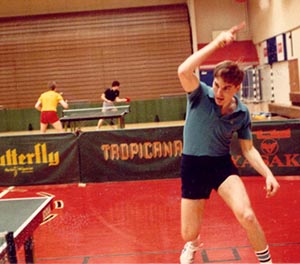
 Photo by Donna Sakai
Coaching Matches is Trickier Now
Coaching matches used to be easier. In most matches in the "old days" (twenty years ago?) there'd be a style conflict since the odds of two players with the same style playing was rather low. I mean, what were the odds of two players playing with the same style, such as, say, both being two-winged loopers? Sure, it happened sometimes, but there were a lot more common styles back in those days – hitters, counter-hitters, blockers, choppers, various types of pips-out, conventional penholders, Seemiller grip, and all sorts of forehand/backhand combinations.
All of these styles still exist, but it's a matter of degree – they used to be common. Now the matches I coach are mostly up-and-coming players who train regularly under top coaches, and so there are very few "old-fashioned" styles among them – they are nearly all two-winged loopers these days. The few that don't play that way are still usually inverted players who loop both sides, just not all the time.
With style conflicts, there are obvious tactics. There was the thrill of the clash of styles, such as when a looper met a hitter, or a one-winged forehand looper met a blocker. The tactics were more straightforward.
These days, since the large majority of the matches I coach are between standard two-winged loopers, coaching is a bit subtler. Both players tend to play the same, with the same serves, same surfaces, same strokes, and often the same strengths and weaknesses, with subtle differences in degree.
There's still diversity, but nothing like before. In the past it was like throwing a lion, a wolf, a bear, a giant anaconda, a crocodile, a rhinoceros, a shark, and a black widow spider into the quarterfinals, and they'd battle it out. Now it's more or less eight lions, all running around looping everything. The game is more athletic, but it's also more uniform.