
Blogs

Larry Hodges' Blog and Tip of the Week will normally go up on Mondays by 2:00 PM USA Eastern time. Larry is a member of the U.S. Table Tennis Hall of Fame, a USATT Certified National Coach, a professional coach at the Maryland Table Tennis Center (USA), and author of ten books and over 2100 articles on table tennis, plus over 1900 blogs and over 600 tips. Here is his bio. (Larry was awarded the USATT Lifetime Achievement Award in July, 2018.)

Make sure to order your copy of Larry's best-selling book, Table Tennis Tactics for Thinkers!
Finally, a tactics book on this most tactical of sports!!!

Also out - Table Tennis TipsMore Table Tennis Tips, Still More Table Tennis Tips, and Yet Still More Table Tennis Tips, which cover, in logical progression, his Tips of the Week from 2011-2023, with 150 Tips in each!

Or, for a combination of Tales of our sport and Technique articles, try Table Tennis Tales & Techniques. If you are in the mood for inspirational fiction, The Spirit of Pong is also out - a fantasy story about an American who goes to China to learn the secrets of table tennis, trains with the spirits of past champions, and faces betrayal and great peril as he battles for glory but faces utter defeat. Read the First Two Chapters for free!

Off Tomorrow - New Year's Day

See you next year, on Friday, January 2, 2015!

MDTTC Christmas Camp

Yesterday was a busy day. Besides the camp (10AM-1PM, 3-6PM), I had a 90-minute private session during the lunch break, so I was essentially coaching from 10AM-6PM non-stop except for a few short breaks. I've been on the go almost constantly for the past month, and am badly looking forward to a couple days off after today!

I posted a camp picture yesterday, but we were missing a number of players, so here's one from yesterday with nearly everyone.

During the 90-minute lunch session yesterday with Sameer we kept track of nets and edges for a while - and as usual, it was completely one-side as he beat me 22-6 in nets & edges. (I've blogged about this several times, such as here.) We spent part of the session practicing exhibition tricks as we're doing an exhibition for a charity event in late January. We'll be practicing these tricks more in January, and I'm sort of self-conscious that other coaches and players are going to see our sessions and think we're goofing off. By the end of January Sameer's going to be a great lobber!

I had my group do a lot of service practice yesterday. Besides spin serves we had a number of contests to see who could hit a bottle with their serves. The kids are pretty competitive. Several of the new kids are already learning to loop.

As we traditionally do at every Christmas Camp, we finished yesterday's session with "The Candy Game." I bought (at my own expense) several bags of Jolly Ranchers and Hershey Kisses (both plain and with walnuts - the latter are my favorites). I piled the candy near the back edge of the table, and the players lined up, taking turns (three shots each) trying to hit them off the table. Whatever they knocked off the table, they got to keep! (I allow trades - they can trade what they knock off with other candy on the table.) This went on for about 45 minutes. At the end, because (as usual) I had bought too much candy, each of them were allowed to take five free pieces.

We have one more session in the camp, this morning from 10AM-1PM, and then we're done for the year.

New MDTTC Players

We have two new players at MDTTC. One is our new player/coach/practice partner Sun Jianhao. He's 19, apparently about 2600 level. No Americanized name for him yet - how about "Sunny"?

The other is 13-year-old Klaus Wood. He's not really "new" - I'm told he started out in one of my junior classes about six years ago. But he's spent most of these past six years in Taiwan, returning to Maryland periodically. He's caused havoc at the last two USA Nationals, where his rating has gone from 637 to 1747, then 1747 to 2370. That's a gain of 1110 and 623 points, respectively, or 1733 in two tournaments! I'm fairly certain that's a record. As a 637-rated player he beat a player rated 2261, a 1624 rating difference - I'm betting that's also a record. (After the 2013 Nationals he should have been adjusted much higher than 1747, probably to around 2100. He had wins over players rated 2261, 2068, 1906, and 1892, and his worst loss was a five-gamer to a 2132 player - and yet he only went from 637 to 1747??? The USATT rating adjustment system needs adjusting.)

Professional Table Tennis in the U.S.

One of the five main issues I campaigned on in the USATT election was to professionalize table tennis in this country. In my Election Page the fifth main issue was, "Create a Professional Players Association and Professionalize the Sport," and I explained how I thought we should go about doing so. Since that time I've learned of at least five (5!!!) other plans to do this. Besides my own, there's the North American Tour, one from Jim Butler, two others I can't comment on right now, and this one (see "Professional League" near end) from ITTF North American President Tony Kiesenhofer, where he wrote:

"I would like to see us work towards a professional table tennis league; to start, we may explore to become a “farm team” operation of, say, the Chinese Super League or the German Bundesliga, in North America; then we will see where we can move from there”, continued Tony Kiesenhofer. “If we cannot get the interest from one or two of the major table tennis leagues, to explore a more modest start with North American teams; it is important that such a league serve the player development of North American players."

If elected - results will be announced on January 7 - I'll have to go over these plans with others and find the best one. We need to have some sort of professional tour or league going within four years as that's when the current incredible group of players in the roughly 12-14 age group will hit college age. I'm a big advocate for college, but if you're 18 years old and 2600 or so, why not take off a few years and see how good you can get? Otherwise you might spend the rest of your life wondering. Besides, it's a great way to see the U.S. and the world!!!

U.S.-Born Players Who Have Broken 2700

Here's a list of U.S.-born players who have broken 2700. Did I miss anyone? (Online ratings only go back to 1994. I have all the old magazines going back past 1976, but I'm not about to go through them all one by one!) For me (and hopefully most others), the list of players who have broken 2700 is only of academic interest, not an accurate evaluation of player performance, where winning titles is a bit more important than a few digits on a rating. 

  • Dan Seemiller several times (I think he was the first U.S. player to do it. Ratings have inflated since his heyday, so it was a lot tougher for him.)
  • Eric Boggan many times
  • Jim Butler many times
  • Eric Owens (four ratings over 2700 in 2002; highest 2712)
  • Todd Sweeris (2706 in Nov. 1995; had 15 other ratings over 2650)
  • Barney J. Reed (2751 in 2001. Reed went in rated 2528, and his best four wins were over players rated 2751 (Zoltan Varga, coincidentally Reed's end rating), 2516, 2465, and 2409 - and was mysteriously adjusted all the way to 2751. There are serious problems with the USATT rating system adjustment system.)

OTHERS:

  • Khoa Nguyen was 2727 in 1995, but while he was 100% U.S.-trained, he was born in Vietnam and came to the U.S. as a little kid before he ever played. 
  • Mark Hazinski reached 2695.
  • Sean O'Neill came close, but I don't think he ever went over 2700. His best ratings were from before the ratings went online in 1994. 

Table Tennis Tips by Jan-Ove Waldner

Here's the new video (2:20) from the King himself!

Coaching Articles by Samson Dubina

Here are recent ones. And here's his International Skills DVD!

Why You Don't Want to Be an Insect

Here's the video (33 sec) from PingSkills on brushing an insect off the ball.

Serving Secrets Introduction

Here's the video (2:31) from PingSkills that introduces their new video. You have to pay for the full video, but the intro has some good stuff to watch as well.

Forehand Looping

Here's a new video (3:27) that just shows top players looping over and over, including slow motion. How does your technique compare to these?

Ask the Coach

Episode #54 (14:25) - Farewell Wang Hao

  • Previous #PQOTD  - 0:32: What has been your personal Table Tennis highlight of 2014?
  • #PQOTD  - 2:10: What is your Table Tennis Goal for 2015?
  • Discussion - 2:35: Wang Hao's Career
  • Question 1 - 5:45: Is it ok to stretch the rubber (inverted) when gluing it onto the blade? Jared
  • Question 2 - 6:58: You can use sidetape that covers a lot of the edge of the racket. This will help a bit, but unfortunately a lot of the rubbers are fragile and will chip on the edges. Gary
  • Question 3 - 8:23: My problem is that my techniques of forehand attacking a topspin and backspin ball interfere with each other. I try to play a lot 5th ball drills concentrating on switching between those two strokes and regulating the swing, can I do anything else? Ilia
  • Question 4 - 10:52: One of my friends continuously hits to the backhand side then forehand side. This is becoming a big issue since he makes me quickly lose control and balance. How do I play against him so that he wont be able to place ball? Akash

ITTF News Feed

Lots of international news here!

Great Point

Here's the video (23 sec) with the "spin-round" finish.

Xu Xin vs. Fan Zhendong Highlights

Here's the video (1:26) of the two playing on the "Men's Road to Suzhou 2014."

Best Ping Pong Commercials of the Year

Here's the article and with links to the videos from Table Tennis Nation, showing their picks for the top nine of the year. Personally, I picked the Energizer commercial (their #9) as my #1.

Ten Absolutely, Totally Useless Things I Learned to Do Before I Was Twenty

  1. Tie and untie knots with my toes. When I was a kid I read a biography of escape artist Harry Houdini and learned that he could do this. So I spent months practicing. I'd challenge other kids to knot up my shoelaces as tight as they could, and I'd untie them with my bare toes, and then retie the shoelaces with a perfect bow knot!
  2. When I was a kid I also learned to pick every lock in my house. Once at the USA Nationals the janitor didn't show up, and we were all stuck outside the playing hall - hundreds of us. I picked the lock, to the cheers of everyone!
  3. Shoot the Moon. That's this game - when I was a kid I spent months practicing until I could do it every time. I kept track on paper. I finally stopped after getting Pluto 500 times in a row. Forty years went by. Then, this past summer I saw it at a store and bought it, practiced up again, and brought it to the club. At MDTTC it's now our favorite break time pastime - and I can still get Pluto nearly every time, even blindfolded and behind my back!
  4. Play music with my hands - like the guy on the left here.
  5. When I was about twelve I memorized every Orioles baseball stat from 1973, and every World Series game ever played (teams and scores). No, I no longer remember most of this, though I still remember that Al Bumbry, Rich Coggins, and Tommy Davis batted .337, .319, and .306, respectively.
  6. When I was around ten I memorized the first two chapters (25 pages) of "The Forgotten Door." It was my favorite book for years and my introduction to science fiction.
  7. Learned three ways to "prove" that 2=1. (One with algebra, one with simply arithmetic involving complex numbers [square roots of -1, where that was mostly to mislead with the real trick elsewhere], and one with simple calculus.
  8. Learned to juggle ping-pong balls, including under the legs and bouncing off the floor.
  9. Blowing a ball in the air at an angle. I do this by spinning the ball by blowing under it, with the spin keeping the ball floating in air.
  10. Learned to rally in table tennis by blowing the ball back - my record is 33 in a row. Here's a picture from an exhibition.

***

Send us your own coaching news!

USATT Ratings

After 14.5 years, North American Table Tennis will no longer be doing the USATT ratings, as of January 15, 2015. They are being taken over by RailStation. Here is the note on the USATT Ratings page from Richard Lee, president of NATT:

Dear USATT Members, January 15th, 2015 will be the last time NATT updates the ratings. USATT has selected a new service provider. It has been a pleasure providing this service to the USATT membership for the past eleven years. Fong Hsu and Marynes Parra have been integral in managing the service and I want to thank them for their tireless and consistent updates. Good luck in all your future matches!
Best Regards,
Richard Lee, North American Table Tennis

Below is my interview with Richard Lee - who won nearly every junior event at the Junior Nationals and Junior Olympics as a junior star from MDTTC in the 1990s!

Q: Some of us remember the mess the ratings were in 2003 when NATT took them over - constantly late. Tell us how NATT fixed and stabilized the problem.

R: As a USATT member who just came fresh off of a tournament, it was always exciting to wait and see what my rating would be when USATT officially posted them.  It was disappointing when USATT headquarters ran into delays which occurred quite often.  We were offered the opportunity to review USATT’s practices for processing ratings and worked on a solution that would help smooth out the system so the membership could expect to get their updated ratings timely.  USATT’s office staff has many core responsibilities and to have them deal with processing individual results makes sense if the ratings coordinator isn’t busy dealing with 5 other tasks.  Also, when a large tournament comes in, the USATT ratings coordinator didn’t really have any backup support that could help speed up the process.  By using NATT’s services, we were able to meet the demand of handling the labor intensive task of processing ratings by putting additional resources to the task when necessary. 

Q: When and why did the rating services agreement end?

R: The ratings services agreement with USATT will come to an end with our last results being processed on January 15, 2015.  USATT will be working with RailStation to continue processing the ratings.  I have supported the transition with everything they need and will continue to offer our support if necessary.  For myself, table tennis is priority and I hope that the transition will be smooth and that RailStation can become an added benefit to the membership.  The RailStation system currently being used for membership processing was put into motion a couple years ago by the USATT board of directors and it was a planned transition so that RailStation can become the one system used for membership, ratings, and all other member communication needs.  I’m excited for USATT’s new CEO Gordon Kaye’s energy and direction with the association and hope he is able to implement some of the great ideas he has.

Q: Any other comments or suggestions on the ratings or ratings process?

R: I hope the membership is patient with USATT while they transition to this new system.  It’s been an honor to provide this service to USATT and the membership.  The system has been used by several table tennis organizations worldwide and we are proud to have been USATT’s partner for the past 11 years.  I wish everyone the best of luck in their next match! 

Christmas Camp

Yesterday was a relative madhouse compared to most days. This was primarily because we had a bunch of unexpected new players, and so were jammed. At one point I had nine players on just two tables for 90 minutes - and if you've ever tried to deal with nine kids (ages 5-11) in such a small area for that long, you know what that's like.

Because of the extra players, we brought out an extra table, but discovered the net was missing. We ended up using the netless table as the robot table, with rows of cups as the net. When the kids became more intent on knocking down the cups than hitting the ball over the cups, I brought out the adjustable serving height device as the net, with the bar at the lowest level - meaning the "net" was two inches too high.

Smashing and pushing were the focus of the day. I was surprised at how fast some of the new players picked up pushing. It's always amazing watching their faces the first time they push a ball with so much backspin that it comes to a stop and rolls backward on the table! Surprisingly, beginners do this more often than more advanced players because they often push the ball higher and shorter, with less forward motion.

I worked with some of the advanced players on their serves. One of the most uncorrected problems I see with advanced players is they contact the ball too high when serving, resulting in a serve that crosses the net too high. In general, even most advanced players don't understand how to make their serves bounce low. Here's my article "Serving Low," which covers five things you have to do to serve low.

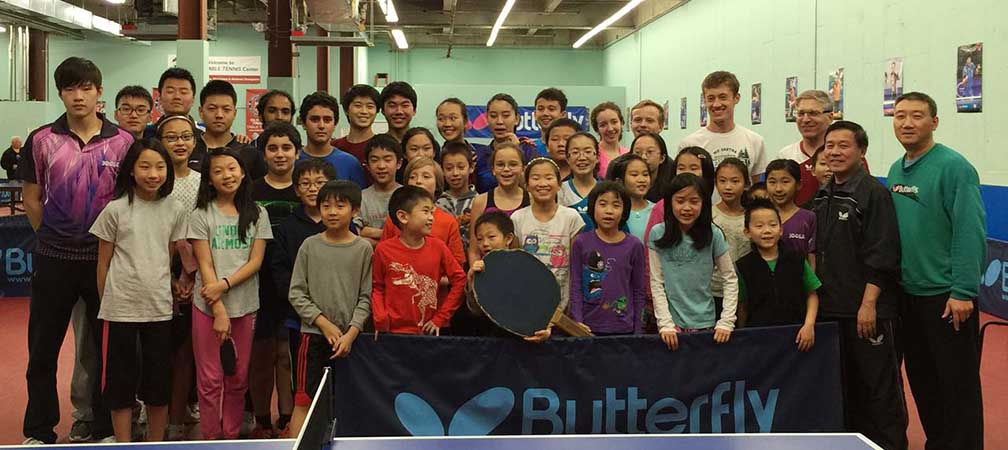
Here's a group picture. It's a mostly Chinese group, but if you look closely you'll find six non-Asian players.

Westchester Open

MDTTC player and coach Ruichao Alex Chen won the four-star Westchester December Open this past weekend at the Westchester TTC in New York, defeating Michael Landers in the final, 7,9,7. (MDTTC player Nathan Hsu also made the final of Under 2500, losing to Kun Yang in the final, 5,-9,15,9.) Here's a video of the final (19:03). Here are the results. Here are photos by Glen Randmer and Warren Rosenberg.

Smash Table Tennis in Sterling, Virginia

Another full-time club in my area - Smash Table Tennis! Here's a virtual tour (52 sec), and their Facebook page. There are now seven full-time clubs within 40 minutes of me! Here's what Director/Coach Mike Levene wrote to me about the new club:

At Smash Table Tennis there’s an emphasis on growing the sport recreationally and at grass roots whilst still providing top class training for elite athletes. We have top European player/coaches who are very keen to visit – Ryan Jenkins is one and we'll confirm his dates early in the new year– the space itself is high end and was a former Gold’s Gym. A recent review on Facebook reads “Smash Table Tennis is perhaps the nicest table tennis I have even seen! Perfect flooring, perfect lighting and a facility that is a departure from the usual industrial feel of a table tennis facility”. That said I am not done with improvements to date – I plan to further improve the lighting and add a large TV for our party/recreation/conference/after school room.

League results will be pushed to our web site within 24 hours; along with player statistics. Online player profiles are available here. Anyone can register and post their player profile and picture. Note public profiles are subject to approval.

Foot traffic through the center, exposing a new audience to Table Tennis will be significantly boosted by our resident/locally well-known and 5-star rated children’s entertainer “The Jelly Bean Queen” – the creator of Balloon Man Table Tennis. The Jelly Bean Queen is 100% exclusive to Smash Table Tennis.

Being next to “Spunk”, a popular local gym, we have had several visitors from the gym curious about our sport – one was genuinely amazed seeing my 14-year-old son execute a perfect kill shot this evening (the visitors timing could not have been better!!). Language lessons in our conference room will further draw people through our center. The first step toward growing our sport is finding ways to expose people to the sport.

For recreational players Smash Table Tennis is organizing periodic meet-up events. The first event has just been announced. Details can be found here.

Check out our holiday schedule, location, events and updates online at www.smashtt.com or on our Facebook page.

Interview with the Alguetti Brothers

Here's the interview by Rahul Acharya.

Great Lobbing and Counterlooping Point

Here's the video (35 sec) between Romain Lorentz and Yu Ziyang at Korean Open.

Best Ping Pong on TV and the Movies in 2014

Here's the article from Table Tennis Nation.

Wang Liqin and Ma Long Show

Here's video (9:18) from a year ago of the two putting on an exhibition.

Super Miss Ping-Pong?

Here's the picture!

***
Send us your own coaching news!

Tip of the Week

Brick-Wall Blocking Defense.

I'm Back!

Because of the USA Nationals and Christmas, I've been mostly away since my last blog on Dec. 15. Now I'm back to blogging regularly Mon-Fri, though I'll likely take Jan. 1 off like everyone else. However, writing this morning's blog wasn't easy - I was exhausted! I had done the Tip of the Week already, but when would I find time to do the blog and still make it to the MDTTC Christmas Camp this morning? Normally I'd just do it the night before, but I'd barely gotten four hours of sleep the night before, and could barely keep my eyes open. So I did something I normally wouldn't have believed possible - I went to bed last night at 8:30 PM, and got up this morning at 5:30 AM to do the blog. (Meanwhile, my todo list is roughly from here to China and back.)

Christmas Camp

We're halfway through MDTTC's 23rd annual Christmas Camp, which we've done every year since we opened in 1992. We've got 30+ players in the camp, mostly junior players, from beginners to 2450, with coaches/practice partners myself, Cheng Yinghua, Jack Huang, Zeng Xun ("Jeffrey"), Wang Qing Liang ("Leon"), Chen Bo Wen ("Bowen"), Chen Ruichao ("Alex"), Raghu Nadmichettu, and Han Xiao. As we've done for the last three years or so I'm working with the beginners. So far we've focused on forehands, backhands, and serves. Today I introduce pushing. I'm also going to bring out the adjustable serving device so they can work on serving low. This week's group seems especially fascinated by spin serves, so we're working on that a lot. Camp started on Dec. 26 and ends at 1PM on Dec. 31 (Wednesday).

USATT Election

As most of you know, I ran for the USATT Board. The voting ended on Dec. 27, with the results to be announced on Jan. 7, nine days from now. I'll post the results here when they come out. And now, with voting closed, I can post my real plans - heh heh heh!!! (Shouldn't board members automatically be rated higher than mere USA team members, get huge salaries and bonuses, and have statues of them erected at USATT expense? C'mon, who could be against any of this?)

USA Nationals

If I'd taken notes I could probably write about the Nationals for weeks - but I was busy coaching and attending meetings most of the time, and at this point much of it is already old news. Congrats to the Men's and Women's Singles Champions Jim Butler and Lily Zhang! Here are the complete results. (Use the dropdown menu to see complete results for each event - every match!) Here's the Men's Singles Final (1:11:33) and the Women's Singles Final (35:33).

I was especially happy to see 12-year-old Crystal Wang (from my club) make history by becoming the youngest player ever to reach the final of Women's (or Men's) Singles, upsetting top-seeded Zheng Jiaqi in the semifinals (here's the video, 44:46), as well as becoming the "second youngest" player ever to win Under 22 Women's Singles. (Who was the youngest? Crystal winning it one year ago at age 11!) Han Xiao, also from my club, made the semifinals of Men's Singles. It's promising that two juniors made the final of Men's and Women's Singles (Kunal Chodri and Crystal), though it says something of the state of our top men right now that 43-year-old Butler was able to win.

I'm not going to write about the matches I was coaching; that's mostly between me and the players I coach. But there was one humorous event I can report on. I was looking for Nathan Hsu and couldn't find him at the table he was supposed to be at. So I called him on his phone. He was sitting about ten feet away, with Chen Ruichao ("Alex"), who is pretty big, sitting between us so I hadn't seen him.

In a ceremony after the Men's Semifinals, Nathan Hsu received the Wasserman Award and $1000 for winning the 18 & Under Wasserman Championships, held at the South Shore Open a couple months ago. During the presentation, Si Wasserman read a poem that he said the editor several years ago refused to run. For the record, I wasn't the editor at the time and I'd never seen the poem!!!

As usual, there were ringers galore. Two were from my club. One was 13-year-old Klaus Wood, rated 1747 from a year ago. He's been living and training in Taiwan most of the last few years, and from his results from last year really should have been rated well over 2000 even then. He won Under 1800 and Under 2000 (the only two rating events he was in), beat a bunch of 2300+ players, and came out 2370. (He started out in one of my beginning junior classes a few years ago!) Another was Daniel Sofer (just turned 10), who was listed at 1423 for the Nationals (though he'd jumped up at the North American Teams a few weeks before), and who started out slow at the Nationals but finished strong, winning all three matches in his Under 1800 round robin despite being the last seed. (I coached those nail-biting matches - deuce in the fifth, 11-9 in the fifth, and deuce in the fourth.)

Overall it was another well-run event. Special thanks goes to USATT, North American Table Tennis, and all the staff, volunteers, and officials who put it together and ran it.

USATT Board Meeting and USATT Assembly

I attended (as a guest) most of the USATT Board meeting held at the Nationals, 9AM-4PM on Tuesday, and 9AM-3PM on Wednesday. Over the years I've attended about 70 of these. The meeting was open to anyone (except for a short closed session where they presumably discussed personnel matters). It was the first board meeting for new CEO Gordon Kaye. I think he surprised many on the board by how ambitious he was on many issues, ranging from turning the Open and Nationals into premier events to various membership proposals. Board discussions ranged from budget items (there's a budget crunch, mostly due to USOC cutting funding for next year and magazine advertising shortfalls), what to do about boosting (which is similar to speed gluing but nearly undetectable), the idea of a discounted membership for non-tournament players (who could buy unlimited tournament passes), and how best to professionalize the sport for the top players. On the latter I spoke up and pointed out that there is a specific timetable. We have the strongest players in roughly the age 12-14 range in our history right now - it's not even close - and in about four years if we don't have professional table tennis we're going to lose most of them.

I think Gordon (or Gordy, as he prefers to be called) is trying to break the CEO/Board dysfunctional impasse we've had for many years. For decades the USATT CEO has been reluctant to take action to develop the sport without the Board first directing him to do so, and the Board has been reluctant to take action to develop the sport without the CEO taking the lead. Result - status quo.

Here's my overall review of the board meeting. It's the first one in decades where I wasn't depressed afterwards.

After the Board meeting, from 7-9PM on Tuesday, was the annual USATT Assembly. Attendance wasn't great - only about 35 attended. After a few reports, the meeting went into question and answer mode. There were a number of unhappy members with pointed questions and observations about the state of USATT. Gordy and USATT Board Chair Mike Babuin did a pretty good job in responding to them. The simple reality is that when it comes to developing our sport, USATT has been dysfunctional throughout its history. Let's hope that is ending now.

The two candidates for office were each given three minutes to speak to the group. Alas, Jim McQueen (my opponent in the election) didn't attend the Nationals, and so didn't give a speech. I gave an overview of the items I'm focusing on (see my Election page). I had a little fun at the start where three times I pointed out something about myself, then observed that Jim had matched or topped me there. (I've been in the sport nearly four decades - but he's been in it at least a decade longer; I'm in the Hall of Fame - but so is he; I was editor of the magazine for twelve years - but he's the current chair of the editorial board.) But most of the speech was about the issues I want to pursue.

My Seven Years at San Francisco Airport

After the Nationals I flew to Eugene, Oregon, for Christmas with my family. Or rather, I tried to. Instead I got stuck at San Francisco Airport, which will forevermore be my nemesis. Here's a rough breakdown of what happened on Dec. 22-23, 2014. (One strange thing about all my flights to the Nationals and for Christmas - for the first time in over a decade security didn't require me to remove my shoes or belt.)  

  1. Arrived San Francisco just before noon on Monday, Dec. 22.
  2. Discovered that my 1:30 PM United Flight had been cancelled. (I was told this was because of fog at other airports which had caused delays, and they had been forced to cancel a number of flights to catch up.)
  3. Went through customer service, standing in line from 12:10 PM to 2:20 PM: 2 hr 10 min.
  4. While in line spent 45 minutes on phone with United. Was put on the 8:53 PM flight. Had to stay in line however so I could get standing boarding passes for two earlier flights.
  5. 4:00 PM flight delayed 45 min, couldn't get on by standby.
  6. 5:37 PM flight delayed 80 min, couldn't get on by standby.
  7. My 8:53 PM flight cancelled around 5 PM.
  8. Spent another 45 min on phone with United agent arranging a flight to Seattle and then Eugene, only to be cut off while on hold. She never called back.
  9. Spent still another 45 min on phone with another United agent, who said the flight to Seattle was now full, and the earliest I could catch a flight to Eugene would be about 9PM the following night.
  10. Second time through customer service: 1 hr 45 min standing in line. My legs still haven't recovered from these two long waits in line.
  11. Tried to buy a ticket by phone for an Amtrak train at 9:39PM, three hours to Portland, where I could then rent a car and drive to Eugene. But Amtrak was sold out. (Amtrak station is about 30 min from airport.)
  12. While at customer service the second time a spot opened up on flight to Portland at 10:40 PM. I booked the flight, and another flight to Eugene the following day at 12:30 PM (nothing earlier), arriving in Eugene a little after 1:00 PM. However, I managed to catch an 8:53PM flight to Portland on standby - first class window seat.
  13. The 8:53 flight to Portland had a problem and they couldn't use the plane. However, they got another in its place and it was only delayed 20 min or so.
  14. Got to Portland just after 11PM, caught a shuttle, and made it to the Radisson Hotel around 11:30 PM.
  15. Was shocked to discover United wasn't paying for the hotel. (I'll be contacting them about this and other compensation soon.) My bags presumably went to Eugene. All I have is my laptop computer and a few reading items. My cell phone and computer are running low on power.
  16. I considered renting a car and driving to Eugene (two hours), but decided against it.
  17. Flight was scheduled the following morning at 12:30PM out of Gate A7. Gate was jammed, no place to sit, so I sat at Gate A5. I got there 90 minutes early.
  18. Flight was changed to Gate 5, which was where I was sitting.
  19. Flight was changed back to Gate 7. After finding it still hammed, I returned to Gate 5.
  20. Plane was pulled due to mechanical problems. New plane was arranged to come in. Flight delayed to 1:10PM, at Gate 2. It was jammed, so I ended up sitting against the wall the last 30 minutes.
  21. Caught flight to Eugene, 40 minutes late.
  22. Made weird discovery. My cell phone had been almost out of power, down to a single bar out of four, with my recharging cord packed with my luggage. Somehow it was now back to three bars! Sort of reminded me of the story of the Hanukkah Menorah!

USATT Coach of the Year

Here's the USATT notice about nominations, which are due Jan. 5.

How to Develop the Habit of Winning

Here's the article from Expert Table Tennis.

Slow-Motion Serve Demonstration

Here's the video (1:14) by Samson Dubina.

Serving Secrets Introduction

Here's the new video (2:31) from PingSkills.

Athletes are Born and Champions are Made

Here's the article by USATT Hall of Famer George Brathwaite.

ITTF Development and Education Programs Continue to Innovate and Expand

Here's the ITTF article.

USA Pan Am and National Team Trials

Here's the info page for the Trials, to be held March 6-8 in Forth Worth, Texas.

Top Ten Craziest Table Tennis Shots of 2014

Here's the video (3:39).

The Tao of Ping Pong

Here's the video trailer (1:14) for the upcoming movie. Looks pretty interesting! "Fei Mo is an ambitious Chinese Ping Pong genius. In the midst of the U.S. Open Tournament, he unintentionally meets the superhuman American Ping Pong player Ethan White. When their contrasting personalities collide on and off the court, what appears to be only a game becomes a matter of life and death..."

Interview with Frank Caliendo

Here's the video interview of the table tennis playing comedian by Brian Pace, Part 1 (10:07) and Part 2 (10:14). Frank's been taking lessons, and is up to about 1800 level. (I played doubles with him a few months ago when he stopped by my club.)

The Comeback Story of American Table Tennis Champion Jimmy Butler

Here's the video (9:05).

Jan-Ove Waldner vs. Jim Butler

Here's video (9:11) of the two playing a game back in 1996, when both were at their peak. Butler actually once defeated Waldner in a match in the Swedish league, where I'm told Waldner took Butler on backhand-to-backhand - a tactical no-no but apparently something of a challenge for the Swede.

Table Tennis Grand Slam Champions Unite

Here's the article from Tabletennista, featuring the four members of "The Club," the four players who have won Men's Singles at the World Championships, Olympics, and World Cup - Jan-Ove Waldner, Liu Guoliang, Kong Linghui, and Zhang Jike.

Waldner is Sweden's Third Greatest Athlete of All Time

Here's the article from Tabletennista. Persson was 19, Bengtsson 61, and Appelgren 85.

Zhang Jike Salutes Wang Hao

Here's the article from Tabletennista. (Wang Hao just retired from the Chinese team.)

Quadri Aruna's Shoe Comes Off

Here's the video (9 sec) as the Nigerian (world #31) continues the point without his shoe.

Fantasy Pong

Here's the new artwork from Mike Mezyan. This sort of reminds me of the theme music to the 1989 World Championships, "Magic Ball" (3:09).

Lots of Rackets on the Grassy Knoll

Here's the picture!

Waldner Video

Here's the video (30 sec) of Waldner making a crazy shot and juggling balls, set to music.

Adam Bobrow Directing Aircraft

Here's the picture! Good thing he had a second racket.

Non-Table Tennis - Redcoats

Here's my humorous science fiction Christmas short story "Redcoats," set in post-Revolutionary America as we battle a new sort of Redcoats, published by Abyss & Apex on Christmas. (I got paid $60 for it!)

***
Send us your own coaching news!

USATT Election

USATT members, don't forget to vote!!! Here's my USATT Election Page. (You have to be at least 18 years old to vote.) I think we have to decide if the main purpose of USA Table Tennis is to develop table tennis in this country, or just maintain the status quo. If you believe as I do that it's to develop table tennis in this country, then I hope you'll vote for me.

If you're at the USA Nationals, stop by the USATT Assembly Tuesday night (7-9PM), where I'll be giving a short speech. Come to the Larry Side, we have cookies!!!

I resume Blogging on Monday, December 29

As noted below, I'm out of town at the USA Nationals and then a family Christmas. So the next blog will be after I return, on Monday, December 29.

Tip of the Week

Backhand Footwork. (Some of this is a rewrite from my blog last Friday, but I've added to it.)

USA Nationals, and Last Blog Until after the Nationals and Christmas

I'm off to the USA Nationals early this morning with a group of other Marylanders - and so am writing most of this the night before. I'll be back next Sunday night, but only for a day as I leave the following morning for a family Christmas gathering in Eugene, Oregon. (Yeah, I'm flying coast-to-coast on consecutive days, don't ask.) So this will be my last blog until Monday, Dec. 29, when I get back to daily blogging.

The playing hall at the Nationals will be open today (Monday) from 3-8PM. I land at 3:45PM, and will likely be at the playing hall around 5 or 6PM. Due to my recent back problems, I won't be hitting, alas. But I think I'll be ready for the hardbat events on Wednesday. (I normally play sponge, but at the major tournaments where I'm coaching I like to play hardbat.)

If you are in the tournament, this might help - Top Ten Ways to Play Your Best in a Tournament. Have you practiced your serves? Well, have ya???

While at the Nationals I'll be attending much of the USATT Board meeting (Tues 9AM-6PM, Wed 9AM-Noon). I want to emphasize something I wrote recently - that if I get elected, my goal is to help turn this Board and the new CEO into the greatest ones in history. I really mean this, and I want to be a part of it. The indications I'm getting so far is that the thinking is changing, and we might be ready to really tackle the serious problems faced in developing this sport.

I've been in a number of discussions recently about developing a Pro Tour. There are serious complications as there are more than one way to do this. If you have three ways of doing something successfully, and there are three contingents all insisting on their way, then you can't get more than 33% in favor of any one way! Of the five main issues I'm focusing on, this might be the most difficult. Ultimately, the best way to make a Pro Tour successful is to grow the sport, through leagues and other programs, so there is funding. If I'm on the Board, that'll be my focus. When you have 600,000 paid league players as they do in Germany, it's easy to support the top players. If we had 100,000 paid USATT members, or even 50,000, it would be easy to do so in the U.S.

Here's an informal goal: A successful professional circuit in this country - where the top players can make a living - by the time Kanak Jha (and about ten other cadets who are chasing him!) is college-aged. So we have four years. Let's get crackin'! (Sorry, Kanak, we also plan to train this generation of cadets so well that in four years you're going to have some serious competition.)

And yet, with all my talk of pro circuits, leagues, state associations, and how to develop the U.S. Open and Nationals, the issue I'm personally most interested in is developing a USATT coaching academy. Well, of course! I'm a full-time professional coach from a club with seven full-time coaches. (The other six work longer hours than I do - they work incredible hours.)

In recent years I've worked mostly locally, at MDTTC in Maryland. But the sport in this country isn't getting better, and I finally decided I'd done enough talking about it, it was time to take action national to make things happen. I don't want my club to be a big fish in a small pond; I want my club to be one of many huge fishes in a huge pond.

At the Nationals I'm looking forward to finally meeting our new CEO, Gordon Kaye. I've spoken to him on the phone several times but have never seen him. It is my theory that he's just a disembodied voice, with the online pictures of him taken from Getty Images, with the whole plot orchestrated by RailStation. Soon I will get to test my theory.

Here's a list of some of the things I'm taking to Las Vegas:

  • Coaching notes
  • Rackets (sponge and hardbat)
  • Floor towels (for players playing on cement)
  • Table tennis clothing (including my "USATT Certified Coach" shirt from long ago)
  • Ten precious Nittaku Premium 40+ poly balls, the ball used at the Nationals but with limited supplies
  • USATT Election Flyers
  • TableTennisCoaching.com flyers
  • Flyer stands
  • My table tennis books and bookstands. The books will be on sale at the Butterfly and Paddle Palace booths.
  • Starting times schedule for players I'm coaching
  • Various folders:
    • USA Nationals folder
    • USATT Election folder
    • Table Tennis Professionals of America folder
    • State Associations folder
    • USTA folder (to show how tennis does things differently than USATT)
  • Laptop computer
  • Kindle full of great books. I just started "The Wise Man's Fear" by Patrick Rothfuss, the sequel to "The Name of the Wind," which I finished recently. I also have Tahl Leibovitz's "Ping Pong for Fighters" and Alex Polyakov's "The Next Step."
  • 500-piece "The Hobbit" Jigsaw puzzle - I plan to put it out somewhere for players to put together during the Nationals!

Things I'm Not Good At

Since some of you might be considering voting for me in the USATT Election, perhaps you should know the things I'm not good at.

  • Foreign languages, and remembering technical terms and names. (I think these all go together.)
  • Judging esthetic or fashion issues.
  • An irrational belief that people will respond more favorably to logical arguments than to emotional ones.
  • Dealing with Internet trolls and other time-wasters.
  • I often speak too fast. I took public speaking classes to overcome this for my group coaching.
  • Hearing when there's background noise. I hope I won't need a hearing aid someday.
  • Stiff and injury prone.
  • Demonstrating smooth strokes.
  • I see way too many movies in theaters - better than one a week. I must have low standards when it comes to movies. But the popcorn is great!
  • I'm a picky eater. No seafood, hamburgers, mushrooms, mushy vegetables, and if I don't recognize it, I don't eat it. I'm also a non-drinker, sometimes a problem in social situations.
  • Looking good in a suit. I can barely tie a tie - but I only wear one about once every few years (weddings and funerals).
  • I still use a flip phone. Once I go to a smart phone and am connected 100% of the time, there's no going back. I'm told "resistance is futile," but I'm still fighting this. Someday I'll weaken and life will never be the same. (I use the flip phone to take on challenges from my beginning junior classes.)
  • And here are weaknesses in my table tennis game - see "How to Play Larry Hodges"!

$1,000,000 ITTF World Tour Finals

The event finished yesterday in Bangkok, Thailand. Here's the ITTF home page where you can find complete results, articles, pictures, and video. Congrats to the champions - Jun Mizutani (JPN), Kasumi Ishikawa (JPN), Cho Eonrae/Seo Hyundeok (KOR), and Miu Hirano/Mima Ito (JPN)! (As noted in previous blogs, the top Chinese didn't play enough Tour events to qualify for the Finals.) Here's the ITTF Press Release on the two 14-year-old Japanese girls (Hirano/Ito) who won Women's Doubles. Here's the ITTF Press Release on Japan sweeping both singles titles. Here's the Day Four Daily Review (4:50). And don't forget to check out the daily Shots of the day for Day One, Day Two, and Day Three!

Newgy Coaching Articles

Here's the page - I count 114 coaching articles (!) including ten by me.

Ask the Coach

Here are all 47 "Ask the Coach" videos. (By the time you read this there might be more!)

International Table Tennis

While I'm away at the Nationals and for Christmas you can keep track of USA Table Tennis news at the USATT News Page, and all the International news at TableTennista (which especially covers the elite players well) and at the ITTF home page (which does great regional coverage).

Another Reason the Serving Rule Needs Fixing

Here's a thread with links to pictures showing more hidden serves at the European Championships. These aren't isolated incidents - it's common all the time. That's why I want to change the rule to, "Throughout the serve, the ball must be visible to the opponent and to both umpires, or where the umpires would sit."

Scott Preiss "The Ping Pong Man" and Jimmy Butler on Live with Regis and Kathie

Here's the video (4:04), which just went up though I think this was from 1996, after Jim made the U.S. Olympic Team.

Atlanta Beats JOOLA in 2014 North American Teams Championships

Here's the article, along with pictures and video.

USATT CEO Pays Visit to Sports P'ville 'Mecca'

Here's the article.

Washington Post Style Invitational: Think Up a New Radio Channel

Here's the article and graphic. So what was the #1 example used? "Ping-Pong Radio: Play-by-play and analysis of global table tennis tournaments. Station doubles as a metronome if commentary is disabled."

Model Pong?

Here's the video (75 sec) from Spin NY that features "A night of very unique entertainment featuring 'Model Citizens Benefit Match' between Kenza Fourati and Amanda Salvato."

Santa Pong?

Here's the picture!

Bird Pong?

Here's the repeating gif image! This really should be on the home page of some club.

***
Send us your own coaching news!

USATT Election

USATT members, don't forget to vote!!! Here's my USATT Election Page. (You have to be at least 18 years old to vote.) 

SPUR USATT Growth and Filling Up a Club

How do you SPUR growth in USATT? This has always been one of my favorite acronyms. SPUR, or more properly S.P.U.R. stands for:

  1. Show the sport
  2. Play: get them to play
  3. USATT: get them to join
  4. Rejoin: get them to rejoin

If you do three of these things, you generally won't succeed. (This is for USATT growth; you can replace the USATT part with something else if that's what you are trying to grow.) It's like a chain missing a link. I try to incorporate all four in programs I propose to USATT, or have programs that, working together, do all four.

Many don't understand the concept that to grow the sport, you don't just look for places where there are already players and then set up a club or league. (Though you do want to continue to grow those areas until table tennis is outrageously popular there.) You set up clubs and leagues and other activities to create a player base. That's how the sport grows.

And yet I'm always hearing the following:

  • "There aren't enough players for a league."
  • "There aren't enough players for a club."
  • "There aren't enough players for a training center."
  • "There aren't enough players for a full-time coach."
  • "There aren't enough players for the sport to be big in this country."

All I can say when I hear this is Jeeeeez!!! These are the people who are living in the status quo mediocrity that's been accepted for so many years in our sport, at least in the U.S. You grow the player base, and that's how you get enough players for the first four items above, and this all leads to the final item.

To grow the sport does mean finding solutions to problems, such as how do you get players into a club? (That's #2 in SPUR.) There's a great quote about this type of thing:

"Complaining about a problem without proposing a solution is called whining."
-Teddy Roosevelt

So what is the solution to filling up a club? The two best ways are leagues and coaches. If your club has a singles league for all levels, then you can fit new players into it right from the start, and they become regulars. If you don't have such a league, and instead have the common "call winners" club concept, then new players call winners, get killed by regulars, and you never see them again. So you need a league if you want to keep these new players and turn them into regulars.

The other way is with coaches bringing in players. A key to all this is understanding the purpose of a table tennis coach in an area where there aren't many players. You don't want a coach who just sits around waiting for students - how does that help the club increase the number of players? You want coaches who are out there bringing in new players as students - and thereby filling up the club. It is this implicit deal between clubs and coaches that has led to the success of many - the coaches bring in the players (who pay for memberships, tournaments, leagues, group sessions, equipment, refreshments, etc., and thereby finance the club) while the club lets the coaches keep most of their money in return for them bringing in players.

It isn't always like this - once a club is successful (i.e. full of players), or if they have a major sponsor (rare), then they no longer need their coaches to be out there scrambling for students. (The best clubs with the strongest players have elite coaches who aren't scrambling for students, but are instead working with the best players and developing them.) But coaches looking for students, and thereby filling the club, is what's needed at the start. They need to be out there doing exhibitions at schools (including Asian schools on weekends), talking to the press, and going to rec centers and churches. They need to have flyers or business cards to give out everywhere, always trying to turn potential players into regular players at the club.

So let me re-iterate: A primary purpose of a coach for a new full-time club is to bring in players.

Backhand Footwork

I've been having my students do a lot of backhand footwork training recently. This is one of those things that a lot of coaches have their students do enough of. I think I've figured out why.

The most basic backhand footwork is no different than forehand footwork - you put the ball side to side, and the student moves side to side and hits backhands. (There's also in-and-out footwork.) This is exactly what a player has to do in a game when covering the backhand side with the backhand, so why don't more coaches do this? Most often when students do backhand footwork drills it's incorporated into a drill where they are also doing forehand footwork, such as side-to-side footwork, where they alternate forehands and backhands, or other variations that mostly have the player move from the forehand side to the backhand side to hit a backhand. But players also have to move around on the backhand side to hit backhands, and need drills to cover. In fact, it was backhand footwork training that Eric Owens attributes as the primary reason he upset Cheng Yinghua in winning Men's Singles at the 2001 USA Nationals.

What happens with many coaches is this. At the beginning stages, players focus on just the strokes, and so don't do footwork. When they can do footwork, they might do some backhand footwork. But soon the forehand becomes the dominant shot, and so the players focus on moving around and attacking with the forehand. Often the backhand isn't as developed, and so the coach doesn't want to push the player into doing too much movement while doing backhands as they think it might hurt the stroke. This is especially true of intermediate players making the transition from standard backhands to topspinning the backhand - and so the backhand is often in a perennial situation of being behind the forehand in development. And so the coach focuses on forehand footwork while focusing only on technique on the backhand side as the backhand develops into a topspin attacking shot.

By the time the player does have a solid topspin backhand, both the coach and the player aren't in the habit of doing backhand footwork drills in their sessions, and so they just don't do them. And this can lead to a weakness in the player's game as they don't move around as well as they could in covering the backhand side. This is a problem as the backhand by its very nature is a more cramped shot, with the body in the way, and so being able to move about and attack with the backhand is key.

A version of this will likely be the Tip of the Week on Monday - sorry in advance for any redundancies!

Back Injury

On Wednesday I wrenched my back pretty badly. I didn't realize at the time how bad it was, but on Thursday morning when I got up I could barely move. Even feeding multiball is like having a knife in my back. So I've had to cancel all my coaching through Sunday. (I leave for the U.S. Nationals on Monday morning.) It seems like I always get injured just before the Open or Nationals. It's like clockwork. Alas, pain killers never seem to work on me.

So if you see me at the Nationals and I'm sort of hunched up, or walking funny, or noticeably even stiffer than usual, now you know why. Thank god for wheeled playing bags! I am entered in two hardbat events, but I don't play until Wednesday, so we'll see if I'm at all recovered by then.

USA Nationals

They are next week, Dec. 16-20, in Las Vegas, Nevada. I leave for them Monday morning. (I should still get one last blog and a Tip of the Week in on Monday before leaving.) Here's the home page for the event. Here's an alphabetical listing of all 761 players, and here's a listing by event. (Make sure to set dropdown menu to "2014 US Nationals.")

I checked with USATT, and the playing hall will be open for practice on Monday from 3-8PM. I arrive at 3:45 local time, and will likely be at the playing hall soon after.

It's going to be a busy trip for me, probably made worse by the back injury I wrote about above. I'm mostly there to coach (that'll take up most of my time), but I'm also in two hardbat events (we'll see about that) and a lot of meetings. Official meetings I hope to attend include:

  • Board meeting, Tue 9AM-6PM, Wed 9AM-noon, room N251
  • USATT Assembly, Tue, 7-9PM, room N245-247
  • Officials & Rules Committee: Wed 7PM room N247
  • Hall of Fame Banquet: Thur 6:30PM

I've also got meetings for the Table Tennis Professionals of America; to demonstrate Createspace (for would-be table tennis authors); and with someone who's apparently writing a training center manual. Plus I finally get to meet that disembodied voice better known as the new USATT CEO Gordon Kaye!

Here's an assignment for all players going to the Nationals (and really for all readers): Read the rules. It always astonishes me how many players have never done so. If you do it just one time, you'll have a better idea of just what's in there - and some of it might surprise you! Here are the ITTF Rules.  

$1,000,000 ITTF World Tour Finals

The event continues today, Dec. 11-14 in Bangkok, Thailand, with Men's and Women's Singles and Doubles. Here's the ITTF home page for the event where you can get results, articles, pictures, and video. USA's own Adam Bobrow is, as usual, doing the TV commentary. Here are player bios.

PingPod #42 - Change the Service Rule

Here's the new episode (8:28). (Here's a text version.) At 3:09 (and in the text version) they refer to my serving proposal, but leave out a key part. My proposal isn't that both umpires must be able to see the ball, but the following: 

"Throughout the serve, the ball must be visible to both umpires, or where the umpires would sit if there were umpires."

The second part is key, since most matches do not have umpires. And just as the purpose of the 6-inch toss wasn't to make players toss the ball six inches but to make sure they weren't serving out of their hand, the purpose here isn't to make players serve so the ball is visible to both umpires (or where they would sit) but so that the ball is clearly visible to the opponent - which is the result of this rule. (I didn't originate this idea, but I'm hoping to push it through.) 

Ask the Coach

Episode 47 (20:01) - Pick the World Tour Grand Final Winners

  • Yesterdays #PQOTD  - 1:04: Do you remember your first tournament?
  • #PQOTD  - 4:18: Write down the Mens & Womens Singles World Tour Grand Final Winners as a comment on the Blog to this show and win a free 1 Month Premium membership. First to name both winners on the PingSkills blog wins. You are only allowed one guess.
  • Question 1 - 6:27: I heard the term "dummy loop" on some table tennis blog that I can't quite recall. It had a vague definition and I couldn't quite grasp the concept. What is it? Sawyer Meverden
  • Question 2 - 10:00: I see a few players serving with a "pick axe” motion a shakehand version of Wang Hao's service. I don't understand why a professional is serving this way, because there seems to be hardly any wrist action. I must admit that they are hard to read. Dieter
  • Question 3 - 13:28: I have been unable to return balls which dribble over the net. Often they are hit hard and I am expecting them to come fast and far back. Is it possible to increase reaction speed to the point that you could lunge forward and return it? Adam
  • Question 4 - 15:40: Some friends of mine said that my game is very predictable, like hitting the ball back right at where it come from, and some other stuff. I often lose because of this. I'm a looper, and how to fix this? Erriza

International Table Tennis

Here's my periodic note that you can great international coverage at TableTennista (which especially covers the elite players well) and at the ITTF home page (which does great regional coverage).

Topspin Charity

Here's a photo gallery from USATT of the event held this past weekend at the Metropolitan Pavilion in New York City. Top players included Sean O'Neill, Lily Yip, Ariel Hsing, Erica Wu, Wally Green, Kaz Yakoyama, and a host of celebrities - go through the pictures to find out who! And here are three pictures of Joel Roodyn on his way to winning the tournament they held (presumably the "celebrities" event).

Inclusion Table Tennis

Here's the USATT News Item.

Table Tennis on Reuters

Here's the article, Table Tennis: the Addictive Spin. "Table tennis bounces as effortlessly as its little white balls through all sorts of venues, from church basements to the Olympic Games to urban social clubs for the ultra cool."

Dangerous Beauty

Here's the latest table tennis artwork by Mike Mezyan - but how do we teach footwork to this fiery pong player?

Xu Xin Under-the-Leg Shot

Here's the video (18 sec), and check out the sidespin!

Don't Forget the Ball

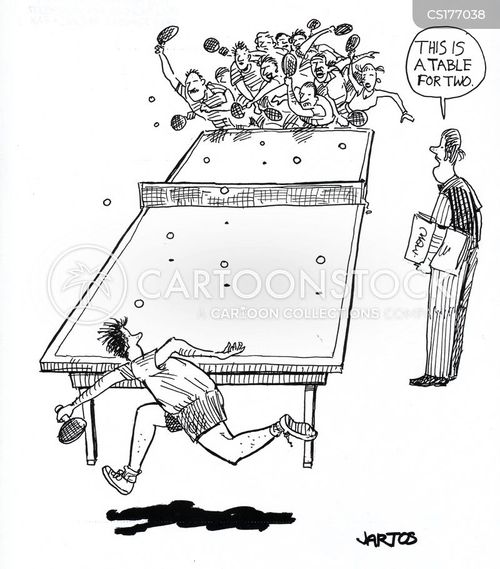
Here's the table tennis cartoon!

***

Send us your own coaching news!

Table Tennis Professionals of America

I've started work on Table Tennis Professionals of America (TTPA). This would be a USA professional players organization, sort of like ATP in tennis but for U.S. players. The primary goals are a professional circuit in this country within four years, where top players can make a living, as well as an upgraded U.S. Open and Nationals. I've finalized a draft (is that a contradiction?) on its creation, including funding (top priority at the start), plans, and goals, and will meet with some players about it at the Nationals. (I've had some busy messaging sessions the last few nights over this.) I'll go over the plans publicly at some future date, but not at this time. (We will be soliciting an Executive Director - are you interested?) For this program, I need USATT's cooperation, not their funding, which will be a lot easier if I'm on the board. I blogged about this on December 2 and of course it's something I promised to do in both my election mailings and on my Election Page. If I'm not elected, well, I'll still get this one done, maybe others.

Wednesday Coaching

I had two of my students spend some of the session watching our top players train - nice, fluid shots, as I want my players to have. Daniel (10, about 1600), for example, tends to back up too much when forehand looping and then reaches forward to sort of lift the ball up with his upper body. By staying a little closer to the table and taking the ball later (in relation to his body), he gets more body rotation (i.e. a power from entire body, from legs on up), and a much nicer stroke, with more power, control, and less stress on the arm. (He's had arm problems.) He always starts sessions looping a bit awkwardly, but as we get into it his shots get better. I'm worried that at the Nationals next week, under pressure, he'll fall back into old habits rather than the "good" ones. (And he's probably reading this - aren't you, Daniel?) We'll make sure he gets a good warm-up.

Several students have been having trouble smashing high balls, so we did a lot of smash against lobs and fishes yesterday. ("Fishing" is sort of a low lob.) It was fun for me as they ran me around the court. Toward the end I gave play-by-play commentary during the points. We also played several points for the "world championship." Yes, I'm the world champion, I won it fair and square.

Something historic occurred yesterday. I was doing a drill with Matt (13, about 1700) where he serves backspin, I push back randomly, and he loops. Over about a ten-minute period at least half his serves were net serves, nicking the net. It got to be incredible! Twice he served four net serves in a row. One of those times, after doing four in a row and then serving a non-net serve, he followed with three more in a row. (He only served a few into the net.) He rarely did two "clean" serves in a row as over and over his serves nicked the net. When I commented on how incredible it was getting to be, instead of falling back to the norm he began serving even more net serves! It went on and on and on, to the point that we could barely drill as we were laughing too hard, and there were just too many "interruptions" with so many net serves. In my 38 years, I don't think I've ever seen anything like this. Recently I've been stressing to him and others the importance of serving low, but this got to be ridiculous! (Side note - I'm calling them "net" serves to be clear, but technical they are "let" serves.)

About ten years ago I while hitting with a beginner we suddenly had seven consecutive net balls - he got a net, I returned with the net, etc., with him getting four nets to my three, consecutively. I don't think I've had another rally with more than three or four in a row.

My arm, neck, back, and the rest of me are holding up, but sometimes I feel like I'm moving like a 70-year-old. I need one of those portable telescoping rods that pick up balls for me. (Addendum added later - my back is bothering me this morning. This is worrisome.) 

Top Tournament Tactics

Here's the preview (3:58) of the new coaching video (1hr 49 min) from Brian Pace. "This video covers everything you will possibly need to know to equip you with how to exploit your opponent’s weakness and achieve victory." Topics covered include Tournament Play Analytics, tactics against attackers, defensive players, choppers, lefties, and short pips, tactics for serving, serve return, defensive play, and counter-attacking, how to coach tactics, and training with the pros.

Ask the Coach

Episode 46 (23:05) - Ovtcharov's Backhand Serve

  • Discussion - 0:45: There was talk on a local radio station about Table Tennis as an Olympic sport. Should it stay?
  • Response to Yesterday's #PQOTD  - 3:22: Why are left handers over represented on the World Rankings list? Xu Xin and Ding Ning are both number 1.
  • #PQOTD  - 5:19: Do you remember your first tournament?
  • Question 1 - 5:41: This one's for both of you. Do you have any signature serves? Brony
  • Question 2 - 7:55: Do the balls lose any quality of spin, speed or bounce after a certain amount of usage? Thanks guys. George Byron
  • Question 3 - 9:19: What happens if you make the ball touch the net twice or more during a serve? Lance Ramos Yeo
  • Question 4 - 10:47: When my opponent lobs the ball I can't hit the ball consistently and it just annoys me when my opponent takes the point. I mostly lose the point when the lobbed ball hits the table on the third line and I'm forced a bit away from the table. Utkarsh
  • Question 5 - 12:36: I noticed that Ovtcharov's backhand service are sometimes effective, sometimes not. Once when he executes this service, Ma Long easily returned the ball around the net and won the point. So what are the advantages and disadvantages of this serve? Viet
  • Question 6 - 15:24: I have a lot of problems when receiving heavy sidespin short serves. Since theres is almost no backspin nor topspin, what is the most effective way to receive? Michel
  • Question 7 - 18:04: ma long serve plz - Jerome
  • Question 8 - 19:47: I have been having trouble against the Ma Lin serve recently and was wondering if there's a good way to counter it - Tyler.

$1,000,000 ITTF World Tour Finals

Here's the ITTF Press Release. The event takes place Dec. 11-14 (starting today) in Bangkok, Thailand, with Men's and Women's Singles and Doubles. Here's the ITTF home page for the event where you can get results, articles, pictures, and video. USA's own Adam Bobrow is, as usual, doing the TV commentary. Here's the article from Tabletennista explaining why there are no Chinese players in the World Tour Finals: "Because they don't meet the criteria for this event: to attend to at least 5 World Tour events during the year." Here's sort of a video preview (38 sec) of the players there training for the event - how many can you name?

ITTF News Feed

Here it is, where you can keep track of all the ITTF press releases.

Top Five Rallies from the World Junior Championships

Here's the video (2:21).

The Ultimate Drop Shot

Here's the video (25 sec, including slow motion replay) by 2368-rated He Jiaming. Even his aced opponent, the 2732-rated Zhang Xiang, applauded the shot.

Jiaqi Zheng Preparing for 2014 US Nationals

Here's the video (36 sec) as ICC Coach Masimo Costantini feeds multiball.

Budweiser Commercial

Here's the commercial (31 sec) that features table tennis twice. At 13 seconds in, while giving reasons for friends to come over, a character says, "…play a little table tennis." At 25 seconds in, another character says, "We're all ready over here," as he waves arm toward basement ping-pong table with a sponge racket and ball on it.

Table Tennis Moon Launch

Here's video (16 sec) showing the future of the USA Space Program and its new moon launch capabilities. Alas, after six successful launches the seventh one ends in disaster, though all aboard survived as it crashed into the safety net.

***

Send us your own coaching news!
Tuesday Coaching and Neck & Arm Update

I only did an hour of coaching yesterday, but it wasn't easy - both my neck and arm were hurting. However, I don't think I'll have to miss any sessions over it. I have three hours of coaching today. If it does get to be a problem I'll bring in one of our top players/practice partners and they'll do the hitting while I coach. We'll see. (Ultimately, this is I'll have to do. I'm getting slower every year, alas.)

One of the two kids I coached yesterday is an interesting case. He's seven, and not at all serious about playing. He's the definition of a goof-off. I wish I had video of him back in January when he joined our afterschool program with all the desire, focus, and hand-eye coordination of a three-year-old. And now? No, he's not on track to be U.S. champion, but he's really beginning to pick it up. If I can just keep tricking him into learning without his realizing he's learning, next thing you know he'll be old enough to play seriously, and he'll have the foundation needed to reach a high level. He can even loop, in multiball, against either backspin or topspin. If he does reach a high level, the first time I hear someone say something like, "Oh, he's just talented" I think I'll tear my ears off.

USATT Stuff

Readers, I'm doing a lot of writing about USATT since I'm the election for the USATT Board. Bear with me on this for just a few more days, and soon I'll be back to blogging mostly on coaching issues! I'll be out of town for two weeks starting next Monday (coaching at Nationals and Christmas with family), and so won't be blogging after next Monday until after Christmas. Then I can go back to more coaching related issues, along with regular USATT updates, whether I'm elected or not.

USATT Committees

On my Election Page I wrote, "A few years ago most of the USATT committees had the word 'Advisory' added to their names, which emphasized that they are only advisory rather than action committees. That was a mistake. We need committees that get things done, not just sit back and advise."

Why was it a mistake? These committees need to work on a regular basis with the CEO as they implement programs to develop the sport. For decades when I talk to USATT people I've constantly heard about their plans, but the plan-to-implementation ratio is unbelievably high. Rarely are these plans actually put into practice. Even as I write this I know I'll be surrounded by people at the Nationals telling me about their plans - but that's the problem, it's always plans. This has gone on roughly since USATT was created in 1933. Often a lot of time and work go into these plans, just as a lot of work is done in advisory issues. And while we should be grateful for this work, there is something missing.

From the USATT Advisory Committee Responsibilities, it says:

"Advisory Committees (ACs) are, by definition, advisory in nature to the Board of Directors and the Chief Executive Officer (CEO). ACs are not policy making bodies but they can recommend policy and operating procedures to the Board or CEO."

The problem here is the emphasis is on advising rather than doing. Having an Advisory Committee advising the USATT Board or the CEO may sound nice, but who is going to do the actual implementation of these programs? The tiny, overworked USATT Staff? Rarely. That leaves volunteers - except they are stuck on Advisory Committees that are mostly advising!!! There's a reason why USATT struggles to implement anything. Contrast this with, say, USTA (tennis) or SFWA (Science Fiction Writers of America), two organizations I'm familiar with, which get a huge amount done using volunteers.

Now let's look at the Committee Responsibilities, from the same document. It says:

All ACs are expected to perform the following tasks:

  1. Submit articles to the magazine on a regular basis on topics relevant to their respective AC’s missions.
  2. Review and update all respective AC related materials on the website
  3. Submit web/blog posts to the webmasters on a bi-monthly basis. Posts should cover a topic related to the committee’s area of focus and be of interest to the general membership.
  4. Meet on a regular basis (suggested monthly) via web or teleconference to ensure continued progress on committee-related responsibilities
  5. Meet face to face annually at either the U.S. Open or U.S. Nationals/Annual Assembly, provided committee members are able to make the trip.
  6. Submit minutes of any meeting conducted for posting on the website. Minutes are expected to be submitted in a timely fashion, within 30 days of a meeting date
  7. Submit an annual report on committee activities in December of each year to the Board and CEO. Present and discuss the committee’s annual report at the subsequent Board meeting.

Read through this as many times as you need to convince yourself that there isn't anything listed there about implementation! The closest is #4 - but what are "committee-related responsibilities"? Ah, but we're getting that.

Further along in the document it gives more specific responsibilities for each of the Advisory Committees. Over and over you see words like "recommend" and "develop" and "review." ("Review" is a favorite, used 18 times. Apparently a lot of reviewing going on!) Rarely does the word "implement" occur - and where it does in the progressive committees, sadly nothing is really happening right now. Part of this is because of a lack of funding, but as I've shown in my blogs, there's a lot you can do with little funding by organizing and using volunteers.

Here are a couple of typical examples. From the Club Advisory Committee guidelines, it says, "Review the existing USATT club membership structure and advise the Board on the promotion, growth and support policy of clubs." So they will advise the board on this, but who is going to actually implement something to actually promote, grow, or support clubs? Or from the League Advisory Committee guidelines, where it says, "Develop plans to promote the growth of affiliated leagues." I haven't seen these plans, but if they exist, who actually implements them? I'm guessing we may actually have some good plans sitting around - but that's all they mostly do, sit around. I'm already in the process of implementing a local Capital Area League - or more specifically, two gung-ho volunteers I'm working with are doing it, both with experience in overseas table tennis leagues - and if it works, it could become a proto-type for a nationwide regional league that can spread everywhere, one of things I promised if elected.

Here is the list of USATT Committees. As I've blogged before, I divide USATT issues into "progressive issues" and "fairness issues." Both are important, but USATT tends to get bogged down on fairness issues and so never develops the sport with progressive issues - and those are the ones I want to focus on. Some of the committees I consider central to these progressive issues include the following:

  • Junior Advisory Committee
  • Senior Advisory Committee
  • Tournament Advisory Committee
  • Clubs Advisory Committee
  • League Advisory Committee
  • Coaching Advisory Committee
  • Hardbat Advisory Committee
  • Marketing & Fund Raising Advisory Committee

But notice - all eight of these committees are all Advisory Committees! Sure, they can take the initiative sometimes in progressive ways (as the Coaching Advisory Committee did a few years ago to adopt the ITTF Coaching Program, and as others sometimes do), but these committees are by definition advisory in nature, and so that's what they mostly do. We need ones that are progressive in nature, who will work together and with our CEO to develop our sport. These "Advisory" committees should be central to developing the sport in this country - but the emphasis needs to be on developing the sport, not advising on how to do it. Implementation is key.

There are also six Standing Committees. But five of them are clearly in the "fairness issues" department, leaving only one non-advisory committee in the "progressive issues" category - the High Performance Committee (HPC). So out of all our committees, we have exactly one progressive non-advisory committee. That needs to change dramatically. (Alas, I'm told the HPC budget is being cut dramatically next year due to USOC funding cuts. They will have to get creative.)

I'm told by one committee chair that dealing with the Board is a headache, simply because they are not really knowledgeable or even interested in their topic, meet infrequently, and you have to spend too much time trying to convince them of various things. Plans change, but it's difficult for committees to change once their annual plans are approved. From the Advisory Committee Responsibilities listing above, it says, "ACs will conduct their business in accordance within a budget that is approved by the Board on an annual basis." The problem is that the budgets are itemized, and so once it gets its annual approval, it's stuck in stone, unable to change without another board vote.

Once we have the right people in the right positions, we need to give them great freedom to do as they think best. The board still oversees when they choose, mostly at budget time, but as long as they stay within budget, I want committees to have the freedom to operate more independently, working with USATT mostly through the CEO. That may mean changing their plans in mid-stream when the situation arises, but so be it. At the least allow this with the go-ahead of the CEO rather than having to go through the entire board each time there's a change in plan.

Have You Practiced Your Serves Today?

The Nationals start in six days. If you are not going (what's wrong with you?) then you probably have other tournaments, league matches, or other important matches coming up. Have you practiced your serves? Well, why not??? Here's my article "Practicing Serves the Productive Way." Get to it.

Ask the Coach

Episode 45 (20:45) - Ma Lin's Awesome Flick

  • Discussion - 1:10: 2014 ITTF World Tour Grand Finals. The Draw is out.
  • Response to Yesterday's #PQOTD  - 4:30: In what year will a Non Chinese player win a World Mens singles championship? - 2031 :)
  • #PQOTD  - 7:09: Why are left handers over represented on the World Rankings list? Xu Xin and Ding Ning are both number 1.
  • Question 1 - 7:32: Can you explain to me the Ma Lin awesome flick? Nick V
  • Question 2 - 9:17: I am a defender, my opponent attacks on my forehand and I would play a very fast deep chop but my opponent just plays it short and I need to run for it. So is it right to play a fast, deep chop or should I play a normal chop allowing him to attack? Rutvik
  • Question 3 - 13:52: I struggle with my backhand topspin against loose/dead balls which are just dropping of the edge of the table. I also sometimes find myself doing the stroke either in slow motion or too much vertical, why? Mudit
  • Question 4 - 16:48: I played against a top player in my school. I lost points when he does a very fast topspin serve to my Backhand side. Sometimes I can return with an attacking topspin stroke. But then he increased the speed and sometimes put a little sidespin. Nicho

Core Muscles

Here's the article by Samson Dubina.

International Table Tennis Skills

Here's the promo video (1:20) for the new coaching DVD by Samson Dubina! And here is where you buy it.

Nittaku ITTF Monthly Pongcast - November 2014

Here's the video (12:48).

Pride of Africa Takes the World by Storm

Here's the interview with Nigeria's Quadri Aruna by Matt Hetherington

Jan-Ove Waldner Reflexes and Touch

Here's the repeating Gif image. Context: He was giving a point to the opponent (Primorac) because the Umpire had made a wrong decision in the previous point.

Toronto Maple Leafs Dion Phaneuf and Phil Kessel Play Ping

Here's the article from Table Tennis Nation.

Ping Pong Cakes and Cookies Ideas

Here are pictures and discussion - just in time for the holidays!

Lily Zhang and Prachi Jha Chewing on Their Bronze Medals

Here's the picture!

"Here's an empty table."

Here's the cartoon!

***

Send us your own coaching news!

Ringers at the Open and Nationals

I've had a few people email me about this problem. At every Open and Nationals most of the rating events are won by "ringers," i.e. players who are way under-rated. Most, though not all, are rapidly-improving juniors. Because of these ringers, some of the fun is taken out of competing in these tournaments. After all, when you play, say, an Under 1500 event, you expect to play players whose level is under 1500, or at least not that far over it. The reality, of course, is that to win a rating event at the Open or Nationals usually you have to play well over the rating cutoff. To have a chance of winning, you probably have to be at least 200-400 points over the rating cutoff of an event. (The lower the event, the more volatility and the more you have to be over the event's cutoff.)

I considered putting this down as one of the issues in my "Other USATT Issues" portion of my USATT Election Page and mailing. But in contrast with the other issues I did put there, there is no easy solution to this. All we can do are find "less bad" solutions. But we really do need to address this.

There are three main types of "ringers" at these tournaments. They are:

  1. Up-and-coming players - mostly juniors - who are playing tournaments regularly but have recently improved dramatically.
  2. Players who haven't played tournaments recently and have improved dramatically since their last tournament. Again, these are often juniors.  
  3. Players who intentionally dump matches to get their rating down for big tournaments. These are low-life scum.

There is little you can do (or perhaps should do) about players in Category One. They were legitimately under the cutoff, are playing tournaments regularly, but due to lots of practice have suddenly improved a lot, and now they are reaping the rewards. Congrats to them! Perhaps you can allow the tournament director or staff to rerate such a player once they realize how under-rated they are - but be somewhat lenient. If a 1000 player is playing an estimate 1500, perhaps let them play Under 1400 or even Under 1300, while taking them out of Under 1200 and Under 1100. Estimates are only so accurate, and you do want to let players compete when you can. Even if they are playing 1500 level they are going to have a tough time winning Under 1300 - they won't be the only ringer.

But there's a weakness to their new level, which experienced players can take advantage of, even if their level is no longer as strong - these rapidly-improving players are new to this level, and so under pressure are not always so good. They get nervous, they aren't sure what type of tactics to use, and they often either fall back onto old habits when it's close or begin to play wildly, as they aren't confident of their new level yet. Stick with them and keep it close (not always easy), and you have a good chance against them. (The downside is these players, mostly kids, usually have coaches - such as me - and we're pretty good at guiding them through these close matches. Sorry!)

What can be done about those in Category Two? There are several options.

  1. You can have rules that don't allow players to play in their lowest rating event if they haven't played a tournament in, say, six months. Or perhaps add 100 points to their rating for eligibility purposes (but not for seeding). The downside is many long-time players with legitimate ratings don't play that many tournaments, and so may object to not being able to play in their best events at the Open or Nationals. I tend to like this one. Perhaps require a player to play at least a certain number of "competitive" matches in the last six months, i.e. players rated within 100 points, so as to get a more accurate rating.
  2. You can run the rating events in reverse order, highest to lowest. If a player wins one event, he is no longer eligible for another. There are several problems here. First, it's a scheduling nightmare, and probably not feasible. (If not in sequence, you can still take players out of lower events, but then eligibility is often based on the order of events, which is somewhat arbitrary.) Second, suppose someone rated 1000 wins Under 1500 - then he can't play any lower events, and is out of U1100, U1200, U1300, and U1400? Suddenly it's not much of a tournament where he's taken out of four of his five rating events, and so not much is left for him to do in a five-day tournament. And third, suppose he loses in the final to some other ringer - he's obviously better than 1000, but by losing that final (because of an even better ringer) he gets to stay in U1100, U1200, U1300, and U1400. Suddenly it's sort of arbitrary, with eligibility for four events based on one match. (Strong incentive to dump even!)
  3. You can allow tournament directors or staff to rerate players who are obviously under-rated. They should be somewhat lenient here - when in doubt, let the player play an event. But if a 1000-rated player is beating 1800 players, at least rerated to 1600 or 1700.
  4. You can use a rating system with standard deviation, and not allow a player in their lowest events if their SD gets too high. This would be a complete revamping of the system, a possibility but not something I'm thrilled with. There are strengths and weaknesses to such a system, and which have been debated extensively - and I have no desire to get into another such debate.   

What can be done about those in Category Three, other than immediate expulsion from the human race? (I'm against execution, but it's a close thing.)

  1. You can use a player's highest rating of the past year for eligibility. But what about the poor player rated, say, 1350, who has one great tournament, gets to 1601, then drops back to 1400, and suddenly can't play Under 1500 or Under 1600?
  2. You can require that a player cannot drop more than 100 points from their highest rating in the past year for eligibility purposes. So if a player dumps matches and drops 200 points, he'd effectively only go down 100 points, and so wouldn't be able to really dominate that event. (Most likely he'd lose to a ringer from categories one or two - yay.)
  3. You can simply give the tournament director (or a tournament committee) the power to rerate a player they believe has been dumping.

You'll note that allowing a tournament director or staff to rerate a player is in all three categories, and I believe this should be allowed - but as noted, it should be applied leniently. But overall, there are no easy solutions. And yet, the current situation is worse than some or most of the above. I think the USATT Tournament Committee (and perhaps a much-needed USATT Ratings Committee) needs to really address these problems, with the understanding that there is no perfect solution.

Monday's Coaching

Once again we had the headache of keeping the various balls separate. Fortunately, with the World Junior Championships (Butterfly plastic balls) and the North American Teams (JOOLA plastic balls) both over, we're mostly down to players training for the USA Nationals next week (Nittaku Premium plastic balls, very limited supplies) and celluloid. I still have eleven of the dozen Nittaku Premiums I ordered a few weeks ago and I'm religiously guarding them. When I coach someone going to the Nationals we combine our balls and usually have over 20 - almost enough to do some quick multiball! I've taken to using the two tables in the far back corner, which are barriered off separately, so as to keep these balls apart from the rest of the club.

One of my students came in about ten minutes late. While waiting I was sitting on a sofa, with one of the cubicle shelves used for players to store their bags blocking my view of the door. I kept leaning forward and craning my neck so I could see the door to see if my student was coming in. I finally commented to others that their putting the cubicle there was going to cause me to wrench my neck, which would lead me to being unable to coach, which would leave me unemployed, leading to my living in the streets, penniless, hungry, and shivering in the cold. Sure enough, I did wrench my neck - I think I hurt it a bit while trying to watch the door, and aggravated it while coaching. So all last night my neck was stiff and hurting. I think I'll be okay - I only have one hour today, so I can mostly rest it. I've got a busy schedule Wed-Sun, and then I leave for the Nationals.

Christmas Stocking Stuffers

Looking for Christmas stocking stuffers for a table tennis player - or yourself? Here are a few suggestions.

Full-Time Coach Wanted

Here's the help wanted notice. "Full-time coach opening at Fremont Table Tennis Academy starting at the beginning of 2015. FTTA will need another coach to join its coaching team."

Coaching Articles by Samson Dubina

Here are two new ones.

Giving Advice During a Match

Here's the coaching video (7:27) from PingSkills - I don't think I posted this previously.

Ask the Coach

Episode 44 (13:46) - 10,000 counterhits

  • Response to Yesterday's #PQOTD  - 1:07: How many counterhits can you do in a row?
  • #PQOTD  - 4:04: In what year will a Non Chinese player win a World Mens singles championship?
  • Question 1 - 4:26: I see lot of discussions here on footwork but am not able to understand why it is required cus I have seen many players in my colony not using efficient footwork but can play very well. Chandrachur
  • Question 2 - 7:26: When using long pips what is the proper stroke to use against another long pips no spin ( dead) return assuming you are not going to twiddle to the inverted side? Should this stroke be only defensive or can it be use more offensively? Jeremiah
  • Question 3 - 9:48: How many sets are required to win a match? I thought that the game is 3 of 5 sets till 11 points, but now i see matches with 4 of 7 sets. Is it fixed value or depends on tournament or judges? Or rules are changed? Dimitar Dimitrov
  • Question 4 - 11:31: l bought a Grass D Tecs rubber last year and l am very happy with it , After playing a match this week my opponent was not happy , and produced a list of legal rubber which he stated it was not on his list and declared my rubber illegal. Robert Atwell

Barbara Wei Profile

Here's the feature on her from Butterfly. Barbara practically grew up at MDTTC, my club, starting at age 7, and eventually traveling the world as a member of the USA cadet and then junior team.

Great Rally

Here's video (28 sec) as Kalinikos Kreanga of Greece plays a great point. Among world-class players, I think Kreanga is the best at playing spectacular points.

Another Great Rally

Here's video (34 sec, including slow motion replay) of a great rally with a great finish between two kids.

Go All In - This is Table Tennis

Here's the video (1:42) of mostly junior training at a club, set to music.

Fundraiser in Florida

Here's the video (48 sec) "PongUniverse and The Florida Grassroot Table Tennis Association at the Pinellas County 2014 Annual Tennis Shoes and Tie fundraiser. Tropicana Field. Tampa, Florida."

World Chess Champion Plays Table Tennis

Here's the picture of Magnus Carlsen of Norway, care of Alberto Prieto.

Ping-Pong Balls in Mouth

How many? (Kids, don't try this at home; he's a trained professional. I think.)

***

Send us your own coaching news!
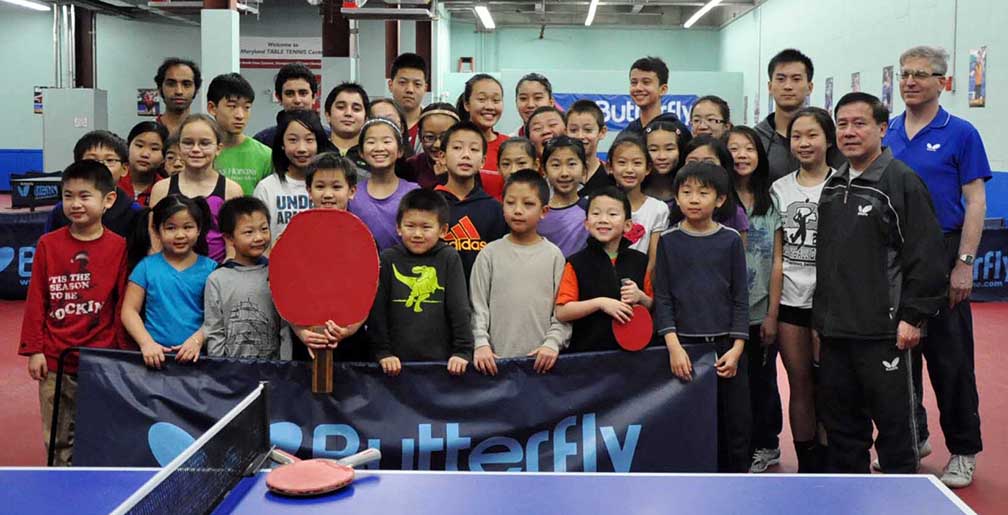
Tip of the Week

Keep Your Strokes Simple.

USATT Election

We're five days into the election. If you haven't voted yet, here's my Election Page, and here's the USATT Voting Page. Read over the various programs I will work on, and if you agree we need these things to develop the sport in this country, please vote for me. Equally important, ask others from your club to vote for me. Perhaps print out some of my Election Flyers to distribute!

I've heard some describe my plans as "grandiose," but they are only grandiose if I claimed I could get them all done, say, in my first year. I will do whatever I can to get the process started on all five the first year, and hope to have results to show after two. Four years in and I'll be up for re-election, and if I don't have good results to show at that point, then of course it's time to throw us scoundrels out. It really comes down to a Shakespearean question - to work to develop the sport, or not to work to develop the sport?

Two of my goals are to make the new CEO, Gordon Kaye, into the most successful CEO in our history, and to have this board of directors go down in history as the greatest ever - the equivalent of Eisenhower and "The Greatest Generation" after World War II. Let's get it done.

Nets and Edges

I've blogged about this before, such as on February 6, 2012. They don't even out - some styles do get more than others. I've tested this many times. Choppers, hitters, and blockers (especially those with deader surfaces such as long pips) hit with a lower trajectory, and so get more nets. Aggressive hitters and blockers hit the ball deeper on the table and so get more edges. Blockers who angle a lot get lots of side edges. So it is a matter of playing style. There is, of course, the argument that these players are playing a more aggressive style, playing life on the edge (yeah, pun intended, sorry) as they keep the ball low to the net, deep, and at wide angles, and so deserve those nets & edges - but then that's the argument, not that they all even out. Since they are hitting lots of shots dangerously near the net and table edges, they are also hitting a number of balls into the net or off the side. Some nets aren't as valuable as others - for example, choppers mostly hit the ball more slowly, and so it's not such a timing problem adjusting to their nets, plus since they are often off the table they can't always take advantage of your weaker returns off their net balls.

In the blog linked to above I was out net & edged 32-10. On Friday I blogged how two of my students beat me at it 19-8. This weekend Sameer decided to keep track of all nets & edges during our 90-minute session; he won 32-13. So for those three sessions I was out net & edged by a total of 83-31. Let me read that again: Eight-three to Thirty-One. That's a 52-point deficit. Of course, some would say it's a matter of level, but I used to keep track of this as well when I was developing and practicing regularly with Brian Masters, a future USA World Team Member and 1983 Pan Am Singles Gold Medalist. He was also rated higher, and would typically out net & edge me nearly 3-1 - but he was an aggressive Seemiller-style blocker who hit deep and at wide angles, with a low trajectory, and often flipped to the antispin on the other side. So he had all the ingredients for someone who would get lots and lots of nets and edges, and he did.

So, do you have the edge (sorry) with a net surplus (sorry) in the net & edge department?

China Sweeps the Medals at the World Junior Table Tennis Championships

Here's the ITTF press release for the championships that were held in Shanghai, China, finishing yesterday. Here's the ITTF home page for the event (results, articles, pictures, video). Here's the USATT page for the event, where you can see USA results (upsetting South Korea in the QF to get the bronze in Girls' Teams!), pictures, video, and lots of great quotes from the USA juniors. Here's the Boys' Singles Final (8:16, with time between points removed) between China's Yu Ziyang and Japan's chopper/looper Yuto Muramatsu. Here's the all-China Girls' Singles Final (6:14, with time between points removed) between Wang Manyu and Zhu Chaohui. (However, it was not all intense competition at the Junior Worlds as the world's best juniors took some time out to play with some school kids in Shanghai - here's the video - 69 sec.)

Kanak Jha vs. Kim Minhyeok

Here's the video (5:21, with time between points removed) of USA's Kanak Jha vs. South Korea's Kim Minhyeok in Round One (round of 64) of Boys' Singles at the World Junior Championships. (Kanak had to go through the Qualification RR to get there, while Kim was seed directly to the Final 64.) It's a nice match to watch, where you can analyze what each player did well and won or lost on. (I'll leave that as an exercise for you.) Spoiler alert - Kim wins the match 4-1, and wins the next two rounds 4-0, before himself losing 4-0 in the quarterfinals to eventual winner Yu Ziyang of China.

2014 North American Table Tennis Tour Update - ICC Stiga California Open

You can read about it and see pictures on the Bay Area Facebook Page.

Backhand Loop Technique Development

Here's the newest video (4:47) from Coach Brian Pace.

Ask the Coach

Episode 43 (16:55) - The New Plastic Balls

  • Response to Friday's #PQOTD  - 0:56: When should local clubs start using the Plastic balls?
  • Discussion - 3:56: World Junior Championships results, Chinese dominance and choppers.
  • #PQOTD  - 6:04: How many counterhits can you do in a row?
  • Question 1 - 6:16: After watching your demonstration of how to execute pure backspin on serving by contacting the ball underneath with a completely flat level bat please advise how you impart enough forward movement to get the ball up the table and over the net. Thanks. Les
  • Question 2 - 9:14: I am a penhold player, and I play at my local high schools, table tennis club, I have difficult doing a backhand when people hit the ball hard and fast, and also when they hit in the middle, How do I have a strong backhand while playing penhold grip? Ben
  • Question 3 - 11:00: I’m not sure if you guys have a video of it but i was wondering what the rules are when it comes to accidentally hit the ball with the finger or the racket handle, the ball goes over the net, and hits the other side of the table. Jayce Soberano
  • Question 4 - 13:30: I am having a hard time with my forehand loops. It seems that I am able to loop it because it is a long ball but when I hit it I feel very awkward because it feels like the ball is too close to the table for me to do a proper forehand loop. Any tips? Mark

USA National Team Trials

Here's the USATT article. "2015 Pan Am, National and Worlds Team Trials will be held on March 6-8, 2015 in Fort Worth, Texas at Texas Wesleyan University. Prospectus and entry form will be posted on USATT webpage soon." I'll probably be there coaching. 

Topspin Charity

Topspin Charity is having an event on Dec. 10 (this Wednesday) at the Metropolitan Pavilion in New York City. "Who else is counting down the days until our 6th Annual Charity Ping Pong Tournament in NYC?? Join us for an exclusive event at Metropolitan Pavilion that helps out children's education in your own city." They also have this nice picture!

Marty Reisman Feature from Spin NY

Here's the trailer (65 sec), with a full version coming by the New Year. "On December 5th 2014 SPIN NY celebrated the LIFE of the GREAT "MARTY REISMAN" American Ping Pong - Table Tennis LEGEND. This fabulous EVENT was held at the famous SPIN NY. It was attended by many of the TOP players in the US."

See the Light

Here's the latest table tennis artwork from Mike Mezyan. (And like this picture, table tennis in the USA is still in the jungle, but we're starting to see the light!)

Ping Pong: The Ultimate Social Networking Tool

Here's the article from Pong Universe.

Stone Age Concrete Table Tennis

Here's the new video (1:50) on concrete tables, some of it showing how they are made.

Ibrahim Hamato Recognized at Al Maktoum Creative Sports Awards

Here's the article on Hamato, who gained fame earlier this year as a guest of the ITTF at the World Championships where he played points with the best players in the world. He has no arms, and holds the racket in his mouth. Here's video (2:43) of him hitting with the best players in the world at the World Championships. (There's an Internet rumor that he died - that's false.)

Table Tennis Best of 2014

Here's the video (12:56)!

Serious Racket Throw

Here's the video (9 sec) as a player reacts to losing. Amazingly the opponent doesn't even react to his opponent's paddle whizzing by at high velocity. Equally enthralling is the mournful cry of "Nooooo!" by a spectator as the thrower loses the last point. Do you think the racket survived the journey? Do you think the player survived without penalty?

Underground Pong with Santa

Here's the video (11 sec)! They're pretty good, and since they are miners, can they play in the World Junior Championships? (Okay, I know, I know, it's "minors.")

Plate Pong

Here's the video (41 sec) of some incredible ball bouncing off plates into cups. It starts pretty simple but by the end it's pretty wild!

***

Send us your own coaching news!
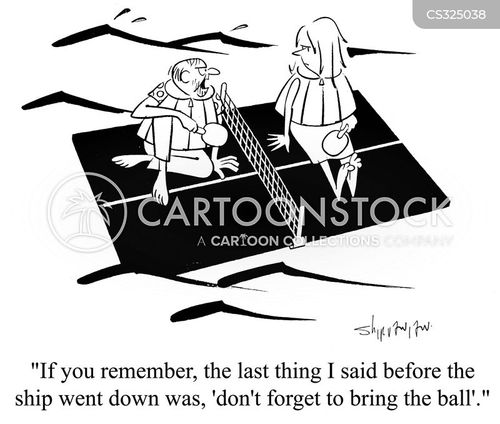
Election Stuff and Other Stuff

If you are sick and tired of reading about USATT and election stuff, jump past the first two items here! However, I think USATT members might be interested in the following USATT vs. USTA comparison.

USATT vs. USTA

I've pointed out for years how, when it comes to promoting and developing their sports, USTA (tennis, 700,000 members) seems to do so many things right, while USATT (8000 members) does not. As I've also pointed out, this is not the norm. Tennis is big in Europe, but in nearly every country there are more paid table tennis memberships than tennis. The U.S. is the big exception here. And yet we're so used to thinking of tennis as "big" and ourselves as "small" that we've come to accept it. But the only reason for this is that tennis does things right, and we don't. Here's a comparison.

Membership Rates

  • Adult Membership fee: USATT $49, USTA $44
  • Junior Membership Rate: USATT $25 (under 18), USTA $20 (under 19)
  • Family Membership Rate: USATT $90, USTA $72

USTA does have the advantage of large numbers that allows them to keep low rates, but low rates often lead to large numbers. I'd like to see USATT lower their rates to match USTA, with the idea that they would likely come out roughly even with the lower rate by getting more members this way. However, USATT is currently facing budget problems, and would be unlikely to lower the rates. Perhaps we can at least freeze them until USTA at least catches up?

USTA Membership Benefits

As a former member of USTA, I have a copy of their main brochure. What do they focus on? In order, this is what the brochure advertises:

  • Annual subscription to Tennis Magazine (a monthly print magazine)
  • Special access to discounted and early ticket sales for seats to the US Open and other major tournaments across the country.
  • Opportunity to participate in USTA League, the world's largest recreational tennis league.
  • Members-only savings on sports gear, hotel reservations, entertainment, and dining.
  • Travel discounts to major tennis tournaments around the world including the four Grand Slams.
  • Special benefits and discounts on tennis instruction and your next great vacation.
  • They also prominently advertise a US Open cap for those who join.

Also note that besides the regular brochure, they have a very nice brochure for the USTA League. Here's a picture, front and back - sorry about the poor resolution.

Let's also look at the USTA webpage and see what they offer:

U.S. Tennis Association ($44/year)

Membership Benefits

  • USTA Leagues & Tournaments
    From recreational leagues to tournaments offering the opportunity to qualify for a national ranking, the USTA provides play opportunities for players of all ages and abilities.
  • Top Tennis Publications
    Adult and Family members receive subscriptions to TENNIS magazine and Tennis Tuesday digital magazine offering tournament previews, insight into the professional game and its players, fitness tips, instruction and other features to improve your game. Junior members ages 11-18 receive Tennis Tuesday digital magazine, while Junior members age 10 and under receive Bounce.
  • Special Benefits at Top Tennis Tournaments
    Beat the crowds! USTA Members have special access to discounted seats and early tickets sales for the US Open, Emirates Airline US Open Series and other major tournaments across the country.
  • Savings & Discounts
    Enjoy a 10% discount on US Open and USTA merchandise, as well as, discounts on dining, travel, retail, and entertainment at well-known hotels, car rental agencies, restaurants and more.
  • Resort & Camp Program
    Bring great vacations and tennis instruction together with benefits ranging from free private lessons, room and package discounts, complimentary restringing and more.
  • US Open Travel Packages
    Steve Furgal’s International Tennis Tours, Inc. offers USTA Members packages to one of the greatest tournaments in the world—the US Open!
  • Tennis Tuesday
    Delivered weekly, Tennis Tuesday provides coverage of the sport from its most renowned players, top instructors, exciting personalities and talented writers.  Each edition offers compelling on- and off-court insight into the pro tours, and offers tips and techniques for players to improve their games, including racquet, apparel and gear reviews as well as compelling features and video instruction.

Now we compare this to USATT:

USA Table Tennis ($49/year)

Membership Benefits

  • Personalized help in locating clubs and coaches in all fifty states
  • Liability insurance during USA Table Tennis Sanctioned Events
  • Certification programs for Coaches and Officials across the nation
  • Discounts with Hilton and United for hotel and travel for USA Table Tennis Sanctioned Events
  • Ratings which allow you to compare yourself to other players who play in sanctioned tournaments. Ratings will be updated after information is received from each tournament.
  • Monthly newsletter
  • Bi-monthly digital Table Tennis Magazine

Quite a contrast, isn't it? USTA's biggest focus is on their print magazine, leagues, and US Open. USATT no longer has a print magazine, it doesn't have any sort of leagues to offer, and the US Open isn't something they advertise much. All this needs to change. (I plan to bring USTA brochures and their magazine to the USA Nationals to show at the USATT board meeting and USATT Assembly.)

USATT Election

If you haven't voted yet, now's a good time! Here's my Election Page, and here's the USATT Election page where you can vote.

I was up past 3:30 AM responding to 162 emails, all table tennis-related, almost all election-related. Lots of interesting comments! The most common theme was the call for the return of the print magazine.

If you are a USATT member age 18 or over, then you should have received the USATT election notice two days ago, and my email yesterday. (If you didn't, and you are sure you are a current member, then contact USATT to see if they have your correct email address.) However, not all adult USATT members received Jim McQueen's email of two days ago, and many former (but not current) USATT members did receive it. Based on a sampling of people from my club, I've come to the conclusion that the email list he used was probably from July, August, or September 2012. There's a member of my club whose membership expired on Sept. 30, 2012. He received the McQueen email, but not the other two. I found another who is a member now (and so received the emails from USATT and me), but apparently was not a member between June 30 and Sept. 30 in 2012, and did not receive the McQueen email. So presumably the email list he used was from July, August, or September of 2012. But we don't really know for sure. 

However, I don't plan to make an issue of this from this point on. I'm very much for transparency and do want to know what happened, but I also told USATT that if they allowed me access to their email list so I could also do a mailing by Thursday morning, that the issue would basically be resolved. They agreed, and so for me the issue is basically resolved.

One of the things I decided not to do in this election is use endorsements. I have a list of prominent players and people in the sport who have endorsed me in the election, but I'm not using those names. (I'm sure my opponent could get some as well.) Why? Because even the appearance of conflict of interest is a problem. The last thing I want is to appear to be favoring or to "owe" people for their endorsements. This doesn't mean individuals can't endorse my candidacy, just that I won't use them myself in the election. I was originally going to use them but I really want to think ahead to when I might be on the board, and decisions come up that involve them. Almost by definition many of them involve some of these prominent players or people. (I'm already planning to abstain from issues that directly involve Butterfly, since I'm sponsored by them - I put that in my application to be on the ballot.)

Regarding my own email to the membership yesterday, some of you may have noted it didn't have great formatting. I spent a lot of time creating it very nicely in Word (here's the original), but USATT uses a program called Constant Contact that lost much of the formatting. (Headquarters did the best they could to match my formatting, which I appreciated.)

Two of the coaches at my club had problems voting with their iPhones. When they tried to input the required date of birth, the dropdown menu wouldn't drop down - and without that, the software wouldn't accept their vote. They showed it to me, and I also tried it, but it wouldn't work. Both of them voted instead on an iPad. I know that the software was tested on other iPhones where it did work, so I don't think this is a widespread issue. (They both probably had the same make and model, and I'm told that the Chinese character set they have on it might have caused a problem.) Did any of you have trouble voting?

Thursday Coaching and Other Happenings

Thursday was a somewhat busy coaching day, with four hours of coaching. (For most of our other full-time coaches, five of whom coach at least 50 hours/week, this would have been a very light day!) In the junior class I taught the focus yesterday was on smashing, which of course is very popular among kids and non-kids alike. One question that always comes up is how much to enforce the "proper" grip. With smaller hands, kids often feel more comfortable with their hands lower in the handle, with their index finger more up the middle. But this leads to a floppy wrist and tightness in the forearm. However, some find it uncomfortable holding it higher. We often have to find a compromise. We do have some smaller kids rackets with smaller handles (which are easier to grip), but some of the kids don't like the smaller racket faces.

In two of my private sessions we had a contest to see who would get the most/least nets or edges. I've done this before, and I always get the least. Yesterday's results were actually among the closer results. In both cases we kept track for perhaps 15 minutes. Daniel got 10 to my 3, and Sameer got 9 to my 5.

On January 24, Saturday night, we're running a fund-raiser at MDTTC for Cystic Fibrosis. Sameer (13) is the driving force behind this. He and I will do a demo and exhibition, and then run a recreational tournament. The Baltimore Orioles promised to donate an autographed item, though they haven't said what yet. More on this later.

World Junior Championships

They are continuing in Shanghai, China, Nov. 30 - Dec. 7. Here's the ITTF home page for the event (results, articles, pictures, video). Here's the USATT page for the event, where you can see USA results, pictures, video, and lots of great quotes from the USA juniors.

Yesterday wasn't a great day for the USA juniors, with four of the five left in singles losing in the round of 64. In Girls' Singles, Prachi Jha lost 4-3 to Bernadett Balint of Romania; Angela Guan lost 4-0 to Soo Wai Yam Minnie of Hong Kong; and Crystal Wang lost 4-0 to Wang Manyu of China. Only Lily Zhang advanced, 4-0 over Giorgia Piccolin of Italy. In Boys' Singles, Kanak Jha lost 4-1 to Kim Minhyeok of Korea.

In Girls' Doubles, in the round of 32, Prachi Jha/Lily Zhang defeated Reem Morad/Aida Rahmo of Egypt 3-1, while Angela Guan/Crystal Wang lost 3-0 to Miyu Maeda/Hitomi Sato of Japan.  In the round of 16, Prachi Jha/Lily Zhang lost 3-1 to Ji Eunchae/Lee Zion of Korea.

In Boys' Doubles, in the round of 32, Kunal Chodri/Kanak Jha defeated Claus Nielsen/Tobias Rasmussen of Denmark 3-0, while Krish Avvari/Aashay Patel lost 3-0 to Tomas Polansky/David Reitspies of Czech Republic. In the round of 16, Kunal Chodri/Kanak Jha lost 3-0 to Liu Dingshuo/Wang Chuqin of China.

In Mixed Doubles, in the round of 32, Kanak Jha/Prachi Jha lost 3-0 to Patryk Zatowka/Natalia Bajor of Poland; Kunal Chodri/Crystal Wang lost 3-1 to Kilian Ort/Nina Mittelham of Germany; and Krish Avvari/Lily Zhang lost 3-0 to Asuka Sakai/Miyu Maeda of Japan.

So the only remaining USA player in the tournament is Lily Zhang, who is in the round of 32 in Girls' Singles, where she'll face Orawan Paranang of Thailand.

195 Tips of the Week

I just put in a direct link so you can browse all 195 Tips of the Week I've written since January 2011. You can buy the first 150 (2011-2013), formatted nicely by topic, in my book Table Tennis Tips! (Coming early in 2017: More Tips of the Week, with 150 Tips from 2014-2016.)

Ask the Coach

Episode 42 (17:31) - Table Tennis Strokes to Master

  • Response to Yesterday's #PQOTD  - 0:40: Should Table Tennis players use a tennis grip?
  • #PQOTD  - 3:22: When should local clubs start using the Plastic balls?
  • Question 1 - 3:40: I wonder how often i need to change my racket if i take care of it. Jasper Nokkosmaki
  • Question 2 - 8:33: It's clear that Alois and Jeff have mastered all the shots, forehand and backhand blocks, topspins, loops, flips and chops. But for the club player, should we focus on the few shots we are strong at or try to master all the shots? Mark Roberti
  • Question 3 - 11:02: Can you please explain the angles required to execute banana flip on short and low serve with large backspin and moderate sidespin on it? Parkash Rawat
  • Question 4 - 13:25: I am 13 I have started table tennis could I play international tt tournaments Gavish Pandya
  • Discussion - 15:00: World Junior Table Tennis Championships

International Table Tennis

Here's my periodic note that you can great international coverage at TableTennista (which especially covers the elite players well) and at the ITTF home page (which does great regional coverage).

Which is the Table Tennis Star Point of 2014?

Here's the video (4:05) from the ITTF. "Vote for which shot/rally you think should be the Table Tennis Star Point by going to ITTFStarAwards.com!"

Great Rally

Here's the video (27 sec) of this counterlooping duel between two top lefties!

Triangle Table Tennis

Here's a video (5:50) by Jim Butler that features the gigantic Triangle Table Tennis Center in North Carolina. (When I hear "triangle table tennis," I think of a triangular table tennis racket I once saw many years ago. But I was unable to find a picture of one online, though I did find this and this - triangular TT medallions.)

1938 Table Tennis Poster

Here's a picture of a table tennis poster near the end of the Calvin Coolidge Administration.

1971 U.S. Junior Team

Here's a picture of the 1971 U.S. Junior Team to the World Junior Tournament in Canterbury, England. Back, L-R: Coach/Captain Dell Sweeris, Bill Lesner, Jeff Smart, Mike Veillette, and Dan Seemiller. Front, L-R: Kathy Scheltema, Elsie Spinning, Angelita Rosal (now Bengtsson); and Sue Hildebrandt. (Yes, we had a member of the Junior Girls' Team named Spinning!)

Soccer Pong

Here's video (3:45) of the "Top Ten" rallies in this new emerging sport - these are some incredible rallies!

"This is a Table for Two"

Here's the table tennis cartoon!

***

Send us your own coaching news!