Blogs

Larry Hodges' Blog and Tip of the Week will normally go up on Mondays by 2:00 PM USA Eastern time. Larry is a member of the U.S. Table Tennis Hall of Fame, a USATT Certified National Coach, a professional coach at the Maryland Table Tennis Center (USA), and author of ten books and over 2100 articles on table tennis, plus over 1900 blogs and over 600 tips. Here is his bio. (Larry was awarded the USATT Lifetime Achievement Award in July, 2018.)

Make sure to order your copy of Larry's best-selling book, Table Tennis Tactics for Thinkers!
Finally, a tactics book on this most tactical of sports!!!

Also out - Table Tennis TipsMore Table Tennis Tips, Still More Table Tennis Tips, and Yet Still More Table Tennis Tips, which cover, in logical progression, his Tips of the Week from 2011-2023, with 150 Tips in each!

Or, for a combination of Tales of our sport and Technique articles, try Table Tennis Tales & Techniques. If you are in the mood for inspirational fiction, The Spirit of Pong is also out - a fantasy story about an American who goes to China to learn the secrets of table tennis, trains with the spirits of past champions, and faces betrayal and great peril as he battles for glory but faces utter defeat. Read the First Two Chapters for free!

Spammers

Due to massive spamming attacks, I've been forced to switch to requiring administrator approval for new accounts. Yesterday I had to block over 50 new accounts, each of which was posting spamming notes all over the comments section on my blog and the forum, which I also had to delete. (Fortunately I can generally delete all postings by a spammer with a few clicks - but it does take time.) So starting last night, new visitors can create accounts but administrator approval is required. It seems to be working - since last night 18 more accounts were created, but only two legit. (On a related note, anyone who has to constantly waste time battling these spammers believes in the death penalty.)

Table Tennis Leagues in the U.S.

Last night I had a debate on the MyTableTennis forum on the future of leagues in the U.S., and whether a nationwide network of local leagues is possible. Here's where I join the discussion. I ended up posting thirteen notes. (You can also read the previous postings of course.) I was thinking of copying and pasting the entire discussion here, but I'll just post my first note, and link to the rest. There's some lively discussion, so if you have any interest in leagues or the growth of table tennis in the U.S., I hope you read the rest of it.

The goal of a nationwide network of local leagues isn't to set up leagues for currently existing clubs. The purpose is to use the leagues spur the creation of new clubs and players. This is how it was done in places all over the world, including Europe. Germany didn't start with 11,000 clubs and 700,000 and then decide to set up leagues; the leagues are what spurred the development of these 11,000 clubs and 700,000 players. The whole point is to set up local leagues, so nobody needs to drive hundreds of miles. [Note: I'm responding to a note that said leagues wouldn't work in the U.S. because players might have to drive hundreds of miles to get to the next local club.]

I remember when we opened the Maryland Table Tennis Center many years ago. Over and over we were told there weren't enough players to support a full-time table tennis center devoted to coaching, and that there was no way players would pay enough hours for coaching to make it pay for itself. They missed the point - we weren't going after current players, we were going after NEW players. Now we have seven full-time coaches and over 300 hours of private coaching per week (plus group sessions), and full-time clubs with full-time coaches are popping up all over the country (about 60 of them now, compared to about 10 just seven years ago). Similarly, the purpose of a nationwide network of local leagues would be to bring in new players and new clubs, not just for existing ones.

It will not an easy task, and it probably does need to start in populated regions. If there are local organizers, as tennis does in the U.S. and other countries do in table tennis, than any city can develop table tennis leagues, and from the players signing up for those leagues more clubs can pop up, just as they do overseas. Tennis has such local leagues all over the U.S. and huge numbers of players, and they started out just where we are now. There's no reason why table tennis can't do the same; in Europe, nearly every country sports associations have more table tennis members than tennis members.

Striped Balls and Backhand Flip

Yesterday I blogged about using colorful soccer-style ping-pong balls for table tennis, since it makes it easier to see the spin on the ball. Here's a video (3:25) of Ma Long's backhand flip (also called a flick) where he's using a striped ball so you can see the spin. The video quality isn't good enough to really see the ball spin with the stripes - you can see it much better in person. I wonder how it would show up on normal TV?

USOC Athletes of the Month

USATT has two nominees for USOC Athlete of the Month for April - Lily Zhang and Timothy Wang. Please vote for them! You can vote for both a male athlete and a female athlete. Here are short bios on both, provided by USATT Webmaster Sean O'Neill.

Timothy Wang, Table Tennis
Olympian Timothy Wang (Houston, Texas) battled to a silver medal at the 2013 ITTF-North American Cup, held April 21 in Westchester, N.Y. Rising to the occasion, Wang registered an impressive 3-0 win over top-seeded Pierre-Luc Theriault of Canada. He followed with a 4-1 semifinal victory over 2011 U.S. champion Peter Li (Laurel, M.D.). Wang, the current U.S. men’s singles No. 1, will lead the U.S. men at the 2013 World Championships taking place in Paris in May.

Lily Zhang, Table Tennis
Olympian Lily Zhang (Palo Alto, Calif.) captured first place at the 2013 ITTF North American Cup, held April 21 in Westchester, N.Y. With the tournament featuring some of the best players from the U.S., Canada and Bermuda, Zhang defeated Olympic teammate Ariel Hsing (San Jose, Calif.), 4-1, in the women’s singles final. The victory qualified Zhang to compete in the STARTS Women’s World Cup, while ending Hsing’s attempt to three-peat as the North American Cup winner. Zhang advanced to the final upon beating fellow world team member Tina Lin (Edison, N.J.), 4-0, in the semifinal. Zhang will be representing the U.S. at the 2013 World Championships in May in Paris.

Table Tennis Master

Here's another interesting coaching article from Table Tennis Master, "Mastering the Counterloop."

Chinese Ping-Pong Song for the Worlds

Here's a music video (4:37) of the Chinese National Team singing their Ping-Pong Song for the 2013 World Championships and thanking their fans. How many of the players can you name?

Jesse Metcalfe

Here's a short article from Table Tennis Nation where actor Jesse Metcalfe (best known for his work on Desperate Housewives and the remake of Dallas) says he sees ping-pong as the future of nightlife.

Six Pictures Preparing for the Worlds

Here are six Facebook pictures from the ITTF showing players preparing for the Worlds at the Werner Schlager Academy in Austria. How many of the players can you name?

Ariel Hsing with Uncles Warren and Bill

Here's an article and photos from Table Tennista on Ariel Hsing, Warren Buffett, and Bill Gates playing table tennis at the annual Berkshire Hathaway Shareholder Meeting this past Sunday. They've been bringing her in annually for this since she was a little kid. And here are three more photos.
Ariel with Bill and Warren
Warren Holding Ariel
Warren and Bill Play Doubles
(If you can't see these on Facebook, try this, this, and this.)

Learn from a Pro

"Adam Bobrow Now on Table 1." Here's the Facebook picture. (If you can't see it there, try this.)

***
Send us your own coaching news!

Tip of the Week

How to Create a Truly Heavy Backspin Serve.

Soccer Ball Table Tennis

On April 26 I blogged about ordering "sports balls," which were ping-pong balls colored to look like soccer, baseball, and basketballs. The baseball and basketball versions weren't particularly good in seeing the spin - the lines were too thin. But the soccer ball versions were great! Here are the six-packs I ordered from Amazon for $5.99 each. (I bought four packs of them, and may get more soon. I'm a bit irritated that I can't get the soccer ball ones only - I have to order a six-pack to get two of them.) I've used such balls in the past, but most of them were "toy" balls that didn't play well, and at some point in the past they all disappeared. These new ones are one-star balls, but they played very well, good enough to rally with.

They were a great hit with the kids in my beginning/intermediate junior classes, and with junior students (and adults) as well. I've had everyone I've worked with this past week try them out. Everyone found them a great aid in getting feedback on how much spin they were getting on their serves. Just as important was that players were now able to see just how much spin a top player or coach can get on the ball. Before they knew it these serves were spinny, but now they had a visual, and could compare to their own - and now they were determined to create that much spin!

It was also useful in helping them learn to read spin. Now they can see it, instead of only having feedback by how the ball jumped off their racket.

The kids also liked playing with them - a much more colorful game, and suddenly you could actually see the spin on the ball, and read serves better.

One interesting thing is that if we were to switch to such balls, reading spin off the ball, especially when returning serves, would become a new skill. Established players like myself can easily see the soccer balls spinning, but we're not used to reading and reacting to spin that way. It'd almost be a new skill.

Here's another type of colorful balls I'm toying with ordering and trying out.

Here's the question that's I keep asking myself. We always worry that spectators cannot see the tremendous spins on the ball, and so often players don't look very good as they make seemingly simple mistakes against spins the spectators cannot see. Plus rallies are weaker because of these mistakes.

Now suppose we played with one of these soccer balls, or a something similar, designed for table tennis so we wouldn't just be copying from soccer. Suddenly we'd have better rallies, spectators would see the spectacular spins - plus it'd be a much more colorful game.

On the down side . . . I don't see a down side. Do you?

So this is a serious proposal. Why doesn't someone somewhere out there break out of the box and run an experimental tournament with balls like these, and see what happens? I might do this as a practice tournament with our juniors, and see what they think. I'm guessing older players won't like it, but younger players will love it, and they'll be the next generation of older players, and by then everyone will love the new balls. We'll have better and more colorful rallies, and it'll be a lot better for spectators.

U.S. Open Volunteers

Want to volunteer at the U.S. Open?

Learning Table Tennis Skills

Here's an interesting article for players and coaches, "Secrets of the Chinese - The Fastest Way to Learn a New Table Tennis Skill." I've actually coached both ways. I think most of the really great players learned in this way at the start, focusing on learning one major skill at a time. I'm going to be thinking about this one for a while; this could be one of the most important articles for coaches to read.

Table Tennis Master

Here's an interesting coaching article from Table Tennis Master, "Developing Bench Coaching Skills."

Li Xiaoxia Serving

Donn Olsen sent me this picture from the Werner Schlager Academy in Austria, where the Chinese team and others are preparing for the upcoming World Championships. The picture is of the table where Li Xiaoxia is practicing her backspin serves. She's on the right. Notice where all the balls are? (See the Tip of the Week above on creating heavy backspin serves.)

Interview with Table Tennis Artist Mike Mezyan

Here's an interview at Table Tennis Daily with table tennis artist Mike Mezyan, which includes some of his artwork.

Kishore Kumar

Here's a picture of the great Indian singer Kishore Kumar playing table tennis with his son.

Floating Ping-Pong Ball

Here's a video (1:34) showing how to make a blowing ball tool so you can blow through a straw and make the ball float. (I can do the same thing blowing the ball with my mouth - I need to get a video!)

***
Send us your own coaching news!

U.S. Open - To Enter, or Not To Enter

I'm always stuck in a quandary about whether to play in the U.S. Open or just coach. I'm going there primarily as a coach, and that's my priority. I usually enter a few hardbat events, and over the years have won a number of events. However, I often have to default out of them if there's a conflict. I've done this repeatedly in singles over the years; only once has anyone complained that I know of. In doubles, I've never had to default, but I've always let my partner know in advance that there's that chance, if there's a conflict between our doubles and a major match of a student of mine.

This year I'm considering entering Hardbat Singles & Doubles, Over 40 Hardbat, and Over 50 Hardbat Doubles. I'm one of the favorites in Over 40 (I've won it four times), and I'm pretty good at Hardbat Doubles (I've won it 13 times), plus there's Over 50 Doubles. I can do well in Hardbat Singles as well - I've won it twice, though I'm not as fast as I was when I was winning the event. But is it fair to opponents who sign up for round robin events when a player doesn't show, and knows in advance there's a decent chance he might not be able to play? On the other hand, it means other players have a better chance of advancing.

I could go all in, and enter other events where I might be competitive, such as Over 50 and Over 40 Singles and Doubles. I made the final of Over 40 Doubles at the 2011 U.S. Open. I could go pretty deep in the singles events, though of course eventually I'm going to run into Dan Seemiller or some former Chinese champion. (I'd have to do some serious tactical magic to beat them - and of course play like a maniac.)  

I'm probably not going to enter the regular sponge events - just too many conflicts, and it would take my attention away from my coaching focus. But the hardbat events? I'm leaning toward playing them, and perhaps, just maybe, entering Over 50 Doubles as well. But I'd have to drop them like a shot if there's a conflict with my coaching.

One disadvantage for me in senior events - I'm considerably better against junior players. I've been playing them for years as a coach and practice partner, and I know exactly how to play them. My overall level these days is about 2200, but against juniors, it's closer to 2300. (This does not include those days, about once a week, where I'm so stiff I can barely move, and my level drops down into the earth's mantle.)

Here's the U.S. Open home page. Deadline to enter is May 11, though you can enter through May 18 with a $75 late fee.

1996 U.S. Olympic Figure Skating Coach

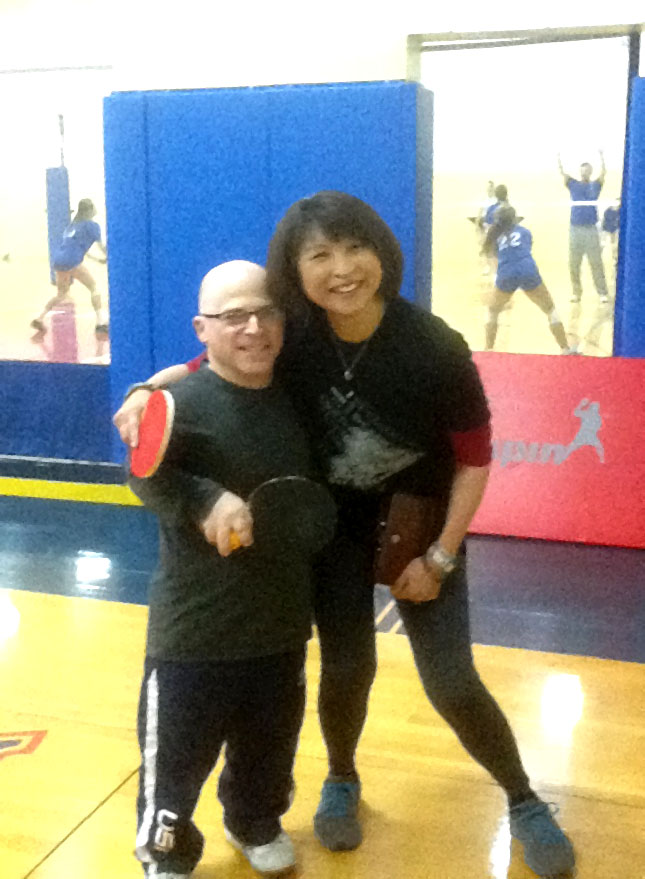
Recently Audrey Weisiger, the 1996 U.S. Olympic Figure Skating coach (Google her if you want more) started taking lessons with me. She started out with inverted, but about ten days ago tried out long pips on the backhand (no sponge), and liked it. (I blogged about this on April 26.) This past week she took a trip to Minneapolis, where I gave her contact info for Mitch Seidenfeld, the world dwarf champion and a professional coach. Here's a short video (27 sec., see Audrey celebrate winning a point!) of them playing, and here's a picture.

Iron Man 3

I'm taking some of our junior players to see Iron Man 3 tonight after practice. Some of them have been dying to see this movie for weeks. Confession - I've been dying to see this movie for years (or at least since #2 came out three years ago). Popcorn, cherry coke, and 130 minutes of fun coming up! Any local juniors who want to join us, we'll be leaving from MDTTC at 7PM, eating a quick dinner at a fast food place, then going to the Germantown Theater for the 8PM 3-D showing. (I'm not high on 3-D, but the kids prefer it.) 

Hong Kong Cup Highlights

Here's a highlights video (2:49) of the Hong Kong Cup, put together by long-time Canadian National Team Member (and player at the tournament) Xavier Therien.

Love and Ping Pong in New York

Here's an article that came out in December in SB National that I just saw, "Table (Tennis) for Two: Love and Ping Pong in New York."

Table Tennista

Here are the latest headline international stories from Table Tennista.

Table Tennis Clock

Here's a really nice table tennis clock. (If you can't see it there in Facebook, try this.) Anyone know where we can buy one? On March 12, I blogged about and linked to 28 different table tennis clocks. (I just added this one, so now there are 29.)

***
Send us your own coaching news!

Fundamentals and 1000 Forehands in a Row

Fundamentals, fundamentals, fundamentals. These are the three things that make up the foundation of your game. If you want to be good, you develop them until they are so ingrained you can do them in your sleep while tap dancing on a hot air balloon Here is my article, Develop the Fundamentals: Strokes and Footwork, from the May/June 2005 USATT Magazine.

Why am I bringing this up now? Because a student of mine, 11-year-old Sameer Shaikh, is rapidly developing the fundamentals - and had a huge breakthrough yesterday. We started the session by seeing how many forehands he could hit in a row. In the first rally he missed after 38 in a row. The second rally went on and On and ON - until I caught the ball after he'd hit 1000 in a row!! Not bad for a kid with a rating of 804. (It'll be a bit higher after his last tournament is processed.) I remember five-time U.S. Champion Sean O'Neill once said that his coach, Chutchai Chan, often made him hit 1000 in a row before they'd move on to other things. (It takes about 20 minutes - if you don't miss.)

It's a matter of muscle memory. When you practice a technique the right way enough times, it becomes so ingrained that it repeats over and over whenever you need it. All you have to do is blank your mind out and let the subconscious take over, and the shot will be there for you when you need it. (Muscle memory doesn't come from the muscles; it comes from the subconscious part of your brain that controls your muscles when you let it do so.)

This doesn't mean you have to do 1000 in a row every session. It's more a mental thing. If you do that 1000 in a row one time, then you pretty much have confidence you can do it anytime. Plus it's great mental training to have the focus to hit 1000 in a row. Once the shot becomes ingrained, you should move on to more advanced practice where you combine strokes with footwork.

I was coaching another kid yesterday, age 10, who had just started. He had a developed a pretty good forehand from hitting with his father (who's also a developing player at the 1000+ level), but he had a few small technique problems, such as a habit of leaning forward as he stroked the ball. He was fine with multiball, but as soon as we went live (i.e. forehand to forehand) he'd fall back in his bad habits. So I used a trick I've used to cure this habit - I had him stand by the table, throw the ball up himself, and smack in a forehand. Since he's no longer chasing after an incoming ball, he stopped leaning forward, and instead stroked with his body going in a circle, as if rotating on a pole stuck through his head, as you want to do. At first he struggled with this, but then it came together. When we went back to forehand to forehand, he'd adopted the change and no longer leaned forward as he stroked the ball. Boom, another fundamental down!

The father had pretty good fundamentals, and is working hard to master looping. He has nice technique on the backhand side (just needs practice to use it in games). On the forehand, he tends to fall back as he's looping the ball against backspin. Why? Because he stands too far from the table, and so has to reach forward to reach the ball. To compensate for this, he falls back with his left foot. Once he moved closer to the table and took the ball from the side instead of in front, the problem was solved. Boom, another fundamental down!

Fundamentals, fundamentals, fundamentals. The three foundations of your game. Have you got your fundamentals down?

The Table Tennis Collector and the ITTF Museum Newsletter

Here's the May issue of The Table Tennis Collector (#68). Here are links to all 68 issues. And here are links to all 31 issues of the ITTF Museum Newsletter. If you are a table tennis history buff, this should keep you happy for a few millenniums. (Still want more? Than order copies of Tim Boggan's 13 volumes - so far - of History of U.S. Table Tennis.)  

New World Rankings

The new world rankings from the ITTF are out. The big change - Xu Xin passed Ma Long for #1 in the men's. Here are the top ten for men and women. (Vladimir Samsonov of BLR just missed the men's top ten at #11.)

MEN

  1. Xu Xin, CHN
  2. MA Long, CHN
  3. WANG Hao, CHN
  4. ZHANG Jike, CHN
  5. BOLL Timo, GER
  6. CHUANG Chih-Yuan
  7. OVTCHAROV Dimitrij, GER
  8. MA Lin, CHN
  9. WANG Liqin, CHN
  10. MIZUTANI Jun, JPN

WOMEN

  1. DING Ning, CHN
  2. LIU Shiwen, CHN
  3. LI Xiaoxia, CHN
  4. FENG Tianwei, SIN
  5. GUO Yan, CHN
  6. ZHU Yuling, CHN
  7. SHEN Yanfei, ESP
  8. ISHIKAWA Kasumi, JPN
  9. WU Yang, CHN
  10. KIM Kyungah, KOR

Beauty of Table Tennis

Here's a new highlights video (5:34) set to music.

Westchester Open Final

There was a great final recently on April 28 at the Westchester Open, between Damien Provost and Zhen Wang. Below are links to all five games. Don't have time to watch them all? Then just check out game five, which ends in a 13-11 victory for...
Game1 (7:50)
Game2 (12:04)
Game3 (9:02)
Game4 (5:05)
Game5 (11:26)

LATE ADDITION: Here's the entire match (45:25)

Stockholm Open Poster

Here's a great promotional poster for the Stockholm Open in May - with Jan-Ove Waldner and Mikael Appelgren with tuxedoes and rackets, looking like a pair of gangsters!

Juwooowww!

Here's a Facebook video (10 sec) of 10-year-old Boris Pavlotsky, a student of Brian Pace, looping forehands, winning the point, and his celebratory exclamation. I don't think you need to be on Facebook to see it.

***
Send us your own coaching news!

Richard McAfee Visits Maryland

Yesterday USATT Hall of Famer, ITTF Trainer, and former USATT Coaching Chair (2009-2013, until USATT term limits forced him out) Richard McAfee, from Denver, CO, visited the Maryland Table Tennis Center. He was in town to do a coaching video with JOOLA USA.

So yesterday afternoon I stopped by JOOLA USA in Rockville, Maryland, which is also headquarters for North American Table Tennis. I hadn't been to their new offices, and so Googled the directions. I followed them exactly - and found myself in a construction site. The paved road had ended and I was driving on a muddy road, worried my tires would sink in and get stuck. I kept driving for 50 yards or so, then stopping and wondering if this right, then driving another bit, and stopping again. I kept wondering, is owner Richard Lee trying to save money by housing everything in half-constructed buildings, with muddy quagmires for streets and parking? Finally I called Richard Lee (president of JOOLA USA and NATT), and discovered the Google directions were off - they had me make a left-hand turn near the end rather than turn right. So I turned back and quickly found the place. I apologized to Richard for even thinking they might have set up offices in the muddy wonderland I'd visited. Unfortunately, my tires and the sides of my car were now all muddy.

The actual place is impressive, with lots of office space, a meeting room, large kitchen area, and a big video room. About a dozen people worked there full-time, each with their own office, some of whom I already knew - Richard and Wendy Lee, Michael Squires, Steven Chan, Rich Heo, and Katherine Wu. Out of the office at the time were Tom Nguyen, Greg Cox, and Mary Palmar. Richard McAfee was working with Rich Heo on the video.

Then I took Richard over to see my club, the Maryland Table Tennis Center. (Richard Lee and Katherine Wu, both of whom developed as players there, joined us shortly afterwards.) We watched as a number of our top juniors trained with coaches/practice partners, and discussed their technique. Then I took Richard M. to dinner at a local Japanese & Korean restaurant. (Teriyaki chicken for me, some sort of shrimp and vegetable dish for Richard.)

When to Call Time-Outs

In my book Table Tennis Tactics for Thinkers, there's a section on when to call time-outs. It was a rewritten version of a Tip of the Week I'd written in 2011. Here's the updated version.

2013 U.S. Open Challenge Series

USATT will organize the ITTF Challenge Series/World Tour to be held during the US Open and will include the following events: Women's singles, Men's singles, and U-21 Men's and Women's singles. Players in these events must be entered by USATT. Here's further info.

Why Chinese Players Are #1 in the World

Here's a short article and video (2:28) exploring this topic, which mostly showcases their training techniques, especially physical training. If you want a more extensive look on some of the reasons China dominates, here's an article I wrote with Cheng Yinghua on the subject for the July/August 2005 USA Table Tennis Magazine, "The Secrets of Chinese Table Tennis…and What the Rest of the World Needs to Do to Catch Up.

Exceptional Table Tennis Skills Around A Table!

Here's a Facebook video (36 sec) with two players doing a pretty good exhibition - on a mini-table! I think anyone can see this, even if you are not on Facebook or "friends" with the players, but if you can't, let me know and I'll try to find another version.

Vancouver Canucks Play Pong

Here's a video (2:04) of hockey players Roberto Luongo and Cory Schneider playing table tennis in what appears to be the team's clubhouse as they prepare for the NHL playoffs. They're pretty good!

Goofy and Mickey

That's some goofy ping-pong.

***
Send us your own coaching news!

Wow, I really enjoyed the video about the chinese dominance in table tennis. I've always wondered how it started and how it was possible, now I know :) And the video was just so enjoyable to watch itself, i mean the scenes etc. Thanks for that ! :D I might talk about it deeper on my table tennis blog soon ;)

U.S. Open

The U.S. Open this year is in Las Vegas, NV, July 2-6. The entry deadline is in eleven days - May 11. (There's a late deadline of May 18, which requires a $75 late fee.) Have you entered yet? Here's the U.S. Open webpage. I'll be there as a coach. I'm toying with entering some of the hardbat events as well, but not sure if I have time. (I normally play sponge, but have won a bunch of hardbat titles on the side.)

One of my annual pet peeves is that there is rarely any advertising or advance notice about the top players coming. This year the U.S. Open is part of the ITTF World Tour, and we know a bunch of top players are coming - but there's no publicity about who is coming. Year after year the entry deadline comes, and it is only after the deadline that prospective players (i.e. potential cash-paying entries) find out who the top players are. For all we know the Chinese National Team is coming, or the top European players - but we just don't know. Rather than wait and see who enters, and announcing it after the deadline, it would be a lot better if USATT pro-actively found out at least some of the top players who are coming before the deadline, and the publicized it. They did this in the early 1990s, and it seemed to lead to increased entries, as well as happy participants who came both to play and watch (as well as to buy stuff, with all the table tennis venders at the Open).

I hope to see many of you at the Open. There are so many reasons to attend - you get to play, see the top players, see friends, see a huge convention center filled up with a hundred tables and 800 players (and hundreds of family members, coaches, officials, staff, volunteers, etc.), explore the many equipment booths, and oh yeah, it's in Las Vegas!

Table Tennis Tactics for Thinkers

For two months in a row I've made more writing about table tennis than actually coaching. So please jump on the bandwagon and buy your copy of Table Tennis Tactics for Thinkers! Or any of the other fine books sold on my Amazon page. I also made a sizeable chunk last year writing science fiction & fantasy - about $2000 total. I'm not sure if it's a profitable hobby or a low-paying job. Here's my Science Fiction & Fantasy page.

Me and Marty

Here's a picture posted on Facebook by Bruce Liu of me with the late great Marty Reisman, taken at my U.S. Table Tennis Hall of Fame induction in 2003. Marty was given the Lifetime Achievement Award at the banquet, while Eric Boggan and David Zhuang were my fellow inductees. (If you can't see it on Facebook, try this.)

Ping Pong Candy

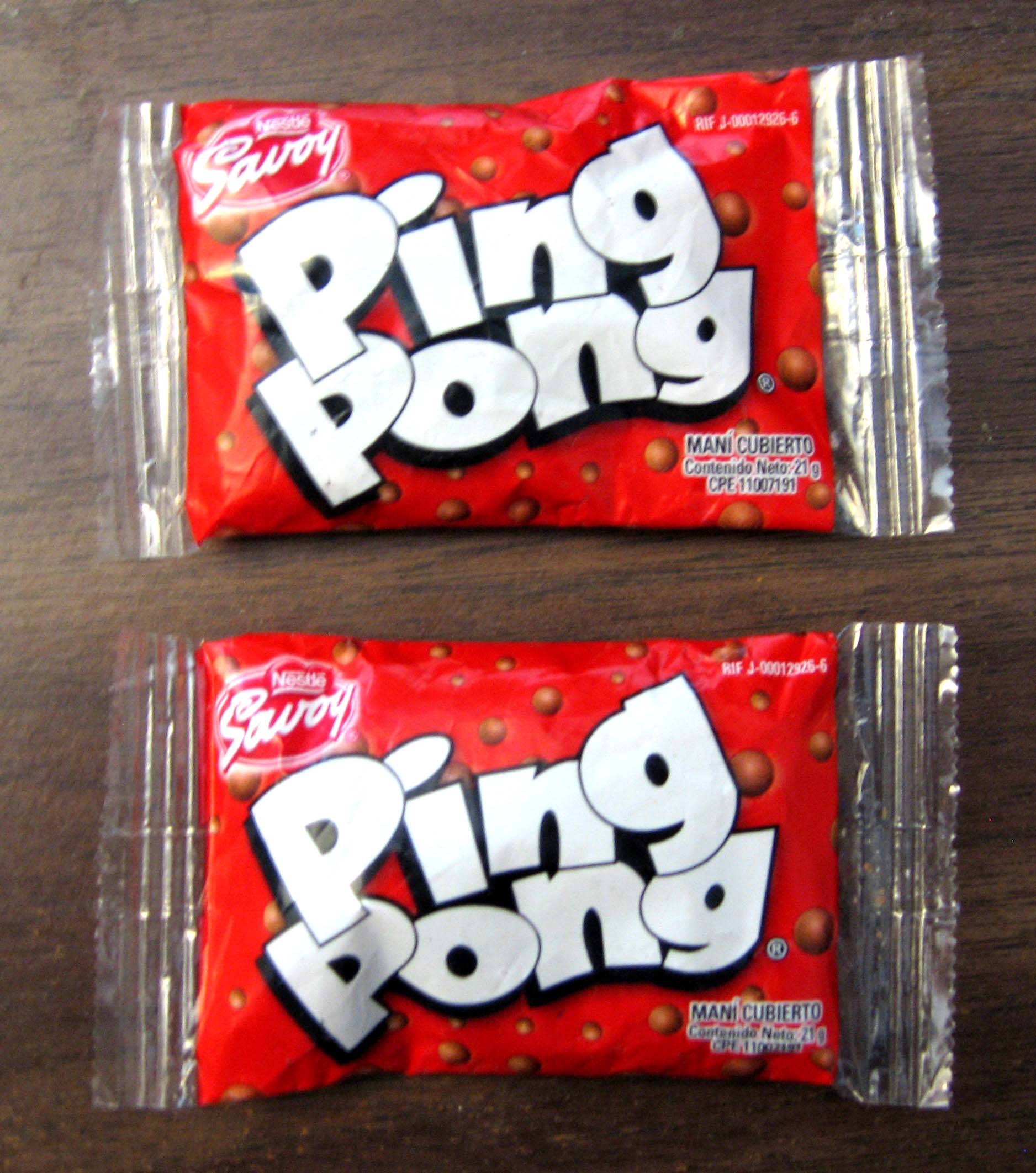
Alabama's Michael Wetzel (that's International Umpire and Certified Referee to you) sent me a pair of Ping Pong Candies, made in Venezuela. Here's the picture! They seem to be chocolate covered nuts or something like that. I haven't decided whether to eat them or keep them as a souvenir.

Table Tennista

Here are the international headline stories right now at Table Tennista

The Inspiring Chinese National Team

Here's a video (2:39) from a year ago on the Chinese National Team in training that I don't think I've ever linked to. It has inspirational narration (rapping?) by "Hiphoppreacher." I think I may have linked to something by him once before, but I'm not sure.

Table Tennis Can Be Really Awesome

Here's a new video (1:20) of shot-making and trick shots, from the "Piing of Power." (Not sure why there are two i's.)

A Boy and his Cat

Here's a continuous gif image of a boy playing table tennis with his cat (really!), with a seven-shot sequence repeated over and over.

USATT Minutes

[NOTE - I usually save the fun stuff for the end - like the boy and cat video above - but I decided to stick the USATT stuff here at the end so as not to scare people away.]

Here are the motions from the USATT Board of Director's April 20, 2013 meeting at Westchester, NY (during the North American Cup). You can see the minutes and motions from meetings going back to 1999 at the USATT Minutes page.

  • MOVED to appoint Rajul Sheth as Chair of the Juniors Advisory Committee.
  • MOVED to appoint David DelVecchio as Chair, and to appoint Adam Bobrow, Alex Figueroa, Willy Leparulo, and Han Xiao (athlete) as members, of the Leagues Advisory Committee.
  • MOVED for USATT to review Diego Schaaf’s Merit Pin Proposal, to incorporate Board comments into a revised draft, and to submit the revised draft to Diego Schaaf.
  • MOVED to deny North American Table Tennis’s request to vacate the Board’s December 19, 2012 Motion regarding the sanctioning of a Butterfly Teams Championship in 2013.
  • MOVED to direct the Clubs Advisory Committee to design a strategy for implementation of the club equipment package proposed by Attila Malek.
  • MOVED to affirm the February 17, 2013 Final Decision of the Board’s Special Committee in the disciplinary matter In re Chui, Case No. 2012-003.
  • MOVED that any service of Roman Tinyszin on the Officials and Rules Advisory Committee prior to December 31st, 2008, was ultra vires; therefore, the waiver approved on March 25, 2013, is inapplicable.
  • Respectfully submitted, Dennis Taylor, Secretary

USATT High Performance Committee

Here are the Actions of the USATT High Performance Committee (HPC) for March by Chair Carl Danner.

During March, the HPC did not hold any formal meetings or conference calls. However, the following summary of its actions and discussions is offered to inform USATT members about the HPC’s activities conducted by email, and through participation in the USATT Board’s March conference call meeting.  

  1. The selection process for the Youth Olympic Games was approved by the Athlete Advisory Council (AAC) and forwarded to the USOC for its approval – which was still pending as of the date this summary was prepared. The HPC reviewed the YOG code of conduct, and approved it subject to one wording change regarding possible serious criminal acts by athletes.  
  2. The HPC continued its discussion about the selection and review of National Team Coaches (NT Coaches). During the Board meeting, Board members advised that the responsibility for selecting, retaining, and opening positions for NT Coaches is the responsibility of the CEO. The HPC and other relevant committees would provide support for that process. The Board also asked the HPC to prepare a memo with its recommendations for the hiring process for able-bodied NT Coaches. As of this writing, it has not yet been determined by the CEO which able-bodied NT Coach positions will be open for applications, or on what schedule. A number of HPC members did emphasize the importance of having defined criteria for the evaluation of the performance of NT Coaches.  
  3. The HPC had some initial discussion of the concept of using multiple trials or tournaments to select national team members, starting first perhaps with the junior and cadet teams. This item will require further research and development prior to being implemented, including identifying specific events that will be counted. No decisions were made in this regard during March.  
  4. Another point of discussion was the potential of requiring some tournament participation during the year in order to validate a player’s rating as current for purposes of seedings in the Nationals Men’s and Women’s Singles events. Lacking that, the tournament committee might be authorized to seed a player based on estimated playing strength instead. Mr. Danner will identify the appropriate USATT committee to forward this proposal.  
  5. HPC members consulted with the CEO and the head of the Coaching Advisory Committee, Federico Bassetti, to help draft position announcements for Para Head NT Coach, NT Coach, and Junior NT Coach positions. USATT Para Program Manager Jasna Rather prepared the announcements, which were posted on the website with an application deadline of May 1.  
  6. The selection discussion for the April ITTF North America Cup in Westchester, NY raised some questions for future consideration about how to select teams for such events. These included understanding the relationship between the members of a U.S. adult team who represented us at a given event (such as the World Championships), the National Team Trial finishing order, and also how the coach’s pick for the World Championship team might fit in. Future selection policies will be more explicit about how priorities will be established among these criteria. 

***
Send us your own coaching news!

Larry,

If you have any information could you expand on 2 of the items in the USATT minutes

1. What is the "Club equipment package" mentioned as being studied?

2. How has the the Butterfly Teams Tournament for 2013 been sanctioned?  Is it on Thanksgiving weekend?  Has it been moved to the Chicago area?  Is it going to be a 2 star?   Was the decision such that it can not be held in 2014?


Mark

In reply to by mjamja

I just sent a query out to get info on your questions. I don't know the answer to all them them yet. I'll get back to you. (I'll be out most of today, so it won't be right away.)

In reply to by mjamja

Okay, here's what I know. The Club Equipment Package" is a packet being put together by USATT board member Attila Malek, for distribution to coaches and clubs to help develop coaching programs. My Professional Table Tennis Coaches Handbook may be a part of that. 

There's a lot of negotiation going on regarding the possible Butterfly Teams. There's nothing yet that they can say publicly. At the moment it has not been sanctioned. 

In reply to by Larry Hodges

Thanks so much for getting the information.

Since our club is trying to purchase some new tables I was hoping the "equipment package" might be some kind of a discount program for tables, barriers, etc.  Just looks like we need to proceed on our original plan in that regard. 

My understanding was that Butterfly Teams was not sanctioned for this year, but that comment in the minutes had me thinking that I got it wrong.  It is a difficult situation.  I hope they can get it worked out so Danny can put on an event.  From everything I have read it sounds like he always puts on a quality tournament.

Mark

Tip of the Week

The Decline of the High-Toss Serve and Why You Should Learn It.

Pong Power Pins Proposal

Martial arts have colored belts. For many years people have proposed that table tennis adopt something similar, but designed for table tennis. But nobody could ever decide just what it should be. Here is my proposal.  

  1. USATT should have specially made Pong Power Pins, numbered every 100 points from 1000 to 2800, which would be sold at slightly above cost to players as they reach these 100-point milestones.
  2. To qualify at each level, a player would need to both reach that rating level in tournament play, and beat at least three players at that rating or higher in tournament play. This latter is to make sure the player didn't just have a fluky tournament that gave them an inaccurate rating, as often happens; three wins at a level is a minimum goal for one who wishes to attain that level.
  3. Once a player qualifies for a pin, he would send in the needed fee ($5-$7?), and USATT would send that person a pin.
  4. The system would be administered by a newly-created USATT Ratings Committee, which would presumably also advise on other ratings matters. However, the actual sending out of the Pong Power Pins would be done by USATT Headquarters.   
  5. The design of the Pong Power Pins would be done by a contest, with the creator of the winning design getting a free five-year USATT membership. The winning design should prominently display the actual rating achieved (such as 1800), and also obviously be table tennis related. For example, the rating achieved might be inside a stylishly designed ping-pong paddle.
  6. A color scheme would be used for the pins, perhaps the following: 1000-1400 (red); 1500-1900 (green); 2000-2400 (blue); 2500 and up (gold).
  7. Since ratings are online from 1994 to the present, players who qualified during that period could apply at any time for a pin. Players who may have qualified from before 1994 must present evidence that they qualified, normally with copies of rating lists from pre-1994 magazines. Players from before 1994 would only need to show they achieved the required rating, and would not be required to have three wins at the required level.
  8. Players would be encouraged to wear their Pong Power Pins at tournaments and at other table tennis activities.

Weekend Warrior

I should write a book on how to beat players without really doing anything. I'm feeling so old and stiff these days that it seems as if I'm barely doing anything when I play. And yet this past weekend, in practice matches with many of our top players, I went undefeated, winning nearly every match 3-0, with none going five. (My final record for the weekend was 13-0, losing a grand total of two games.) Either I'm playing really good without really playing really good, or no one can take my tottering about the court seriously. Anyway, for the weekend I won matches against players rated roughly (I'm rounding these off a bit) 2250, 2230, 2180, 2100, and a mess of players from 1800-2100. At one point I told someone I've never been so tired in my life - and then I went out and beat the 2230 three straight, with two of the games at 3 and 4.

Okay, how am I winning without seemingly doing anything? Mostly off serve, receive, sudden forehand attacks (both looping and smashing), and a steady backhand. I'm throwing every serve I have at players (which doesn't take much physical effort) and taking their game away with effective receives (again, minimal physical effort since I'm mostly controlling the serves with short and long pushes and controlled flips rather than trying to loop all the deep ones like I used to). When I attack, it's usually one-shot affairs, where if they make a strong return my attack ends - but usually, if the first attack is well-placed, it either doesn't come back or it's a weak return. And when all else fails, I just go backhand to backhand. I don't have an aggressive backhand, and I can't stay at the table, but I can keep it on the table, deep and wide to the backhand.

After beating the 2230 player I gave him a pep talk on how he can't let players like me completely dominate with serve and receive. He was relying far too much on pure physical skills, but rarely got a chance to use them.

There was one moment of hilarity when I was playing one of our juniors, and I serve and smashed twice in a row. The kid, who is far more used to players looping than smashing, pointed at me and said, "He's using his hardbat skills!" (I normally use sponge, and loop about as much as I smash, but I'm also a hardbat player on the side where I'm an all-out hitter on the forehand while mostly chopping on the backhand.)

Table Tennis Master

Here are three new coaching articles from Table Tennis Master.

Ma Long Training and Donn Olsen

Here's a video (7:25) with selections of world #1 Ma Long of China in training as he prepares for the upcoming World Championships. The video is at the Event Arena in the same building as the Werner Schlager Academy in Austria. At 5:20, you'll see Coach Donn Olsen of the U.S. walk into the video. He's been to the Schlager Academy a number of times. Donn's doing coverage of the Chinese training, and along with Kyongsook Kim (another U.S. coach) is presenting a paper at the 13th ITTF Sport Science Congress, which meets every two years at the Worlds.

Hou Yingchai vs. Daniel Gorak

Here's a video (4:34) from the ETTU Cup Final, between attacker Gorak and chopper/looper Hou, with time between points removed.

Missouri University and Alan Chu

Here's an article and video (3:08) from Vox Magazine that interviews Alan Chu, a sports psychology graduate student at Missouri University and a member of their table tennis team.

Susan Sarandon and Jimmy Fallon

The two talk ping-pong and Justin Bieber in this article and video (3:58) from Table Tennis Nation. (First you get to meet Susan's cure little white dog.)

The Dark Side of the Paddle

Here's the latest table tennis artwork from Mike Mezyan, a rather dark one as a tornado-style paddle from the seeming dark side comes down to do battle at the table in a seeming cornfield (from The Natural?). (If you can't see it in Facebook, try this.)

Cub Scouts Build Super-Sonic Ping-Pong Ball Gun

Here's the video (2:05) as they blow up watermelons and coke cans! The balls shot out at speeds up to 883 MPH.

***
Send us your own coaching news!

Audrey and Long Pips

A while back I blogged about how I was now coaching Audrey Weisiger, the former U.S. Olympic Figure Skating Coach. I gave her another lesson on Wednesday. She's getting steadier in rallies, can push, and can now create spin with her serves. At the start she was an all-backhand player, where she sort of slashed at the ball. Hitting forehands for her was like me trying to ice skate - i.e., not natural, and pretty much against the natural order of things. However, she now has a pretty good stroke, and has hit 50 or more in a row live.

But on the backhand she still tends to stroke down on the ball, often putting backspin on the ball with her downward-stroking backhand drive (more like a push). She also has trouble returning spin serves (as do all beginners), which is problematic as her primary goal at the moment is to beat a fellow figure skating coach who beats her over and over with his backhand sidespin serve.

So on Wednesday I tried an experiment. I pulled out one of my demo long pips rackets that I keep for students to practice against, the one without sponge on a Dr. Neubauer blade (designed for long pips blocking). She tried it out, and it was like me getting off a hated and not-designed-for-human-usage ice rink! She loved it, and was able to keep the ball in play much better and more effectively. Even better, she was able to return nearly all my spin serves with the long pips.

She'll keep the inverted on the forehand, and focus on steady drives and, when the ball's up, smashing. It also gives her an inverted side to serve with. I showed her how to use the inverted to serve backhand and then flip the inverted back to the forehand. I'm letting her borrow my long-pips racket for now, but soon she'll get one for herself.

Someday perhaps I'll blog about my bad experiences with ice skating.

Serving With Spin

I used to have a bunch of striped balls that I had beginning players use when they were learning to serve with spin. They gave much better feedback than a normal ball, where beginners can't really see how much spin they are getting. At some point I lost those balls. Well, I just ordered four six-packs of "sports" ping-pong balls ($3/pack), where they are colored to look like soccer balls, basketballs, and baseballs. This'll make it a lot easier to see what type of spin they are creating. They are also good for learning to read spin, especially off a serve. They are only one-star balls, but they are 40mm. I'll blog about this after they arrive and I start using them again.

Sharara Fights Back

On Wednesday I linked to the article at Table Tennista about the allegations of corruption against ITTF President Adham Sharara by European Union President Stefano Bosi, "Adham Sharara Accused Of Long-Term Corruption In The ITTF." Here is Sharara's response, "Sharara Fights Back Against Bosi's Allegations." Sharara says, "All the allegations concerning me modifying accounts or hiding the true income are all false," and "Anyone within the ITTF has the right to run for presidency. In addition, anyone also has the right to complain or clarify any issues. Unfortunately, some one is attacking me and at the same time campaigning."

Dimitrij Ovtcharov Vs Robert Gardos

Here's a great video (7:07) that just came out of these two playing in the Champions League in Europe, with the time between points taken out. Ovtcharov of Germany is world #7, Gardos of Austria is world #32. Watch some of the backhand serves of Ovtcharov. (But guess who wins this time?)

Stiga Videos

Stiga Table Tennis has a lot of videos on their webpage - the "Stiga Movie Channel." They are divided into:

A Touch of Magic

Here's a table tennis highlights music video (5:13) that came out last month.

The Misdirected Surprise Serve

Here it is (20 sec)! I've done this in exhibitions. ("Look, up in the sky! It's a bird! It's a plane! No . . . it's my serve." And then you quick serve.)

***
Send us your own coaching news!

Defaults and Rating

There's been an email exchange among some USATT officials, of which I was CCed, on the subject of players defaulting tournament matches to protect their rating, It was instigated by a gentleman who was the victim of this - a player didn't want to play him, perhaps because he had long pips, and so defaulted, apparently to protect his rating. The question raised is why don't players who default matches lose rating points? It's a good question - and below is my response.

I'll jump in and give the reasons for why they do not give away rating points for a default, and then (at the end), I'll offer a possible solution.

It would be somewhat unfair to take away rating points for certain defaults. So the only way I see for a rules change that would allow a rating loss for defaults is if the referee were given the responsibility of determining if the default was "legitimate" or not. That would not be easy to determine, as someone who wanted to avoid playing a match for rating purposes could easily fake one of the below reasons. Here are some legitimate reasons why players default that have nothing to do with avoiding rating point losses - and over the course of 37 years of play, I've defaulted matches at least once for each of these reasons (except for #3 and #8), as have many others. (I'm sure there are other reasons I haven't thought of.)

  1. Tournament runs late, and player has to leave.
  2. Player is injured or sick.
  3. Player is too tired. This happens all the time - sometimes someone older or out of shape advances in multiple events, and simply can't play all of the matches, and has to default some. This especially happens to elderly players.
  4. Player is unhappy with the playing conditions and decides to drop out. If a tournament has poor lighting, a background where you have trouble seeing the ball, slippery floors, or some other such problem, a player might decide to default rather than play in such poor conditions.
  5. Player's equipment is broken, defective, or stolen.
  6. Player is unable to attend a tournament he entered, or is called away from the tournament unexpectedly. Some people are on call, such as doctors. Players have defaulted out of less important matches at big tournaments to do table tennis TV interviews, or to do commentating, or some other function. Or a player may be called away due to a family or work emergency.
  7. Player is also a tournament official or volunteer, and he is unexpectedly needed, and so he drops out (i.e. defaults) to help run the tournament.
  8. Player unexpectedly advances in a major event, and so defaults a less important event. This happens at the U.S. Open and Nationals quite a bit. When I have a top junior who is pulling off upsets and has a chance to win a major age event, I'm almost always going to advise him to drop any rating events so he can focus on the age event and a national title. The problem is the player might not know in advance he'd do so well in the age event, and so enters the rating events as well. This also happens in Men's and Women's Singles, where a player might find himself advancing deep into the draw, and so not want to tire himself out in another event, such as a rating event, some age events, hardbat, sandpaper, etc. When Dan Seemiller, in his late 50s, pulled off some upsets and advanced deep into the Men's Singles event at the 2011 USA Nationals, he defaulted his senior events to save energy for that event.

Some would argue that if a player chooses to default, he should always lose the rating points. But besides being unfair in some cases (such as reason #1 above), that would just make the rating system less accurate. We have enough trouble with under-rated players showing up and sweeping the rating events and messing up the seedings; do we really want to take away 50 points in a default from a player - and possibly multiple times if the player defaults several matches - knowing what this will mean when he shows up at his next tournament? Suppose a player is rated 1830, but defaults out of two round robin events for one of the reasons above. That could be six matches, and perhaps 200-250 rating points. His next tournament he shows up way under-rated and playing in events he should not be eligible for.

What I would suggest as a solution is to have a player who defaults lose rating points unless the referee approves the default, i.e. the defaulting player must give the referee a reason for the default, and the referee must accept it, based on guidelines from the bullet points above. I'd also limit it to a maximum of 50 points lost in one tournament from defaults. I don't think players should gain rating points from a default. There's no perfect solution, and a liar would still get away with defaulting matches to protect his rating, but it would happen less often as many players might have some difficulty flat-out lying to the referee, and sometimes the player's actions would convince the referee he is lying. Also, if a player defaults regularly, then the referee could turn him down.

I'd rather not get into a long discussion of this - I have a busy day coaching and writing tomorrow. But hopefully the above will offer some grounds for thought, discussion, and possible action by those in a position to make changes.

The Plastic Poly Ball

Here's the ITTF's report on the ball. It's 32 pages and seems pretty comprehensive with lots of scientific-looking studies - but no, I haven't read it yet. I'm hoping some of our readers will read it and report your thoughts on it. This could be a scary situation, as one thing that comes out is that the new poly ball plays differently than the current one. Do we really want that? Does the report give a strong reason for doing so?

Stance for Returning Serve

Here's the video from PingSkills (1:16), plus an article on the topic of proper stance and how far to stand from the table when receiving serve.

Table Tennis Master

Here are four new articles from Table Tennis Master.

Crystal Wang on TV

Here's the video (4:34) of Crystal and her dad getting interviewed on NBC 4 yesterday. Crystal (just turned 11 and rated 2292) just won the Hopes Trials at the North American Cup.

Texas Wesleyan University Team on TV

Here's the video (5:03) of the team after winning their tenth straight national collegiate championship, on CBS Local.

Central Florida Table Tennis Club

It's not full-time, but it's 27,000 square feet!!! Here's their web page. They have 18 tables, but with rather large courts.

Great Chopping Point

Here's a great attack versus defense point from the 2012 China Open, featuring world #1 Ding Ning versus world #11 Wu Yang, perhaps the best chopper in the women's game. When it all ends, guess how Wu wins the point?

Roman Table Tennis

I think that's Julius Caesar playing TT!

***
Send us your own coaching news!

Looping Placement

Here's something interesting I noted at the Hopes Trials, which I've also seen in the past. When a player backhand loops, he is roughly facing his opponent, and so can see where the opponent's middle is. When a player forehand loops, he faces more sideways, and the opponent is no longer in clear view. Result? Especially at the junior level and below the elite level, players seem to have far more difficulty in attacking the opponent's middle when forehand looping then when backhand looping. (The middle, in table tennis terms, is the switchover point between forehand and backhand, roughly at the playing elbow.) I watched one player nail the opponent's middle over and over with backhand loops, but when forced to do forehand loops, the player was unable to do so. (This is all true as well for basic forehands and backhands, but to a lesser extent, since players tend to turn more sideways to forehand loop than for forehand hitting.)

The solution? Practice. Look to loop at the opponent's middle at least half the time, usually the weakest spot, and see how often you can nail it. Few opponents are actually moving as you are hitting the ball, so you should be able to see where he is just before you take the shot. With practice, you'll be able to hit the middle over and over. (If an opponent is moving, then usually aim behind him, since he'll have to stop and change directions. Unless, of course, he's way out of position, in which case go for the open area.)  

Table Tennis Commentating at the North American Cup

No, I didn't get to hear any of it - I was there coaching. (I'm told I was on video at least one time, coaching Crystal Wang in the Girls' Hopes Trials.) What I've heard and read over and over was what a great job Barbara Wei did through most of the tournament - and how she was then replaced for the "big" matches at the end by someone who spoke broken and heavily accented English, and various officials. C'mon, people, Barbara was on the U.S. Junior Girls Team, trained nearly full-time for years, and speaks very clearly and intelligently. Listeners raved about her performance. What were you thinking??? (Disclaimer: Barbara came from my club, Maryland Table Tennis Center.)

I've been asked numerous times over the years to do table tennis commentating for TV. I've always turned it down. Why? I don't think I have a good speaking voice for TV. When I first began doing group coaching many years ago, I also had trouble. My solution was to take a course in public speaking. This greatly helped for those group sessions. However, I don't think I could do hours of commentating with my "public speaking" voice. I'd fall back into my normal habits, which tends to be somewhat fast and not the type of voice you want on TV. I'm far better writing.

Answers to Brain Teasers

Here are the answers to the four brain teasers from yesterday:

  1. The opponent was a fish and they were playing underwater.
  2. When you play an opossum, you play possum.
  3. There isn't any room over the net for the ball to go over.
  4. The single hair was a hare.

Table Tennista

Once again they have more international articles. Perhaps the most interesting one is the eyebrow-raising first item, where European Table Tennis Union President Stefano Bosi, who is running for ITTF President, accuses the incumbent, Adham Sharara, with this: "We found that Adham Sharara has been involved in a long-term and serious breach of the ITTF regulations and ethical standards. It is even possible that he also has civil violations. In particular, he is involved in serious violations on the Olympic charter. In addition, Sharara has established a complex system to aid him and his relatives to seek benefits from the ITTF." It also accuses him of "abuse of power and malversation of funds amounting to 20 million US dollars." I'll post Sharara's response when/if it comes out.

Testing the Large Hadron Collider with a Ping-Pong Ball

Here's the article from The Atlantic.

Receiving Options

Here's a video from PingSkills (2:07) on your basic options when receiving.

ITTF Ping Pong Paix at the 2012 WTTC

"Ping Pong for Peace" was a program at the Worlds in Dortmund, Germany, where kids from Burundi were brought in to learn about table tennis. Here's the video (7:58).

Ryu Seung Min vs Bojan Tokic (German League 2012/2013) Play-Offs

Here's the video (7:58).

Justin Bieber Table Tennis

Here's an article and a new short video (about 12 sec) from Table Tennis National of Justin Bieber playing table tennis. Yep, he's still using a two-handed backhand.

Ping-Pyong

Here's a nice cartoon of the U.S. and North Korea playing ping-pong on a nuclear missile, from the Washington Post, the result of a contest, with the caption, "Ping-Pyong: A high-stakes game in which two countries smack threats back and forth with lobs, spin and backhand shots."

***
Send us your own coaching news!