

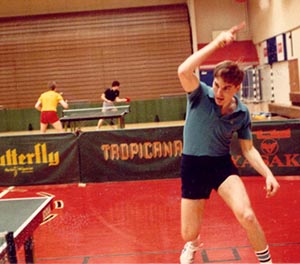
 Photo by Donna Sakai
Day Four of MDTTC Camp - the Backhand Loop and Doubles Tactics
On Thursday morning we focused on the backhand attack against backspin, mostly the backhand loop but also the backhand drive against backspin, especially against a short ball. Nathan Hsu (15, rated 2356) was my partner for the demo. I demonstrated my favorite loop versus backspin drill: I serve backspin, partner pushes to my backhand, I backhand loop, partner blocks, I backhand chop, partner pushes, and I backhand loop, and the cycle continues.
Later I gave a short lecture on doubles tactics. (Short version - Serves: serve low and short, mostly toward the middle of the table. Receive: be ready to loop any ball that goes long. Rallies: hit to the opposite side of the player hitting to you from his partner, so they get in each other's way. And lots more.) Then we played doubles for an hour. We also divided the camp into two groups, and I took the "new" players off to the side and gave a lecture on equipment, which ended with everyone trying out playing against and with anti and long pips. (I also talked about short pips and hardbat.)
There are 34 players in the camp this week. We were a bit worried that we'd get a smaller turnout since we're running camps every week all summer - eleven consecutive weeks - but that doesn't seem to be a problem.
U.S. Nationwide Table Tennis League
Here's a new 30-second ad for the upcoming USNTTL league, which starts in September. Here's their home page.
Reminder - Sports Psychology Night at MDTTC