Fan Zhendong vs. Cho Eonrae
Here's a great video (14:32, with time between points removed) between China's Fan Zhendong (world #3) and South Korea's Cho Eonrae (world #20) in the 8ths of the Qatar Open on Feb. 18-23. Spoiler Alert! Cho wins deuce in the seventh, -12,10,7,7,-9,-8,10. Here is my analysis of the first five points. Fan is in red, Cho in black. Not all points are shown; for example, the second point shown is actually at 3-1. (FH = forehand, BH = backhand. Alas, the direct links to the start of the points make you go through the short ad at the start each time.)
POINT 1: Fan does reverse pendulum sidespin serve short to FH. Cho comes in with FH as if receiving down the line, freezing Fan (who has to cover for the down-the-line shot), and then drops it short the other way, to Fan's FH. Fan steps in, threatening to go very wide to Cho's FH, instead flips down the line to Cho's BH. Since Fan is leading over table, Cho attacks very wide to Fan's BH. Fan has to move quickly, and does a safe backhand topspin to Cho's wide BH. Cho spins off bounce to Fan's wide BH. Both players are trying to avoid the other's FH, and since these aren't highly aggressive shots, they are going wide to the BH rather than the middle, where many attacks go. After his previous backhand loop, Fan is moving back to ready position and is caught slightly when Cho goes right back to the wide backhand. As Fan moves to do an awkward backhand loop, Cho steps around to counterloop with his FH, but Fan BH loops off. Point to Cho.
POINT 2: Cho does FH reverse pendulum serve to Fan's BH. Fan backhand banana flips, but his shot nicks the net and goes off. I can't read the spin from this angle (Cho's body is in the way), but while the obvious thought was the serve was backspin, I suspect it was no-spin from the angle of Fan's racket. His contact with the ball is almost directly behind it; if the ball was heavy backspin, he'd be going more around it with sidespin rather than go up against the backspin directly. (That's a secret of the banana flip.) Point to Cho.
POINT 3: Cho fakes a regular pendulum serve, but does another reverse pendulum serve. It's half-long to the FH, barely off the end, and Fan loops it rather weakly. But since Cho has to guard the wide FH angle, he's slow in stepping around, and so he takes the ball late and goes off the end. Point to Fan. I'm guessing Cho hasn't gotten his rhythm yet or he'd make that shot, even rushed.
POINT 4: Fan does a regular pendulum serve. The motion looks like he's going long to Cho's backhand - watch how Cho starts to step around. Instead, Fan serves short to Cho's FH, forcing Cho to change directions. See how off balanced he is as he receives? He manages to drop it short, but is still a bit off balance as he steps back, and so is slightly caught when Fan drops it back short. He does a weak backhand attack, which Fan easily backhand loops. Since Cho is leaning over the table with his backhand side a bit open, Fan goes to his wide backhand, forcing Cho to block. Fan now does a stronger backhand loop to Cho's middle, forcing a weaker block, and then Fan steps around and rips a FH to Cho's middle. The whole point was like a chess match, where a small advantage is gradually turned into a winning point. Point to Fan.
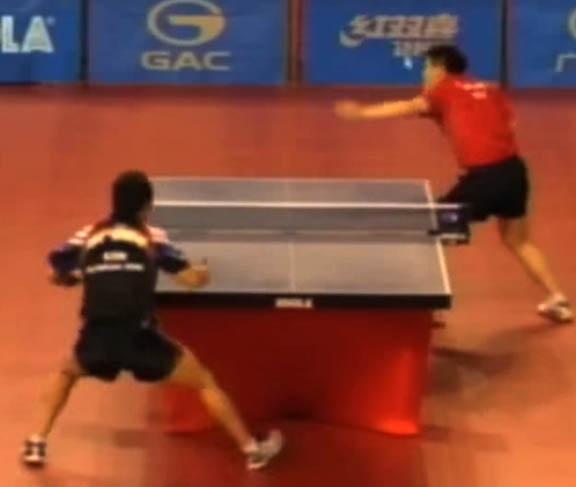
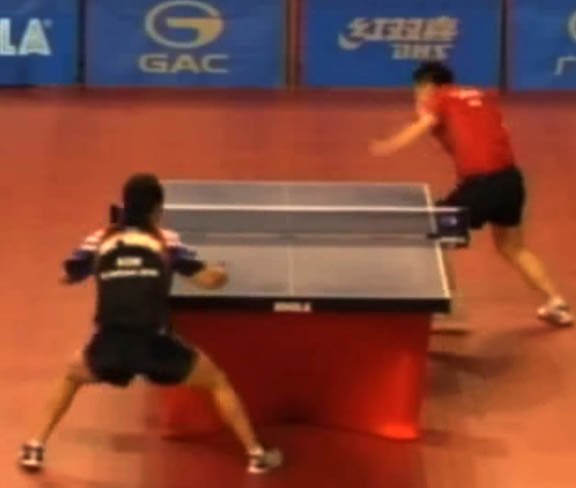
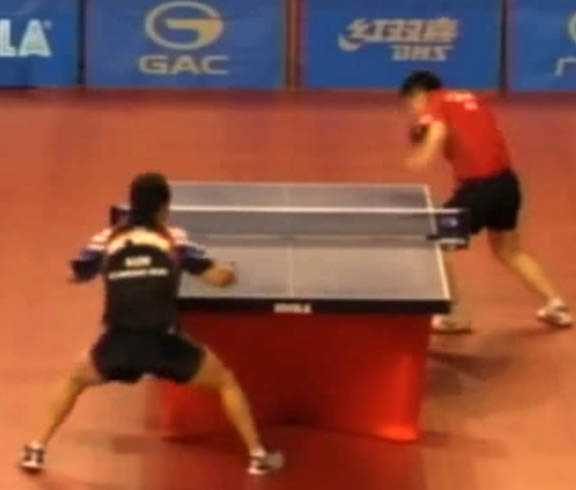
POINT 5: Here's where Fan apparently pulls a fast one. He does a pendulum serve, but it looks like he's hidden contact - but just barely. Here's an image just before the ball disappears behind his non-playing arm, and here's one just after, with the arm now hiding the ball. Can Cho see contact? Most likely contact is hidden, but becomes visible the split second afterwards. Here's one the split second after the arm gets out of the way, where you can see the ball against the racket. It happens so fast it's almost impossible to be sure, but it looks like he contacted it with a regular pendulum serve, heavy backspin, but hidden by the arm, and then, the split second after, as his arm moved out of the way, his racket moves slightly in the other direction as if doing a reverse pendulum serve with sidespin. That's what Cho likely saw, and so he backhands the ball right into the het. (This was the standard technique at the high levels before hidden serves became illegal - hide contact, but show the receiver a fake contact the split second afterwards to mislead them.) Point to Fan.
Was this last serve legal? You decide. Here are the pertinent rules.
2.06.04: From the start of service until it is struck, the ball … shall not be hidden from the receiver by the server or his or her doubles partner or by anything they wear or carry.
2.06.05: As soon as the ball has been projected, the server’s free arm and hand shall be removed from the space between the ball and the net. The space between the ball and the net is defined by the ball, the net and its indefinite upward extension.
2.06.06: It is the responsibility of the player to serve so that the umpire or the assistant umpire can be satisfied that he or she complies with the requirements of the Laws, and either may decide that a service is incorrect.
Veep
Back on October 10, 2013, I blogged about spending a day on the set of the HBO TV show Veep. Well, the episode, "Clovis," airs this Sunday, at 10:30 PM in my area (east coast). I was basically their table tennis advisor, and I brought in three top table tennis players who should appear in the episode: Khaleel Asgarali (2314), Qiming Chen (2221), and Toby Kutler (2154). See the blog entry for info on what we did. So you can recognize them, here's a picture of Khaleel Asgarali. Here's Qiming Chen (on right). And here's 14 seconds of Toby Kutler doing multiball training.
You won't see me in the episode, but there's a scene where the character Mike McLintock (played by Matt Walsh) discovers the snack bar at Clovis. You'll see him talking through a window with the Clovis employee who runs the snack bar, and who fixes him some sort of drink (I think a milk shake). While you can't see me, I'm sitting right behind the Clovis snack bar employee, on the left, hidden by the wall and enjoying the show. (They did this scene about a zillion times, with Matt playing a bit differently each time, so I'm curious which version they went with.)
Knee Problems - Again
Here we go again. Last night during a class I was teaching I demonstrated a forehand smash. I thought something felt funny in my right knee afterwards, but it wasn't until about ten minutes later that my knee started to act up again. And now I'm limping about, hoping I can coach. (I have a 90-minute session tonight, so it's not a busy night, but then the weekend is very busy.) This is not a good thing for an active coach. On the other hand, it's been a while since my knees/arm/shoulder/back acted up.
I've had problems with both knees. When it's my left, I can usually compensate better, but my right knee is my push-off leg for all my forehand shots, plus it's hard to move to the right when it's acting up. We'll see how it is when I coach tonight.
Chinese Table Tennis Association Sticks with Old Ball (for now)
Here's the article.
Zhang Jike Feels Pressure With His Responsibilities in Tokyo
Here's the article.
Team USA at the 2014 World Championships
Here's a video (3:06) honoring the U.S. National Team at the World Championships in Japan. That's me coaching Crystal at 0:54 and 0:56 - see big picture on right both times. (But just for the record, Jack Huang is her primary coach, though I often coach Crystal in tournaments when he's not around.)
USA Men's Team at the Worlds
Here's video (1:26) of the most intensively serious workout they've ever undergone, and some chitchat. And here they are relaxing and playing cards. Here they are on the subway returning to the hotel.
USA Table Tennis Champions of the Century, Part 1
Here's the video (6:38) by videomaster Jim Butler. This one covers Eric Boggan, Dan Seemiller, Jim Butler, Sean O'Neill, Hank Teekaveerakit, Attila Malek, and Lily Zhang.
How You Could Send Something High in the Atmosphere
Here's an article on the use of ping-pong balls to send things into the upper atmosphere for scientific experiments.
7000 Pingpong Balls Dropped for Legacy Week
Here's the article.
Office Prank - 100+ Ping Pong Balls
Here's the video (2:13)!
***
Send us your own coaching news!











Re: April 28, 2014
My understanding is that you are supposed to support decisions based on what is written in the rules with a touch of help from the background given by the ITTF Handbook. The concept of a distance of separation from the hand is not written in either of these. Further, if Kovac's interpretation is correct and "rise" is defined by the initial separation between the ball and the palm - what happens if the hand drops rapidly in "real" (relative to the ground) terms? Given this definition, a player could have virtually no toss and could use a rapid hand drop to create the majority of the 6 inches of separtion. In this way, the player could quickly strike the ball almost with no "real" ball toss at all. The distance would be largely created with just hand movement. Paul Kovac's interpretation seems pretty bogus to me - not only in not respecting the letter of the rule, but by allowing "quick" serves that would seem to violate the intent of the rule.
That said, as a practical matter server's would be wise not to follow the ball up with their hand since doing so would probably make it harder for an umpire to clearly see when the ball departs the palm.
Re: April 28, 2014
In reply to Re: April 28, 2014 by Jay Turberville
Good point - I hadn't considered the idea of just dropping the hand. That's the old Tim Boggan serve - he was infamous for not tossing the ball up, just dropping his hand down.
Re: April 28, 2014
In reply to Re: April 28, 2014 by Larry Hodges
And it is just this type of zero or near zero toss "quick serve" that the six inch rule was designed to eliminate. Kovac's interpretation allows it. That should suffice to discredit that interpretation. But the real problem is that the rule simply does not mention hand separation.
Re: April 28, 2014
In reply to Re: April 28, 2014 by Larry Hodges
And it is just this type of zero or near zero toss "quick serve" that the six inch rule was designed to eliminate. Kovac's interpretation allows it. That should suffice to discredit that interpretation. But the real problem is that the rule simply does not mention hand separation.
Re: April 28, 2014
As a matter of fact I wrote about this to Paul Kovac a couple of years ago and he actually agreed with me back then that the rule doesn't mean 6 inches between ball and palm. He must have forgotten about that!
It never ceases to amaze me how often even educated reasonable people forget to exercise common sense. If the rule says "so that it rises at least 16cm (6") after leaving the palm of the free hand" then that is exactly what the rule says.
My guess is that almost always the palm of the serving hand follows the ball during the toss - that makes it harder for the ump to understand whether ball was tossed 6 inches or not... but it is so much easier to watch the gap between the palm and the ball. That's where the confusion comes from, I think. They are mistaking their common umpiring practice for the actual rule.
Re: April 28, 2014
In reply to Re: April 28, 2014 by JimT
I'm not going to make an issue of it, but I plan to bring it up with some of the referees/umpires at the Open. The problem is that many of them pretty much go by convention rather than by what the rules say. For example, as I've blogged many times, few pay attention to the rule that says it is the responsiblity of the player to serve so the umpire is satisified they are serving legal - and so when the umpire isn't sure if the serve is hidden (i.e. he's not satisifed it is not hidden), they allow the serve when the rules clearly say this should be a warning or a fault. And so many players are allowed to cheat and win. I've brought this up many times to no avail.
Re: April 28, 2014
In reply to Re: April 28, 2014 by Larry Hodges
While I do agree with you, Larry, on the toss issue, I am not sure I am 100% with you on the "umpire satisfaction" issue. Here is why: the rule itself is ridiculous because it has hardwired subjectivity in it. It says that the player HAS TO satisfy the umpire, which is ridiculous on the face of it, because always the proper way was that the player has to comply with some objective rule not with demands of an umpire. But let's forget about that for a second and I will try to give you an example showing why this rule inevtiably leads to confusion and to exactly the situation that you described (and which you don't like - when ump is not sure and lets it go).
Here is what happens everywhere - in every sport (but for diversity sake I will use soccer as a game in this instance; and let's say there is no video recording) - player(s) do something which could be illegal and ref/ump has to make a decision. Let's say soccer ref thinks that player A pushed another team's soccer player B. If he saw it with his own eyes, he punishes A with yellow card. Imagine now - happens a lot - that ref was looking somewhere else at the moment and only caught the aftermath (player B stumbling away from A). What happens then? does he yellow-card player A because he failed to fully satisfy ref's confidence that nothing bad happened, because there is a definite possibility that foul has happened? of course not. He did NOT see it, or he saw something but he cannot be sure what really happened - maybe B is faking, maybe B initiated a tussle and A just bumped into him, who knows? ref does NOT know, that's the important thing here. How can he punish A for that? I am sure you agree with me that would be ridiculous and would ruin the entire game.
Reason - because the rules in soccer do NOT say: umpire will issue a yellow or red card if he suspects a foul; or if the alleged offender cannot fully satisfy the ref that his behavior was legal. The rules say something like - it is prohibited to push the player not in possession of the ball etc. So the rules state some objective fact, and then the ref will use his (admittedly, somewhat subjective) powers of observation to decide whether that fact happened or not. So it is ALWAYS an issue of fact. Did event X happen or not? this is the only thing that should determine the outcome.
Unfortunately this stupid rule (and I will repeat it without blinking - very very stupid rule; or at least the relevant part of it) does NOT deal with an actual event. It deals with imagination and satisfaction of an umpire, which officially incorporates subjectivity into the text of the rule and allows for both abuse by umpires and for overall confusion. Since reasonable umpires feel that there is a huge opportunity to abuse or to misinterpret such a rule they decided (most of them, that is) to treat this rule in favor of presumption of innocence, which in my opinion is much preferable to the other way... which unfortunately, it seems, is the one you are suggesting.
Sorry for rambling, it's just I hope you will see this for what I think it is, a rather important issue which is not even about table tennis as a game but more about logic in rules and making proper decisions based on deeper analysis... which alas is not something that ITTF lately is famous for, I am sorry to say.
Re: April 28, 2014
In reply to Re: April 28, 2014 by JimT
One more quick point. Compare 6-in toss part and the umpire satisfaction part. The first one is about an objective fact (and that is why it is a good formal rule and that is why you and I can make valid logical inferences about the whole original issue of your post) - of course, the decision of an umpire about height of the toss is still subjective because all of our human decisions always are; but at least he starts off the formal definition and non-subjective rule.
In the umpire satisfaction part of the rule the umpire is allowed to "feel" that he was not "satisfied" - by the way, what does it even mean, satisfy? to what degree? there is no fact that he is forced to base his decision on. And that is really really bad.
Dixi
Re: April 28, 2014
In reply to Re: April 28, 2014 by JimT
The pertinent definition for "satisfied" from Merriam-Webster is "to believe something is true." So if the umpire believes the serve is legal, then all is well. If he doesn't believe it to be legal (which includes if he isn't sure), then it's a warning or a fault.
Re: April 28, 2014
In reply to Re: April 28, 2014 by JimT
I think this is where I might disagree. You wrote, "It says that the player HAS TO satisfy the umpire, which is ridiculous on the face of it, because always the proper way was that the player has to comply with some objective rule not with demands of an umpire." Actually, since the rest of the serving rules are (hopefully) objective, the rule about satisifying the umpire isn't subjective; it simply means the player needs to serve so the umpire is satisified that he is serving legally. Otherwise a server could serve in a way that may or may not be legal, but hide it from the umpire, and the umpire has no way of knowing if the serve is legal.
This is what happens all the time with the hidden serve rule, which to me is the most poorly written rule. The rule there should be that the ball must be visible throughout the serve to the umpire or where the umpire would be if there were an umpire. (The exact location of the umpire isn't important since if the ball is visible to any place near where the umpire would be, it's obviously visible to the opponent.)
As the rules are written, if the umpire isn't satisified if a serve is legal (i.e. whether it was hidden or not), then the rules are very objectively clear: it's a warning or a fault. As to the word "satisfied," that is also clearly defined. The pertinent definition from Merriam-Webster is "to believe something is true."If you aren't sure if the serve is hidden or not, you cannot believe it to be legal, i.e. be satisified it is legal, and so it should be a warning or fault.
Re: April 28, 2014
In reply to Re: April 28, 2014 by Larry Hodges
Then they should not have formulated the rule in such a genuinely stupid way. If they wanted to prevent players hiding serves from umpires then that is what they had to do. However you spin it, the rule is about players making sure that umpire thinks that the serve is legal. That is just wrong - the player must comply with a formal and easily verifiable rule that says "serve is legal if..." without mentioning any subjective factors such as umpire's thinking.
The fact that ITTF could not come up with a better way of formulating that rule - and I agree this is not easy - doesn't excuse them for making a bad rule instead.
I think you are a looking at it more from the point of view of an ump - this rule certainly makes life easier for an umpire because it makes it impossible for umpire to misinterpret or make mistakes in applying the rule. For a player, however, this rule could conceivably be a nightmare - just look at what happened with Ding Ning at London Olympics. And that was easily THE MOST important match of her career!!