Blogs

Larry Hodges' Blog and Tip of the Week will normally go up on Mondays by 2:00 PM USA Eastern time. Larry is a member of the U.S. Table Tennis Hall of Fame, a USATT Certified National Coach, a professional coach at the Maryland Table Tennis Center (USA), and author of ten books and over 2100 articles on table tennis, plus over 1900 blogs and over 600 tips. Here is his bio. (Larry was awarded the USATT Lifetime Achievement Award in July, 2018.)

Make sure to order your copy of Larry's best-selling book, Table Tennis Tactics for Thinkers!
Finally, a tactics book on this most tactical of sports!!!

Also out - Table Tennis TipsMore Table Tennis Tips, Still More Table Tennis Tips, and Yet Still More Table Tennis Tips, which cover, in logical progression, his Tips of the Week from 2011-2023, with 150 Tips in each!

Or, for a combination of Tales of our sport and Technique articles, try Table Tennis Tales & Techniques. If you are in the mood for inspirational fiction, The Spirit of Pong is also out - a fantasy story about an American who goes to China to learn the secrets of table tennis, trains with the spirits of past champions, and faces betrayal and great peril as he battles for glory but faces utter defeat. Read the First Two Chapters for free!

USNTTL and Leagues

Alas, it seems the U.S. Nationwide Table Tennis League is no more. When you go to www.usnttl.com, you get a note saying, "This account is expired due to non renewal of services."

I was already a little irritated at them for another reason. Late last summer, after the entire thing was set up, I was invited to be a member of their Advisory Board. I agreed, and I took part in a one-hour phone conference with other newly appointed Advisory Board Members and the ones setting it up, and where I was told about the league. I gave a few recommendations (not sure if any were followed, since it was a bit too late for major changes since the league was already set up), and that was my entire involvement with it. Later, when the league was "postponed," I only found out about it by emailing them after the planned start-up date, after it had already been postponed. When nothing was happening, I asked to be taken off the Advisory Board. But I was told the person who did the web page was now in India and out of contact. So a number of months went by where there was no league going on, and the only names people saw there were the Advisory Board, none of whom had anything to do with the actual creation or running of the league. The names of the ones who set everything up never had their names on the web page.

So at least I'm no longer listed as an Advisory Board for a league that I never really was involved with.

Putting aside their apparent disappearance, and rumors that they kept the entry fees despite never running a league (anyone know if that's true?), it was a good try, but it was likely doomed from the start. The problem with trying to set up a nationwide league the way they did it is that there was little existing infrastructure to support it. To set up a nationwide league, several things have to happen.

First, someone, whether it's USATT or some other group, has to study successful leagues (both table tennis overseas and in the U.S., and other sports in the U.S.) and come up with a prototype of a league that can be run in the U.S.

Second, the country needs to have regional organizations. This is the big one. This means, at minimum, a State Association in every state, with some larger states, like California, having more than one. We started doing this in the early 1990s, but a new administration came in and went in a different direction, and all that work was lost. I blogged about this on Jan. 9.

Third, the leagues have to be organized and promoted at the regional or state level. This likely means starting in one region (perhaps with the existing leagues in the SF and Bay areas in California and the NYC area), and expanding both in their region and surrounding ones.

Fourth, with the leagues beginning to spread, the regional organizers need to focus on bringing in sponsors so the league can continue to grow. Sponsors bring in revenue that can be used to hire organizers and (at some point) as prize money for the Championship division.

When something like the above happens, a growing nationwide league will be possible, and serious table tennis participation - as well as USATT membership - will explode.

USATT League

I led an attempt to set up a nationwide league about ten years ago with the USATT League, but USATT wouldn't get behind it. (Robert Mayer did the software development and now runs it, though it's pretty much self-run.) It's the most active series of leagues in the U.S., but it's only a singles league - we never got to the all-important team leagues, which would have been the next step. To set up the team leagues, the plan was to appoint state league directors, but we never got to that step.

How active is the USATT League? In the past ten years, 16,703 players have competed in 364 different leagues in a total of 359,592 rated matches. In December, 2012, 5023 rated matches took place in 49 different leagues. In October, 2012, we had the all-time record for USATT League matches in a month with an even 6700 in 56 different leagues. So far this month there have been 4451 rated matches in 51 different leagues. (For perspective, other than the Nationals, there were only 4158 processed USATT tournament matches in December. In months where there are no U.S. Open, Nationals, or North American Teams, the USATT League sometimes has more rated matches than USATT tournament matches.) It's a good start if USATT ever wants to build on it - especially since they can email all of the league directors with the press of a button. 

Table Tennis Tactics for Thinkers Update

Yesterday I finished the tedious line-by-line proofing of the book. Starting today I get to input the numerous edits, including some new paragraphs and sections I'm adding. Hopefully I'll finish this by Friday. Current version is 99,534 words long, but I expect it'll go over 100,000 before it's done. In the 9"x6" book format, it'll run a little over 240 pages. In 12-point Time-Roman, double spaced, regular 8.5x11 paper, it runs 482 pages.

LPGA Ping-Pong

Here's a picture of LPGA golfers Michelle Wie and Belen Mozo battling it out in ping-pong. No word on who won.

Waldner Scores in Soccer

Here's a video (14 sec) of Jan-Ove Waldner in his younger days scoring a goal in soccer (football for you overseas fans) with some fancy footwork.

Adam Bobrow vs. Timo Boll

Here's the point Adam won (37 seconds), and his reaction. The two played exhibitions points at the Spin LA event this past weekend.

***
Send us your own coaching news!

A Six-Year-Old's Focus

Yesterday I had a one-hour session with a six-year-old I've been coaching regularly for a while. He always has a hard time keeping focused, not surprising at his age, especially for a one-hour session. Even though he's six, he looks more like four, and I think has more attention problems than normal for his age. I do a number of things to keep his attention, such as using various objects as targets (such as a large rubber frog and iguana he likes to hit), and mixing in game-type activities, such as knocking stacks of paper cups off the table). Getting him to listen and follow directions is like getting Democrats and Republicans to compromise. The fiscal cliff and debt ceiling negotiations have nothing on this kid.

A interesting thing happened yesterday. For the first ten minutes I was having the usual battle to keep his attention. Every minute or two he'd start singing or dancing or making up some weird story or who knows what. He kept grabbing a toy soldier that he claimed was a table tennis champion, and for some reason he kept putting scotch tape on the table, either because he wanted me to hit the tape or because he claimed it was holding the table together.

And then, suddenly, for perhaps the first time ever, he was totally focused. For twenty minutes he was nearly silent, in complete concentration. During that period he played by far the best he's ever played. He was smacking in forehands and backhands with ease and good form (I'm feeding multiball), and hitting the targets I put on the table.

Then the twenty minutes were up, and he was back to being a six-year-old. But at least now I know he can do it. We'll have to keep working on it.

Jack Huang Photos and Nostalgia

Coach Jack Huang (one of my fellow MDTTC coaches and a former member of the Chinese National Team) asked if I could find a series of old pictures of him during his playing days, as well as pictures of his top students and pictures of him coaching. It's for some sort of feature they are doing on him in China. So yesterday I spent about three hours pouring over old magazines and files searching them down. I tried to stay focused, but like the six-year-old in the segment above, seeing all the old articles and pictures was a bit distracting and I kept veering off to read or look at pictures. I managed to put together a good selection for Jack, which I emailed to him. (For some, I scanned directly from the magazine; for others, I found the original, and if it was a hard copy, I'd scan that.)

One photo he was hoping for was a picture of him and Cheng Yinghua winning Men's Doubles at the 1997 USA Nationals. If anyone can find a picture of that, please send it to me.

ITTF News Page

Interested in international news? Then you should be checking the ITTF News Page regularly.

Table Tennis Master Articles

Table Tennis Master has been running a contest for the best table tennis articles. (Deadline is Jan. 24.) Here's a link to the articles submitted so far. 

Reverse Pendulum Serve with Backspin

Here's a video from PingSkills (1:06) demonstrating the reverse pendulum serve with backspin. I'm a strong advocate of players learning both the regular and reverse versions of the pendulum serve as it allows you to use sidespin either way. But many players who learn the reverse version only do so with sidespin or topspin, which hurts them when the opponent realizes this. I like to do it mostly with sidespin-topspin, and then pull out the backspin version near the end of a game, where opponents either miss or give me a weak push almost always toward my forehand side.

Viktor Barna Tutorial

Here's a vintage video (1:42) that just went up, showing and explaining Viktor Barna and his stroking and footwork techniques. Barna was five-time World Men's Singles Champion back in the 1930s, using a hardbat like nearly everyone else back then.

Do the Ping Pong

Here's a new table tennis music video (3:53), with an original song. Not sure if it's going to be a Top Ten hit or Internet sensation, but it's ping-pong, and says "It's the greatest thing!"

***
Send us your own coaching news!

Tip of the Week

The Backhand Banana Flip.

Bringing Back the Forehand

It's harder and harder to play an all-out forehand attack as I approach age 53 next month. But sometimes the stars - or is that ping-pong balls? - align just right. On Friday and Saturday I played as a practice partner in two-hour match sessions with our top juniors. On Friday, I did a little of everything - looping, hitting, blocking, fishing & lobbing, even chopping. And nothing worked.

So on Saturday I decided to bring back the 1980s and play all-out forehand attack, mostly looping, as well as lots of smashing. To do this, I focused on staying very low, with a much wider stance than I've used in recent years, but probably the same stance I used back in the 1980s. And lo and behold, I started to move pretty well, and the shots started to hit pretty well, and guess what? I played pretty well, going undefeated. Most of the players I played were lower, including a horde of 1900 to 2000 players, but I did beat one 2250 player, losing the first game and then dominating three straight. It wasn't until my very last match that my muscles suddenly realized that I'd been coaching or playing since 10AM (it was now almost 6:30 PM), and that's when they let out. Since we were running out of time, the last match was a best of three to 11 against a 1600 player, and after a barrage of misses where my legs and back were on strike, it went deuce in the third before I pulled it out against a very hot but (even though he lost) still pretty excited kid. I almost feel sorry for how hard I plan to play him next time, assuming I'm a bit more rested!

Even though I won, I was impressed with several of the kids on how much better they are getting at returning my serves. Some are still returning them passively with deep pushes (often popping up my side-top serves for easy smashes), but others have been playing more advanced shots, flipping and dropping them short, and one has developed what seems like a 100 mph quick push that is almost unloopable.

Table Tennis Tactics for Thinkers Update

I'm now 2/3 through the tedious line-by-line proofing of the book. (Unfortunately, I probably won't get much work done on it today - huge todo list - but I'll get back to it Tuesday.) Then I have to input all the corrections - including a few new paragraphs here and there - and then get everything properly formatted for final submission to the online printing and ebook formats. So far I'm still on schedule for it to be on sale online by Feb. 1 in Print on Demand and Kindle ebook formats.

The Table Tennis Playbook

Here's a free online 26-page "playbook" that lists tactical plays used by Coach Ben Larscombe of Expert Table Tennis.

China Adds Online Popularity to World Team Trials

Here's the article on how China used online voting to put three players into the final qualification round for the World Team Trials for the upcoming World Championships in May in Paris. China's top two, Zhang Jike and Ma Long, were not in the top three. The three players voted in were, in order, Ma Lin, Wang Hao, and Tianjin player Hao Shuai.

Ma Lin and Wang Hao training

Here's a video (4:28) of Chinese team members Ma Lin and Wang Hao in training. Wang Liqin and Chen Qi are seen doing some drills next to them.

Table Tennis on Grey's Anatomy

There was a table tennis scene in the episode last Thursday, Jan. 17, titled "The End is the Beginning is the End." Here's the video (1:02)! Turns out ping-pong is a recurring theme in the show -  two years ago in another episode (titled "Something's Got to Give"), they saved a life by using a ping-pong ball in surgery!

Air Ping-Pong

Here's 42 seconds of air ping-pong, featuring the worst table tennis strokes ever to fester around a ping-pong table. 

***
Send us your own coaching news!

Target Practice

One of the true tests of your stroking precision is simple target practice. It's also a way to develop that precision. How do you do it? Simply set up a target on the far side of the table, and after bouncing the ball on your side of the table (or jus tossing it in the air), hit the target.

I do this regularly both as a demo and with students, usually using either a 16.9 oz Deerpark water bottle or a 20 oz Gatorade bottle. Usually I can hit it five out of five times. If you can't hit it at least three out of five times, you need to work on your precision and possibly your stroking technique. This exercise allows you to focus on the stroke mechanics and precision without having to worry about an incoming ball that isn't in the same spot every time.

To do this, just set the target on the far side of the table. I usually put it on the far left side (a righty's forehand court). Then I stand by my backhand side, bounce the ball on the table, and whack! I do it both hitting and looping, though the latter has a bit less control. As an added exercise, take a step off the table, toss the ball up a bit, and loop it, contacting the ball perhaps just above table height, and hit the target.

Here's a hint: don't consciously aim the shot. Just line yourself up, look at the target, and then the ball, and just let your natural muscle memory take over. Your subconscious controls these shots; your conscious mind just gets in the way.

Here's a video (1:14) of the late great Marty Reisman doing this . . . with cigarettes! He could hit them well over half the time - at age 80! I've never tried cigarettes, but in honor of Marty, I'm thinking of trying. (I don't think I can bring myself to actually buy cigarettes at a store - I'm a non-smoker, and I'd feel like everyone was staring at me! I'd have to order them on the Internet, or borrow from a smoker.) Marty does "cheat" on some of these, hitting the ball from practically right over the net, but then he's aiming at a target about half the width of your little finger!!!

I had an interesting "bad" experience a few days ago. I demoed this for a student, with a Gatorade bottle as the target, but my shots kept missing, often clipping the top of the net. Then I realized we were using new balls, which come with a coating of dust (apparently from the manufacturing system). The dust was on my racket, and so the ball was sliding, which was why they were going out lower than usual and so hitting the net. I wiped the racket, and then was able to hit the target with ease again.

I sometimes end junior sessions (especially with beginners) by putting a Gatorade bottle on the table, and claim that the liquid inside is "squeezed worm juice," or "squeezed jellyfish" or (if it's a bottle of water) "dog saliva" or something similar. I tell them if they hit it, I have to drink it. I feed multiball as they line up trying to hit the target (two shots each), taking great joy in making me drink the disgusting fluids. I usually end the session by grabbing five balls and going to the other side, and smacking the target five times in a row. It's very impressive, both for the kids and the parents. (If I'm feeling really confident, I'll spread five paper cups on the table, and smack all five off with five shots. But for this I'd bring a few extra balls in case one misses.)

Backhand Loop Training

Here's Backhand Loop Training for Table Tennis, Part 2 (9:20), by Brian Pace of Dynamic Table Tennis. This is actually a promo video for the full video, which is 1hr 43 min. Lots of action video of backhand loops. "Brian Pace gets more strategic and tactical about how to use the Backhand Loop in competition. In Part 1, the focus was on building stroke mechanic and stroke production. In part 2 all of the Exercises focus on every possible case scenario that you will every face in competition that requires you to use the Backhand Loop." In case you missed it, here's Part 1 (6:41).

Jun Mizutani Ghost Serve

Here's video and a forum discussion of Jun Mizutani's serves, in particular his heavy backspin serve that comes back into the net. (The video commentary is in Chinese, but you can follow what's going on.) This serve is one of the most attention-grabbing serves you can do for new players and media people, yet it's not that hard to do for an experienced player. I do it all the time - though I can't "slam" it back into the net as hard as Mizutani.

Chinese Footwork Videos

Here are some nice videos of table tennis footwork. The explanations are in Chinese, but you can follow it easily just by watching. There's also some forum discussion in English that explains some of what's being said.

Google's Ping-Pong Hangout

Table Tennis Nation brings us info on Google's new ping-pong hangout, where they are having their first online tournament. "Go head-to-head with Ad Land's finest in the world's first Ping-Pong Hangout Tournament." Good luck!

Mind-Controlled Pong

Here's video (3:17) of someone playing the online game of Pong using only their mind.

Ping-Pong Warrior Carry Big Stick

What Happens When You Mix Silent Hill Movie, Street Fighter Video Game And Table Tennis? You Get This Guy!!!

***
Send us your own coaching news!

Coaching an Olympic Figure Skating Coach

Yesterday I had the honor of coaching for an hour Audrey Weisiger, the celebrated USA figure skating coach. (She was coach of the 1998 and 2002 USA Olympic Team, and coach of Michael Weiss, and has also coached Timothy Goebel, Lisa Kwon, Christine Lee, Parker Pennington, and Tommy Steenberg.) She plans on taking a series of lessons with me at the Maryland Table Tennis Center. She was referred to me by John Olsen, a player/coach at the Northern Virginia Table Tennis Center.

Audrey had been playing with an extreme backhand grip, trying to cover the whole table with her backhand. Hitting a forehand was a completely new experience for her. When we started out, she sort of slashed at the ball with an open racket, and the balls sailed off the end. (Part of the reason for this was she was used to playing with a hardbat, not the sponge racket she was now using.) She also tended to either use no body rotation, or rotate the entire body stiffly as if it were one solid object.

The first half of the session was all multiball. The key to fixing her stroke was to have her start with the racket slightly lower and slightly closed, and stroke slightly upwards. I also had her rotate her upper body backwards a bit during the backswing. When we did these things, she went off the end with an awkward stroke. She still wasn't used to how the sponge racket grabbed the ball, and so was instinctively aiming too much up. So I had her try to topspin the top of the ball into the net. This she had no trouble doing - and miraculously, it led to a good stroke, just not enough lift. Next I had her do the same stroke but try to lift the ball just over the net. Bingo! From there on her stroke was correct, and she proceeded to hit lots of nice forehands (with decent topspin) in a row. (She also had a tendency to close the racket during the forward stroke, and to back off the table too much, but we mostly fixed those problems.)

We did a lot of forehands to ingrain the stroke, and then did some side-to-side stroking drills, occasionally going back to one spot to make sure she didn't lose the stroke. Finally, when she looked pretty comfortable, we went forehand-to-forehand live. Within minutes she was able to hit up to 20 in a row. It still needs work as she still sometimes backed off the table too much and the stroke sometimes gets erratic if she has to move, but the foundation is now there.

We also worked on her backhand, where she was much more comfortable. We had to change her grip from the extreme backhand grip she had been using, but she picked it up quickly. (At first she was using a different grip for forehand and backhand, but we got away from that.)

We won't talk about her serve as we only had a few minutes at the end, where I learned she'd been using a "bounce" serve where she bounced the ball on her side of the table and hit it directly to the other side, rather than have it bounce on her side first. AAAAAHHHHH!!!!! But she was able to serve correctly before we finished, and promised to practice her serve for next time, along with shadow practicing the forehand and backhand strokes. She has to mix next week - out of town traveling - but will continue the next week.

It was interesting discussing the similarities in coaching between our sports. In both, there's a lot of training to develop muscle memory, and a lot of visualization.

Other celebrities I've coached at MDTTC include Jack Markell (governor of Delaware) and Judah Friedlander (standup comic and one of the stars of 30 Rock.)

Proofing

After I finish this blog and do some promised editing of a long table tennis article for someone, I either collapse into bed or start the final tedious line-by-line proofing of the pages of Table Tennis Tactics for Thinkers. The book is 240 pages with 99,528 words. The bigger question is where do I do the proofing? Ledo's Pizza (pepperoni pizza)? Hong Kong Café (kung pau or sesame chicken)? Wendy's (chili with cheese and onion)? Or at MDTTC (no food, just lots of ping-pong on the side)? For some reason, I rarely do extensive paper proofing at home; I always like to go out somewhere for that, usually Ledo's.

ITTF Coaching Seminars

Two ITTF Coaching Seminars in the U.S. in 2013 are now scheduled, both in Austin, TX. There will be a Level 1 Course on June 10-14, and a Level 2 Course on Sept. 9-14. I took the Level 1 course in 2010, and in 2011 I taught one. There's a chance I may teach another one this year - not sure yet. I was going to take the Level 2 course last year but just didn't have the time or money for it. I really want to go, but to go I'd have to pay roughly $300 registration, $300 air fare, $300 hotel, and lose at least $500 in lost coaching fees, or $1400 total. I can't afford $1400. Anyone want to sponsor me?

USATT Annual Giving Campaign

It's time for the annual USATT Giving Campaign! USATT receives matching funds from the U.S. Olympic Committee for money donated.

Send Gary Schlager to the Maccabiah Games

Here's a nice page Gary's put together to raise funds for his trip. He's raised $5849 of the $10,000 needed. (Maybe I should put one of these together to solicit the money to send me to the ITTF Level 2 course? See segment above.)

$1,000,000 Sandpaper Tournament?

We've already had a couple of $100,000 World Ping Pong Championships, with sandpaper rackets only. Now promoter Barry Hearn is talking $ one million. "You're not going to get kids to pick up the game if it is not aspirational. So I need to get my tournament up to US$1 million prize money as quickly as possible. And then we will blow the whole table tennis world up with a bang." He described sandpaper table tennis this way: "It's rock 'n' roll. It's going to be high-fives, knocking balls into the crowd, interaction between the players and the crowd." And he aims to "catapult the game into the big league" and onto the international television stage, which he says has a potential audience of 700 million.

Timo Boll vs. the Chopper

Adam Bobrow's been posting daily videos on Facebook of Timo Boll, in anticipation of his visit to Spin LA this Saturday. Here's one showing a great point (47 sec) as Timo loops nearly 50 shots to win a point against chopper Ding Song.

Drinkhall's Multiball

Here's a video (7:37) and analysis of England's Paul Drinkhall doing a multiball training session, by Bar Lacombe of Expert Table Tennis.

Table Tennis Mural

They've put up a sports mural at the University of California at Berkeley at the Recreational Sports Facility - and it features a picture of Yau-Man Chan playing table tennis! Also shown are soccer and kayaking, and perhaps others not shown in the picture.

"Trust the Topspin"

I was teaching someone to loop yesterday and he kept looping into the net. I told him to sweep the ball upwards, and "trust the topspin" to pull the ball down. He looped the next ball way off the end. I said "Not that much!" Somehow this exchange struck me as hilarious at the time. Maybe you had to be there.

TT on TV

There were a pair of table tennis scenes on TV recently:

  • CSI NY, Jan. 4 episode, "Command + P," with a 50-second table tennis scene starting at 34:20.
  • Storage Wars New York, Jan. 15 episode, "I've Got a Bride to Sell You in Brooklyn," featuring table tennis player Will Horowitz. The table tennis starts at 16:45 and lasts about a minute as Will explains to two woman the value of their table tennis robot.

Chinese Women's Team Gangnam Dance

Here's the Chinese National Team doing a Gangnam Dance (1:22)!

***
Send us your own coaching news!

Rating Cutoffs at Nationals

There's been a lot of discussion recently about the ratings cutoffs at the USA Nationals. The problem is that at both the Nationals and the U.S. Open they use ratings from well before the tournament to determine eligibility, but up-to-date ratings from just before the tournament for seeding. There's a somewhat good reason for this. Players need to know in advance what events they are eligible for so they can schedule their travel and hotel. So they used to use these older ratings for both eligibility and seeding. But this led to players with very high ratings getting listed with much lower ratings, both for eligibility and seeding. So USATT decided to at least use the more recent ratings for seeding, even if it meant seeding a player with a rating that was over the cutoff. While this does make some sense, it leads to a lot of confusion and irritation when a player is listed with a rating that's over the cutoff.

How serious a problem is this? Below is a chart of the rating winners and runner-ups in rating events at the recent USA Nationals. (Here are the results.) Of the 15 Champions, 9 went in with ratings already over the cutoff. Of the 15 runner-ups, 4 went in with ratings over the cutoff.

Rating Event

Winner

Rating
Before

Eligible
with
Newer
Rating?

Runner-up

Rating
Before

Eligible
with
Newer
Rating?

U-2400 RR

Alto, Earl James

2365

Yes

Eider, Cory

2474

No

U-2300 RR

Cheng, Newman

2341

No

Chow, Brandon

2212

Yes

U-2200 RR

Seemiller Jr., Daniel R.

2258

No

Ruhlmann, Johannes

2059

Yes

U-2100 RR

Shen, Kevin

2018

Yes

Ruhlmann, Johannes

2059

Yes

U-2000 RR

Shen, Kevin

2018

No

Chan, Ming Yung

1930

Yes

U-1900 RR

Yang, Grace

1617

Yes

Kumar, Nikhil

1752

Yes

U-1800 RR

Wong, Jordan

1857

No

Kumar, Shivam

1845

No

U-1700 RR

Lam, Benjamin

1643

Yes

Ackerman, Estee

1578

Yes

U-1600 RR

Yung, Timothy

1348

Yes

Quant, Brandon

1736

No

U-1500 RR

Bai, William

1525

No

Yung, Timothy

1348

Yes

U-1400 RR

Bai, William

1525

No

Meredith, Aidan

1248

Yes

U-1300 RR

Bai, William

1525

No

Nagvekar, Sanam

816

Yes

U-1200 RR

Puri, Sahil

1107

Yes

Nagvekar, Sanam

816

Yes

U-1100 RR

Puri, Sahil

1107

No

Chandrashekaran, Shreyas

1072

Yes

U-1000 RR

Puri, Sahil

1107

No

Chandrashekaran, Shreyas

1072

No

How can they fix this problem? They could switch to using more recent ratings, but the problem with that (before) was there wasn't an easy way to notify players if they were no longer eligible for an event. But now USATT keeps player emails on their database, so they can easily notify players of changes. So they can email the player and ask if they want a refund or to play in the next higher event they hadn't entered in, and give them 24 hours to respond (after which they'd be automatically put in the next higher event). Or they could just put a checkbox on the entry form for players to check their preference. It shouldn't be that difficult to make such a change, other than the usual organizational inertia.

One suggestion I've heard is that players with ratings over the cutoff should simply be allowed to play, but not be allowed to advance out of their preliminary round robin group. But why would a player over the cutoff of a rating event want to play in the preliminary RR group if he can't advance?

One thing us older players have to accept is that rating events will tend to be dominated by junior players. Juniors both learn faster and are often training regularly with coaches. However, that doesn't mean they can't be beat - you just have to play well and play smart. (Remember the old saying - youth and skill can't beat age and treachery!) This might help - my article How to Play Wildly Attacking Junior Players.

Table Tennis Tactics for Thinkers

The covers are done, both back and front. (For the formatting I'm using, it's actually one big cover, connected in the middle with the rectangle that has the text on the binding.) The front cover features my fellow coach and former Chinese and USA national team member Cheng Yinghua serving, with the ball he's tossed up forming the "o" in the "for" in the title: "Table Tennis for Thinkers." Looking down over him is a head shot of Rodin's "The Thinker" looking down over him.

The back cover has three pictures of me coaching matches, including Todd Sweeris at the 1996 U.S. Olympic Trials (he made the team); coaching John and Nathan Hsu in doubles at the 2012 Junior Olympics; and coaching Derek Nie and Seyed Hesam Hamrahian in doubles at the 2012 USA Nationals. I didn't choose the latter two pictures because of the doubles, but because they were nice pictures. I was a little hesitant on the photo that included Seyed, since I don't normally coach him (he's from Ohio, the others pictured all are, or were, players from MDTTC), but he played the junior teams with Derek, and it was a nice picture. (There's still a chance I might change some of the pictures.) I'll post pictures later.

I have a few notes on some minor things to fix, mostly involving layouts. Then I print the whole thing out and do a very thorough line by line editing. If all goes well, it'll be on sale by the end of February, in "Print on Demand" (POP) and ebook formats.

After it goes on sale I'll get to work on getting my other books into POP and ebook formats, and then I'll do an advertising blitz everywhere, with a new web page devoted to selling those books.

Ask Timo Boll a Question

If you could ask Timo Boll one question, what would it be? You can submit it here, care of Adam Bobrow, and that question might get asked when Timo plays at Spin LA this Saturday from 6-10PM. Or you can "like" the questions already there that you like. The questions with the most "likes" will most likely be the ones asked. And since we're on the subject of Timo Boll, here's a video (10:00) of a great match of his against Ma Long at the 2009 Qatar Open.

Ma Long's Backhand Flip

Here's a video (3:25) that features the backhand flip of China's Ma Long, world #3, world #1 for all of 2010 and eight months of 2011. (Overseas they call this shot a flick instead of a flip, but it's a backhand attack of a short ball, usually against one with backspin.) It shows it in both regular and slow motion. There's also some commentary in Chinese. Ma Long was the primary player who revolutionized receive by favoring the backhand receive against short balls to the forehand instead of doing using a forehand flip, as most coaches would urge, arguing that it drew you into a backhand position. Ma often flips with his backhand against a short ball to his forehand, and covering the entire table on the next shot with his big forehand loop.

Swimming Pool Ping-Pong

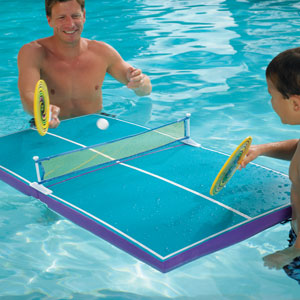
It's raining outside, which inspired me to show you this picture of two players playing table tennis in a swimming pool. Then I realized that this means that somewhere, someone is actually selling these swimming pool ping-pong sets, and some of you might want to buy one. So I searched, and found you can get one for $49.99 ("was $99.99) at In the Swim. You can also get it at Amazon, but there the price is $76.47.

***
Send us your own coaching news!
Larry,

A small correction about the suggestion that players over the limit not be allowed to advance out of the RR.  The suggestion was actually that players whose rating went over the limit before the event be given a choice of 1) Being moved up to higher events for which they were still qualified or 2) Playing in the events they originally entered, but not be allowed to advance out of the RR in any event in which their current rating was over the limit.   The 1st option was the preferred one, but the 2nd was added for the situtation where travel plans (which could not be changed) conflicted with the new event schedule.   The 2nd option is really not that bad for most players, since it most likely would only affect them in one of the five rating event and if they really are improved then they should stand a good chance of advancing out of the RR's in one or two of the remaining 4 rating events.

Mark

Curing the Flat Backhand and the Modern Topspin Backhand

There's an 11-year-old I've been coaching for a while who hits his backhand extremely flat. It's become the biggest problem in his game - it often comes out almost as backspin, often spraying off the end since there's no topspin to pull it down. I've tried for months to get him to put a little topspin on the ball by starting with the racket a bit lower and slightly closed, but to no avail. His sponge was medium fast, but not a modern looping sponge, more of a hitting sponge, which seemed appropriate since he was primarily a hitter on the backhand. (He does have a backhand loop against backspin.)

The sponge was going somewhat dead, so I lent him a sheet of a used looping sponge. His first few shots went off the end. Then he adjusted by closing his racket more, meaning he hit more on top of the ball - instant topspin!!! It was a simple as that. Later, when I fed him multiball, his backhand loop was also vastly improved.

You can put topspin on the ball with a hitting sponge, but the looping sponge made him do so, leading to a much better backhand. While he doesn't need the most high-end (i.e. most expensive) looping sponges, it's becoming more and more important for players to use modern looping sponges even if you aren't using it primarily to loop. They are just bouncier, and make it easier to rally at high speeds.

The "New Modern Backhand" at the higher levels isn't much like the normal backhand of the past. Just watch, say, Ariel Hsing and Lily Zhang, the USA Women's Singles Finalists the last three years, and see how they backhand topspin the ball right off the bounce even when warming up. It's basically an off-the-bounce loop, and it's not a shot they "go for" - it's their standard backhand. The same is true of developing players all over the world if they have modern coaches. At our club, we tend to teach juniors to topspin the backhand like this starting when they are around 1500 or so.

Here's a video of Ariel and Lily playing the Women's Singles Final in 2011. They begin hitting backhand to backhand at 1:48 - watch closely how they both are topspinning off the bounce. Go to 2:04 and you see a closeup of Ariel's backhand - see that incredibly fast movement as she topspins the ball? I think you get an even better view starting at 2:19.

You'll note that I keep referring to these sponges as "looping sponges." I don't like to get into naming specific sponges, but every major manufacturer has their modern looping sponges. Just ask the dealer or another player, and they'll identify them. Or just look at the prices - the most expensive are the best looping sponges! (In general, if you have natural power, go for a harder sponge; if you have trouble generating great racket speed, go for a softer sponge. I use a softer sponge.)

Resignation from USATT Committees

I've served on the USATT Coaching, Club, and Editorial Committees for a while. (Back in the 90s I chaired the Coaching and Club committees.) However, the letter below (sent to the USATT Board of Directors, Staff, and those three committee chairs) explains my resignation from all three.

Dear USATT,

After much contemplation, I've finally decided that I'm just too busy to really contribute as a member of a USATT Advisory Committee. I'm currently trying to coach full-time, run training camps, promote and organize table tennis at MDTTC, run tournaments, write a daily blog and weekly feature articles, write books on table tennis, update numerous TT web pages, as well as recurring projects such as the page layouts and photo work on Tim Boggan's TT history books and many other items. I'm also working on a science fiction & fantasy writing career. And sometimes I like to find time to eat and sleep, a rare luxury these days. When I agreed to join the USATT Editorial, Coaching, and Club Committees, I told the chairs that I wouldn't be able to put in the hours I used to due to these other commitments, but the amount of time I have free for these activities has now gone negative. With two of these committee chairs leaving due to term limits (a bad idea, in my opinion, since greatness often comes from the hard work of uniquely qualified individuals - though of course there are good arguments for term limits as well) this seems a good time for me to turn in my resignation from all three committees. The incoming chairs should generally be able to choose their own committee personnel. I think all three chairs have done excellent jobs, and I wish them and their successors well.

Sincerely,

-Larry Hodges

Choosing the Right Equipment to Match Your Style

Here's an article by Yahao Zhang on choosing equipment. He's the reigning U.S. Under 21 Champion as well as the Southern Open Doubles Champion with Nathan Hsu - I coached them during those matches.

Expert Table Tennis

Here's a new coaching site, Expert Table Tennis, with lots of tips from Ben Larcombe, an English table tennis coach. Four of the lead articles right now are:

  • Using Mental Preparation to Win More Table Tennis Matches
  • The Falkenberg Drill and Why You Should Be Doing It
  • How to Serve Like Kenta Matsudaira
  • The Most Common Table Tennis Injuries and How To Avoid Them

The Index Finger on the Pendulum Serve

Here's a video from PingSkills (1:51) on where to put the index finger on the forehand pendulum serve to maximize spin.

Sean O'Neill Coaching Video

Here's a one-hour video of five-time U.S. Men's Singles Champion and two-time Olympian Sean O'Neill as he gives a clinic at Univ. of Virginia. No flashy graphics, just content.

First Playback Table?

Here's an old video (1:59, circa 1950s?) showing the game of "Smash," where players hit off an adjusted backboard. Two-time World Men's Singles Champion Johnny Leach and two-time World Women's Doubles Champion Diane Rowe are featured in the video.

Catching Ping-Pong Balls with Chopsticks

Here's a video of some sort of Chinese TV show (5:46) that features Ma Long. It's in Chinese so I don't know much about what's going on, but starting at 0:36 there's a man catching ping-pong balls with a chopsticks that are shot at him from a table tennis robot! (He starts slow, but gets better.) Later you see Ma Long trying to pick up balls with chop sticks - not too successfully. The two play regular table tennis at the end - the chopstick man turns out to be a real player. (Anyone know who he is?)

***
Send us your own coaching news!

Tip of the Week

Learning to Counterloop.

USA Nationals and Open Entries

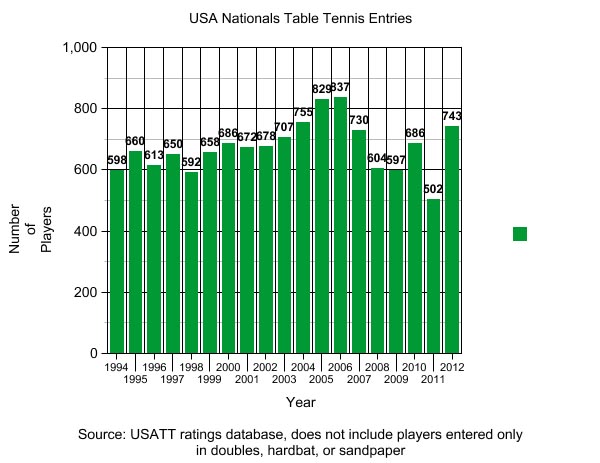
The return to Las Vegas for last year's Nationals in December led to a 48% increase in entries, from a modern low of 502 in 2011 in Virginia Beach to 743 in 2012, the most since 2006's 837. (The data used here only includes those who played in USATT rated events, and does not include players who only competed in doubles, hardbat, or sandpaper events.) The online ratings database gives the number of entries for every year back to 1994, with the event held in Las Vegas every year except 2011.

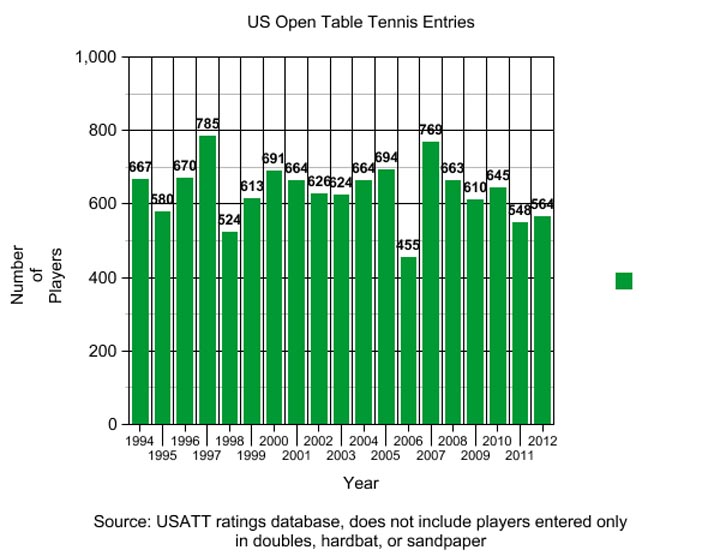
Here's a graph of the Entries at the USA Nationals, 1994-2012. Here's one for the U.S. Open. And here's a chart showing the location of every USA Nationals and U.S. Open ever. (While others watch Honey Boo Boo in their free time, I coach and compile lists.) 

From 1994 to 2002, USA Nationals entries were somewhat stagnant, ranging from 592 to 686. Then began a slow increase from 2002-2006, with 678, 707, 755, 829, and 837. Then it dropped to 730, then 604 and 597. After a jump back to 686 in 2010, there was the huge decline in Virginia Beach to 502, followed by the 743 in Las Vegas in December.

What do these numbers tell us? The obvious answer is that you get more entries at the Nationals if you run it in an obvious "vacation" place, such as Las Vegas. USATT had similar experiences with the U.S. Open, getting relatively large numbers when it's run in Ft. Lauderdale (785 in 1997, the most since 1994) or Las Vegas (769 in 2007, second most), with considerable drops when it was run in Charlotte in 2006 (only 455, a modern low) and somewhat surprisingly, only 524 in 1998 when they ran it in Houston. Of course, how they promote the tournaments make a big difference. There were over 1000 entries at the 1974 and 1975 U.S. Opens in Oklahoma City and Houston, with master promoter Ron Shirley in charge. Similarly, they did a pretty good job of promoting the Open in 2010 in Grand Rapids, leading to a decent 645 entries, probably a hundred more than would be expected in a city not known as a vacation destination.

I had mixed feelings about the Nationals in Virginia Beach. It was nicely run, and it's only three hours from my club. With the reduced traveling time and playing in the same time zone, our players did much better than they often do in Las Vegas, 3000 miles away, where they usually fly in the night before. However, it's hard to argue with 743 entries to 502.

We're still waiting to see where the 2013 U.S. Open will be, but I've been told it's either Las Vegas or Ft. Lauderdale - announcement coming soon - and so either way it'll be a vacationland. (If it's in Ft. Lauderdale, I'm going to arrange a mass trip to Disneyworld - anyone can join us. I've been there once, way back in 1987.)

Marty Reisman Burial and Memorial

Marty Reisman was buried yesterday (Sunday) at Mount Richmond Cemetery on Staten Island. There will be a memorial tribute to him this Friday (Jan. 18) at SPIN New York at 7:30 PM. Info is here.

FASTT Table Tennis

Here's a release from FASTT (Federal Association of Sandpaper Table Tennis) on the sandpaper events at the recent USA Nationals.

How to Handle Drop Shots

Here's a video from PingSkills (1:49) on how to handle drop shots off lobs from under the table by giving a "wobbly" return.

The Beauty of Table Tennis

Here's a new highlights video (8:04) that just came out from ThePerfectionisTT.

Venus & Serena Williams

Table Tennis Nation brings us pictures of the Williams sisters playing table tennis at the Australian Open. As noted in last Thursday's blog, the two were also recently featured playing table tennis in an iPhone 5 commercial.

Table Tennis for the Masses

Is this Quadruples or Octuples?

***
Send us your own coaching news!

Suggested Service Rule

As I've blogged a number of times, many players hide their serve illegally, and many or most umpires allow it. It's frustrating to me as kids see opponents and top players hide their serves illegally and not get called, so why shouldn't they? It's almost reminiscent of the situation baseball players faced in the steroids era.

The current rule requires that the ball be visible throughout the serve to the opponent. The problem is that it's difficult for an umpire, sitting off to the side, to tell if the ball was hidden from the receiver, since often he himself cannot even see the ball, and must estimate where it is, and judge if it is hidden or not from the server's shoulders. Since I've coached and played table tennis nearly every day  for many years, I can see if the serve is hidden or not, but many umpires only see this type of thing on an occasional basis, and so have great difficulty judging it.

Technically, it shouldn't be a problem. The rules state that "It is the responsibility of the player to serve so that the umpire or the assistant umpire can be satisfied that he or she complies with the requirements of the Laws." That's pretty clear - it means if the umpire isn't sure the serve is visible, i.e. legal, then the umpire is NOT satisfied that the serve complies, and so the player should be warned (the first time) or faulted. But most umpires do not do this, and so at the higher levels many players get away with illegal hidden serves.

There are other serving problems. Many players abuse the "near vertical" toss rule, and few umpires enforce it. But the advantage of throwing the ball backwards (instead of near vertical) is minor compared to the advantage of hiding the serve. The same is true of other common transgressions.

But there's a solution to the problem, if we can convince ITTF (and/or USATT) to adopt it. The proposed rule would be that throughout the serve the ball must be visible to both umpires, or to where the umpires would sit if there is no umpire. Problem solved.

The specific rule change would be as follows, rewording rule 2.6.5 as follows:

Current: 2.6.5 As soon as the ball has been projected, the server’s free arm and hand shall be removed from the space between the ball and the net.

Proposed: 2.6.5 As soon as the ball has been projected, no part of the server, his or her doubles partner, or anything they wear or carry may be in the triangular area between the ball and the positions of the two umpires.

Kagin Lee has put together a web page detailing this proposal.

The key thing here is that even if a player tries to abuse the rule and goes into that gray area where it's not clear if the umpires (or where they would sit) can see the ball, it wouldn't matter, as if it's close, then obviously the opponent can see the ball - and that's the whole point of the proposed rule. It's sort of like the six-inch toss rule. For many years, the rule was the ball must be contacted on the drop, but many players would abuse this as it was hard to tell if they were hitting the ball on the drop or not as they practically served out of their hand. A three-inch toss would have been enough to solve the problem, but then there'd be those who'd abuse it by tossing below that, and it would be hard to tell. By making it six inches, the server can abuse the rule all he wants and if it's anywhere close to six inches, the opponent will clearly see the toss, which was the point of the rule.

I'm told that some are opposed to such a new rule because it would mean players would have to change their service motion. Well, duh!!! That's the whole point. But it's not a huge change; anyone change their forehand pendulum serve motion to make it legal; I know, because I can, and I teach this type of thing professionally. You can do so with either a more open position or by holding the ball farther from the body, or some combination of both. And it solves the hidden serve problem. Give players a year to get ready, and there'd be no reason to change the serve rule again . . . ever!!!

Dear Evil Time-Stealing Temporal-Taking Slobber Monkeys

Over the next couple of weeks I absolutely have to do the final editing and proofing (that's two complete reads) of my new book, "Table Tennis Tactics for Thinkers." (I also have to finalize the covers.) Every time I get ready to do this, various Evil Time-Stealing Temporal-Taking Slobber Monkeys come to me with requests for me to do things that are not editing or proofing the book. Things that are not editing or proofing my book do not decrease the time between now and when the book comes out, and things that do not decrease this time are the spawn of  the Devil and his minions, i.e. Evil Time-Stealing Temporal-Taking Slobber Monkeys. So if you are an Evil Time-Stealing Temporal-Taking Slobber Monkey, please hold off for a bit. I'll gladly sell my soul and do your work after the book comes out.

I am working under a rather tight deadline. On Monday, Feb. 4, USATT Historian Tim Boggan will be moving in with me for two weeks as I do the page layouts and photo work (with Mal Anderson's help on the latter) on Tim's History of U.S. Table Tennis, Volume 13. This one, which will once again run over 500 pages, will feature 1984, and if you've read that book, you have a vague idea of what will happen to me (and you) if I don't get my own book finalized before Tim's arrival. So let me have some peace and quiet for a while so I can finish my book. Big Brother is watching.

I've got 240 pages to edit and proof, I've got a full bottle of Deerpark Water*, half a peanut butter & jelly sandwich, it's light, and I'm not wearing sunglasses. Hit it.
    *And Mountain Dew for emergencies

Review of the New Plastic Ball

Part 3 just went up of the Plastic Ball Review from OOAK Reviews. All three parts are linked from their home page. The three parts are:

  1. Why the change and a comparison of their physical appearance (16:16)
  2. High Speed Filming of tests to compare relative rebound speed, bounce and spin (14:35)
  3. Playing Characteristics and Summary (26:40)

1273 Signatures

That's how many we got on the petition to the White House to recognize Table Tennis as a school sport. Not bad, but not good. We were 23,727 short of the needed 25,000. Think of it as a trial run; perhaps next time we can get the major distributors (with their huge mailing lists), celebrities, and others behind it.

The Power of Backhand

Here's a video (8:01) highlighting great backhand shots. The very first rally is pretty wild!

Five-Hour Energy Commercial

With table tennis! (31 seconds)

Be Different

Here's a humorous video (3:21) of some nerdy-looking guy as he takes on the "King Kong of Ping Pong"!

Ping-Pong Ball Spinning in Nitrogen

Here's 89 seconds of a ping-pong ball getting cooled and spinning in liquid nitrogen.

***
Send us your own coaching news!
Beginner's Forehand & Backhand Loop

One week ago, on Jan. 3, I wrote about a "Beginner's Topspinny Backhand and Forehand Looping." This was about an 11-year-old who was learning to forehand loop, and was developing a rather topspinny backhand. I worked with him again yesterday. Jackpot!!!

When I say "Jackpot," I'm referring to how fast he picked up the forehand loop against topspin, which I taught him for the first time yesterday using multiball. We worked on it for 30 minutes, and he was able to do it pretty nicely. He still has a tendency to jam the table and rush the shot (leading to too much arm, not enough body rotation), so I kept reminding him to step off the table to give himself time to use a full body shot - but when I remind him, he has no trouble backing off and doing the shot properly without rushing. (Backing off against an incoming topspin and giving yourself time is key to learning the loop properly, since it's a longer stroke than a regular drive, and the timing is different. When you are proficient at the shot you can start taking it closer to the table.)

He also has a tendency to use too much arm in general, but we're working on that, and when he backs off to give himself time he's better at that. Overall, a very nice first day on looping against topspin. Next session I may let him try it "live" against my block - but only if he's doing it very nicely in multiball.

He's also got a nice backhand loop now against backspin in drills (though he doesn't use it effectively in game situations yet), and really does topspin the ball quite a bit in regular rallies. Yesterday I figured out why, and it's sort of funny. I coach him every week at the same time, and at that same time every week, on the table next to us, Nathan Hsu (16), currently the top-rated junior in Maryland at 2351, has a training session. Nathan always plays on the same side of the table I'm on, so my 11-year-old student has a clear view of Nathan while he's practicing. Nathan's known for his ferocious backhand loop, which he often does close to the table. Guess what? The two have matching strokes!!! The kid I've been coaching, whether consciously or not, has been copying Nathan's backhand.

USATT Coaches of the Year

The results are out! (The page includes shot bios of the winners.) The winners are:

  • Paralympic Coach of the Year – Daniel Rutenberg 
  • Volunteer Coach of the Year – Joel Mitchell
  • Developmental Coach of the Year – Stefan Feth
  • National Coach of the Year – Xin Zhou

Ma Long's Forehand Loop

Here's 23 seconds of 2012 World Cup Winner and former #1 Ma Long's forehand loop.

Schlager's Backhand Block

Here's 53 seconds of 2003 World Champion Werner Schlager backhand blocking against teammate Karl Jindrak.

Ruth Aarons' and Sandor Glancz's Exhibition

Here's 58 seconds of 1936 & 1937 World Women's Singles Champion Ruth Aarons (USA's only world singles champion) and 1933 World Men's Doubles Champion and 3-time World Team Champion Sandor Glancz doing an exhibition, circa late 1930s.

Justin Bieber's Ping-Pong

Here's 41 seconds of Pencils of Promise star Justin Bieber's ping-pong. I think he's famous for other stuff too. 

***
Send us your own coaching news!