
August 17, 2012
Weird Camp Happenings
Lots of strange things happen in regard to table tennis camps. Here's a sampling.
- Read more about August 17, 2012
- Log in or register to post comments

Weird Camp Happenings
Lots of strange things happen in regard to table tennis camps. Here's a sampling.
Training Centers and Their Impact
Yesterday, in the Washington Post article on MDTTC (see yesterday's blog), it said, "Hodges campaigned for the U.S. Table Tennis Association to copy his blueprint, which he believed was the way to expand the sport." I'm going to expand on that.
In December, 2006, I spent a huge amount of time putting together a proposal to USATT to start recruiting and training coaches to set up junior programs and training centers. At the Board meeting at the Nationals I made the proposal. The response? Two board members ridiculed the idea of "full-time training centers," saying there weren't enough players to support such a thing, and so it wouldn't really affect the development of players in this country. The others in the room were mostly quiet.
The mind-boggling ignorance of such statements from people with no experience in such full-time training centers was, well, mind-boggling. The whole point of the proposal was that you'd recruit the players (especially juniors in junior programs), and simply do what MDTTC and several other training centers had already done successfully.
After I was done with my proposal, there was polite applause from the Board, it was checked off the agenda, and they moved on to the next item. I went through a very similar experience at the 2009 Strategic Meeting. The leaders of our sport, both then and now, just don't get this aspect of our sport (or about developing leagues, anther topic I've blogged about in the past), and so the development of our sport is really left up to those of us with the entrepreneurial spirit to do it on our own. This usually means having to reinvent the wheel over and over since there is no organization to oversee the recruitment and training of such coaches and promoters.
Try a New Style
Why not experiment with a new style? Add some variety to your game? You could do something really crazy, like a shakehander playing penhold or Seemiller style, or try out some weird rubber. But why not try out a style you could actually use in your game? You'll have fun as well as adding a new dimension (i.e. tactical tool) to your game.
I suggest chopping. It's a nice weapon to have both as a variation and when you are out of position, especially on the backhand. Some players really have trouble with sudden chops, and it's a crime not to have this skill against these players. Plus, next time you are out of position against a ball wide to your backhand, just chop it back. Just as importantly, you'll quickly see the game from a chopper's point of view, and become a lot stronger playing choppers as a result. (Your biggest shock will probably be how weak a chopper can be on receive - yet many attackers assume choppers can just chop any serve back, and so don't take advantage of this.)
Though most choppers use long pips on the backhand, that's mostly to chop back loops. If you are only going to chop as an occasional variation or when you are out of position, any surface will do, including super charged-up inverted. That's what I have on my backhand, and I regularly throw in chops.
Table Tennis Foot Dream
The Flat, Regular, and Topspinny Backhand
In my Tip of the Week yesterday I wrote about the Racket Tip Angle on the Backhand. I also referred to the various types of backhands, such as flatter ones and "topspinny" backhands. What exactly are these? Here are three ways of hitting a backhand drive; all are done mostly on the rise or top of the bounce. (Note that the three terms below are my invention, though most coaches would recognize from the meaning what they are.)
Tip of the Week
Racket Tip Angle on the Backhand.
Table Tennis Records
11-year-old Sameer Shaikh, while on break in our camp on Friday, bounced a ball on his paddle 1210 times in a row. Is it a world record? Probably not, but I'll let someone else google it. But it does bring up the question of table tennis records. Unfortunately, I haven't kept track of who did what and when. For example, in our camps I know the record for completely knocking over a pyramid of 10 and 15 cups is 2 and 3 shots, respectively, but I don't remember who did it. These may sound silly, but they are actually great practice. I remember when Sameer couldn't bounce more than a few in a row; now he has good racket control. (When you start a little kid on table tennis, start him with ball bouncing, and see how many he can do. This is how he begins developing the hand-eye coordination to actually rally.) Hitting pyramids of cups may sound frivolous, but it challenges them to be accurate, besides being a fun way to end a three-hour session in a training camp.
I have a few personal records which may or may not be "records": 2755 backhands in a row (at a Seemiller camp in 1978 when I was 18); 14 consecutive bounces up and down off the edge of my racket; 14 consecutive "come back" serves (i.e. high backspin serves that bounce directly back over the net after hitting the opponent's side of the table); and blowing the ball back 33 consecutive times in a rally. So what are your records?
Busyness
MDTTC Camp, Week Nine, Day Four
Yesterday's focus was forehand loop and pushing. That was supposed to be the focus on Wednesday, but because of my car accident (see yesterday's blog), it was postponed a day. Friday's focus is usually pushing and "Player's Choice," and while we'll give that option, today's focus will be Backhand Attack, which is usually the focus on Thursday. I gave my lecture on pushing yesterday, which I normally give on Friday. Yes, these traffic accidents can throw an entire camp schedule off!
I think the loop is the shot that coaches are most picky about getting right. Most players can get away with, say, minor technical problems with the forehand smash because, by the intermediate level, most players are mostly looping on the forehand side, and when they smash, it's mostly against easy balls where you don't need technical perfection. The same is true of many other techniques. But the loop needs to be done really well or it can become the limiting factor in your game. There are two kids I'm working with right now who are probably a bit exasperated on how much I'm harping on some minor technical changes in their forehand loops, but they also understand the importance of getting it just right.
The following was my letter to the editor in GQ Magazine in October, 2004, in response to the article on table tennis in a previous issue by Matthew Klam.
Dear Editor,
Good writing does not equal responsible writing. I am one of the victims of the article in the August issue of GQ, “American Gladiators,” about the American table tennis scene, by Matthew Klam. In fact, I’m the one who introduced Klam to most of the table tennis players he spoke with in putting together this article. I spent a huge amount of time assisting him and answering questions, never dreaming that he would respond by writing that I have a “personality disorder stuck somewhere between high-functioning autism and dorky social misfit,” or that I was a “skid-mark nerd.” I’m only one of many who were maligned by Klam.
How do you defend against such representations without coming off sounding like they are accurate, and further spreading such innuendo? GQ can claim that it was the writer’s personal opinion, and hide behind that. Well, then, it’s my personal opinion that the writer put aside any ethical qualms he may have had in a desperate attempt to make a sale, while GQ stooped to tabloid journalism in a misguided attempt to increase sales. As a journalist myself (master’s degree), I believe you have both embarrassed our profession. Was the story accurate? About as accurate, for example, as Klam’s description of he and I finding an empty table to play on at the USA Table Tennis Nationals in Las Vegas “some hours before the men’s final.” It actually happened at the Maryland Table Tennis Center, three weeks later and 3000 miles away – but why let facts get in the way when fabrications and personal attacks add drama and increase sales? From these personal attacks, I have learned a bitter lesson about knowing to klam up when faced with the likes of Klam.
Sincerely,
Larry Hodges
Editor, USA Table Tennis Magazine
Author, Table Tennis: Steps to Success
Member, USA Table Tennis Hall of Fame
Long-time Professional Table Tennis Coach
Car Accident
It happened yesterday morning at 9:35 AM, while I was driving to the club to coach in our training camp. I was just driving along, minding my own business, and about to go through an intersection (Middlebrook Rd. and Century Blvd.) when a Metro Access mini-bus suddenly pulled right in front of me from the left. I swerved to the left, trying to go behind it, and would have made it except the driver, compounding her error in pulling into my lane, panicked and rather then rushing to get out of my way, put on the breaks, stopping right in the middle of the road and blocking two lanes. I had nowhere to go and so plowed right into it, near the back on the side.
I had the right of way, with a green light. The bus driver had been coming from the other direction and was making a u-turn. There was some construction going on in the road on her side, and she claimed a worker had waved her through.
No one was hurt (the bus had I believe three passengers), but the front of my car was smashed in. The bus had little damage, comparatively, other than a surprisingly small dent. (The advantage of having a higher mass.) Though it looked like something from The Living Dead, my car seemed to drive okay, and I was able to pull into an Exxon station next to us, where we exchanged contact and insurance info. Then I drove to a local auto body place. From there I spent about an hour on the phone with my insurance company (Geico), which will deal with getting the Metro insurance company to pay for the damages to my car.
MDTTC Camps Week Seven Day Two
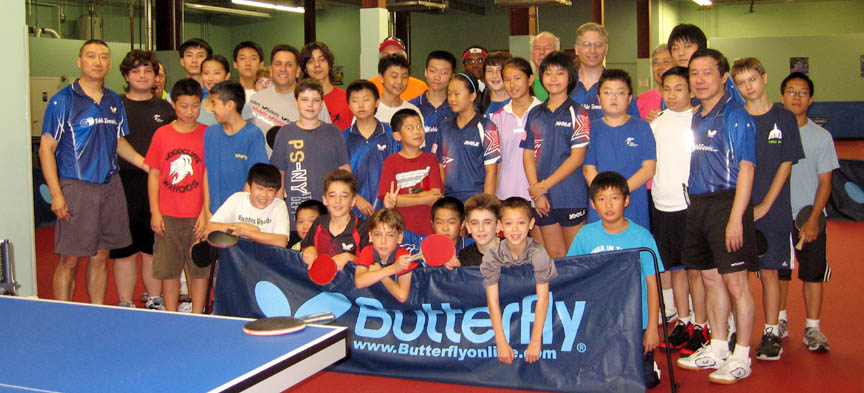
Here's a typical day at an MDTTC camp, morning session, divided into segments based on my most common camp phrases.
Yesterday's focus (as usual on Tuesdays) was the backhand. This doesn't mean that's all we do; it's just the focus, especially for new players. We personalize it more for more advanced players, though even there we focus a bit on the day's focus. Today we'll be focusing on the forehand loop.
Regarding the backhand, besides the basics, I always point out the various backhand styles. For example, players who keep the racket tip low tend to play their backhand almost like another forehand, with great power, but often less consistent, not as quick, and weaker in the middle, compared to those who hold the racket tip a bit higher. Taller players tend to hold the racket tip lower, but not always.
It's going to be a busy day. My rough schedule for today:
11-point vs. 21-point games
I miss playing 21-point games. Games to 11 are still, to me, like cheap soft drinks rather than something more substantive, like a milk shake. Sure, you get a quick rush when you gulp down that Coca-cola, but then it's over and you're left wondering, "Is that all?"
When games were to 21, when you won, you WON. A game to 11 is more hit and miss. A few nets or edges and it's over. A random hot or cold streak, and it's over. You blink and it's over.
There are, of course, more games in a best of five to 11 than in a two out of three to 21. But you used to have to score 42 points to win those two games. Now you can do it in 33. It used to be you could spend the first game figuring out your opponent. Even if you lost the first game, once you figured him out, there was no way they could beat you in a game to 21 (if you were truly better), and they only had two chances at it. Now, if you lose the equivalent of a game to 21 you instead lose the first TWO games, and with games to 11, to win all they need is a few lucky breaks, or a hot streak, or a cold streak by you, and they have THREE chances to do it!!! So instead of spending time trying to tactically figure out an opponent, the strategy tends toward throwing everything at them right from the start and hope for the best.
And don't get me started on serving only two points in a row. (Too late.) It used to be you served FIVE times in a row, and smart players used the serves to set up the next ones. There was serious strategy involved. Now you only get two, and by the time you get to serve your next two, your opponent has probably forgotten what you served before, and so you have to start over. So forget all the tactical subtlety of past years and just throw out your two best serves over and Over and OVER.